Showing posts with label MNLA. Show all posts

Saturday, April 27, 2013

6 people killed after Arab communities clash in northern Mali

BAMAKO, April 26 (Xinhua) -- A confrontation between two Arab communities left six people dead in northern Mali, local sources told Xinhua on Friday.

Each of the rival sides wants to position itself as the main Arab group in Thursday's clash in Anefis, 200 km north of the biggest northern town of Gao.

"This confrontation was due to the events that took place at Ber, where the Arab traders who are organized under the banner of the Arab Movement for Azawad (MAA) pushed out the members of the National Movement for the Liberation of Azawad (MNLA) and injured two of their members.

"The MNLA fighters came to revenge against the peaceful Arab traders in Anefis as they were fleeing to Kidal. The reprisal attacks occurred under the watch of the Serval forces and the International Support Mission for Mali (MISMA)," another source said.

The sources said the MNLA had deployed its fighters in Anefis with about thirty vehicles.

from XINHUA
2013-04-26 19:56:40
Editor: Hou Qiang

Enhanced by Zemanta

Wednesday, February 27, 2013

Seven Killed in Northern Mali Suicide Bombing


A suicide bombing has killed at least seven people in the northern Mali town of Kidal, near the scene of heavy fighting between French troops and Islamist militants.
The MNLA, a Tuareg separatist group now working with the French, says a bomber in a four-by-four vehicle blew himself up at one of its checkpoints late Tuesday. The MNLA says the attack killed seven of its fighters and wounded several others.

Other sources confirmed the attack but put the death toll at six.

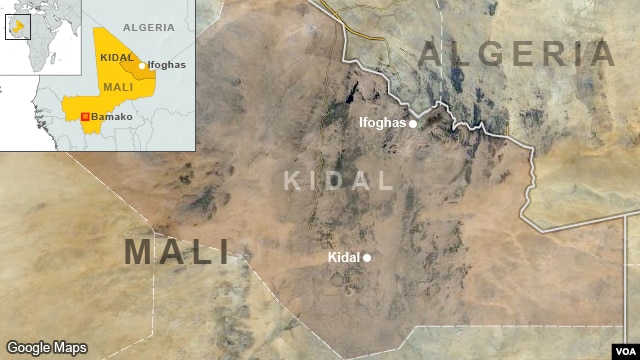
Kidal is on the edge of the Ifoghas mountains, where Islamist militants retreated after a French-led offensive drove them out of northern Malian cities last month.

French Defense Minister Jean-Yves Drian reported heavy fighting in the mountains on Tuesday. He said France and its allies are targeting an area where "the most radical terrorist groups" have gone.

French troops entered Mali in January to push back militants moving toward the capital and have since been joined by African troops in backing the Malian army.

Le Drian said the operation has regained control of almost all of northern Mali but that the hardest portion of the fighting remains.

France has said it plans to begin withdrawing its ground forces and hand over military operations to the Malian army and a West African force.

Some information for this report was provided by AP and AFP.

from VOA News
February 27, 2013

Enhanced by Zemanta

Monday, February 4, 2013

Mali Tuaregs seize two Islamist leaders fleeing French strikes

map by Evan Centanni (www.polgeonow.com)
(Reuters) - Tuareg rebels in northern Mali said on Monday they had captured two senior Islamist insurgents fleeing French air strikes toward the Algerian border, and France pressed ahead with its bombing campaign against al Qaeda's Saharan desert camps.
Pro-autonomy Tuareg MNLA rebels said they had seized Mohamed Moussa Ag Mohamed, an Islamist leader who imposed harsh sharia law in the desert town of Timbuktu, and Oumeini Ould Baba Akhmed, believed to be responsible for the kidnapping of a French hostage by the al Qaeda splinter group MUJWA.

"We chased an Islamist convoy close to the frontier and arrested the two men the day before yesterday," Ibrahim Ag Assaleh, spokesman for the MNLA, told Reuters from Ouagadougou in Burkina Faso. "They have been questioned and sent to Kidal."

France has deployed 3,500 ground troops, and warplanes and armoured vehicles in its three-week-old Operation Serval (Wildcat) in Mali which has broken the Islamists' 10-month grip on northern towns, where they imposed sharia law.

Paris and its international partners want to prevent the Islamists from using Mali's vast desert north as a base to launch attacks on neighbouring African countries and the West.

The MNLA, which seized control of northern Mali last year only to be pushed aside by better-armed Islamist groups, regained control of its northern stronghold of Kidal last week when Islamist fighters fled French airstrikes into the nearby desert and rugged Adrar des Ifoghas mountains.

The Tuareg group says it is willing to help the French-led mission by hunting down Islamists. It has offered to hold peace talks with the government in a bid to heal wounds between Mali's restive Saharan north and the black African-dominated south.

"Until there is a peace deal, we cannot hold national elections," Ag Assaleh said, referring to interim Malian President Dioncounda Traore's plan to hold polls on July 31.

Many in the southern capital Bamako - including army leaders who blame the MNLA for executing some of their troops at the Saharan town of Aguelhoc last year - strongly reject any talks.

French special forces took the airport in Kidal on Tuesday, reaching the most northern city previously held by the Islamist alliance. Though the MNLA says it controls Kidal, a Reuters reporter in the town saw a contingent of Chadian troops - part of a U.N.-backed African mission being deployed to help retake northern Mali - backing up French special forces there.

TARGETING REBEL BASES, DEPOTS

French Foreign Minister Laurent Fabius said warplanes were continuing bombing raids on Islamists in Mali's far north to destroy their supply lines and flush them out of remote areas.

"The objective is to destroy their support bases, their depots because they have taken refuge in the north and north-east of the country and can only stay there in the long-term if they have the means to sustain themselves," Fabius said.

"The army is working to stop that," he told French radio.

Jets attacked rebel camps on Sunday targeting logistics bases and training camps used by the al Qaeda-linked rebels near Tessalit, close to the Algerian border.

French President Francois Hollande made a one-day trip to Mali on Saturday, promising to keep troops in the country until the job of restoring government control in the Sahel state was finished. He was welcomed as a saviour by cheering Malians.

The rebels' retreat to hideouts in the remote Adrar des Ifoghas mountains - where Paris believes they are holding seven French hostages - heralds a potentially more complicated new phase of France's intervention in its former colony.

"We are still in the same war, but we're entering a new battle," said Vincent Desportes, a French former general and now associate professor at Science-Po university in Paris.

"We will look to gradually wear out and destroy the terrorists that are sheltering in the Ifoghas. It's now a war of intelligence (services), strikes and probably action by special forces in the background."

Hollande said on Saturday that Paris would withdraw its troops from Mali once the landlocked West African nation had restored sovereignty over its territory and a U.N.-backed African military force could take over from the French soldiers.

Drawn mostly from Mali's West African neighbours, this force is expected to number more than 8,000. But its deployment has been badly hampered by shortages of kit and airlift capacity and questions about who will fund the estimated $1 billion cost.

Fabius said French soldiers may soon pull back from Timbuktu. Its residents had celebrated their liberation from the Islamists, who had handed down punishments including whipping and amputation for breaking sharia law.

The rebels also smashed sacred Sufi mausoleums and destroyed or stole some 2,000 ancient manuscripts at the South African-sponsored Baba Ahmed Institute, causing international outcry.

"A withdrawal could happen very quickly," Fabius said. "We're working towards it because we have no desire to stay there for the long-term.

from REUTERS

By Cheikh Diouara
KIDAL, Mali | Mon Feb 4, 2013 11:38am GMT
(Additional reporting by John Irish in Paris, Daniel Flynn in Dakar and David Lewis in Timbuktu; Writing by Daniel Flynn; Editing by Pascal Fletcher and Jon Boyle)

Enhanced by Zemanta

Tuesday, January 22, 2013

MNLA supports African force in Mali

map by Evan Centanni (www.polgeonow.com)
Mali separatist group National Movement for the Liberation of Azawad (MNLA) on Sunday (January 20th) offered to join army forces from the Economic Community of West African States (ECOWAS), Le Monde reported.
The secular Touareg rebels are ready to participate in the International Mission for Support to Mali (MISMA), MNLA spokesperson Ibrahim Ag Mohamed Assaleh said.

Meanwhile, French troops on Sunday consolidated gains in Mali's Islamist-held north, AFP reported. Canada, Germany and Russia offered vital aid for the offensive.

Ansar al-Din fighters and their al-Qaeda allies were reportedly abandoning some of their positions and converging on the mountainous region of Kidal, near the border with Algeria.

from Magharebia
21/01/2013

Enhanced by Zemanta

Monday, December 24, 2012

Ansar al-Din, MNLA sign deal in Algiers

[AFP/Farouk Batiche] Members of Ansar al-Din and the National Movement for the Liberation of Azawad (MNLA) sign agreement in Algiers.
Malian rebel groups Ansar al-Din and the MNLA vow to reject terrorism and work together towards securing the areas they control.


from MAGHERABIA
By Hayam El Hadi for Magharebia in Algiers – 23/12/12


Two Malian rebel groups on Friday (November 21st) said they were committed to suspending hostilities and holding peace talks, despite condemning the UN's approval of plans for an African-led intervention to reconquer the country's Islamist-held north, AFP reported.

Ansar al-Din and the National Movement for the Liberation of Azawad (MNLA) signed a seven-point partnership agreement in Algiers under which both parties rejected terrorism and opposed the use of military force in northern Mali.

The two groups have also engaged in talks with Mali's interim government after pledging earlier this month to respect the country's territorial integrity and root out terrorism.

Algeria, with the mediation of Burkina Faso, succeeded in getting Ansar al-Din and the MNLA to reach a deal.

Ansar al-Din's Mohamed Ag Akharib and the MNLA's Bey Diknan pledged to "refrain from any action which may lead to situations of conflict and from all forms of hostility in the areas under their control and to make every effort to honour this commitment".

After the deal was signed, both parties hailed Algeria's efforts to promote dialogue. While in Algiers, Ag Akharib said that his group "reiterates its desire for and commitment to a peaceful resolution" and praised "Algeria's efforts to resolve the Malian crisis through dialogue".

The two groups announced their intention to take steps to free hostages, provide emergency humanitarian assistance to communities and to facilitate the free movement of people and goods. Additionally, they pledged to send in forces to maintain the security of the areas they control.

Ten Europeans and three Algerians remain held hostage in northern Mali, kidnapped by al-Qaeda in the Islamic Maghreb (AQIM) and its offshoot the Movement for Tawhid and Jihad in West Africa (MUJAO) since September 2010.

The two Malian groups jointly condemned Resolution 2085 adopted on Thursday by the UN Security Council, which unanimously approved the deployment of a 3,300-strong international force in northern Mali for one year. The resolution also authorised "all necessary measures" to help the Malian government regain its full territorial integrity.

But the 15-member council insisted that military force could only be used after political efforts were exhausted. It said military plans would have to be refined and approved before any offensive started.

The Security Council also called on the transitional authorities in Bamako to re-establish constitutional order and hold elections before April 2013.

It urged them to engage in "credible" negotiations with groups in the north, including the side-lined Touaregs.

A move toward a military offensive would come in a second phase.

Mali's government hailed the Security Council decision on the intervention plan as a sign that the world would not abandon the country.

"We are grateful to the international community, a consensus has been reached on the Malian situation," said advisor to Mali's interim president Dioncounda Traore.

"We are going to wage war against the terrorists and continue to negotiate with our brothers who are ready for dialogue", he added.

Another Mali politician, Mustapha Cisse, said the UN vote showed "the willingness of the international community not to abandon Mali to its own devices".

Ansar al-Din and the MNLA instead called for a "peaceful, lasting and final solution to the conflict in accordance with Islamic principles and in harmony with the true values of the people of Azawad, respecting all basic freedoms without distinction and universal rules concerning human rights".

Ag Akharib asked "Algeria and the international community to help the people of Mali in their quest for a solution to this crisis, by political rather than military means".

Algerian diplomats have sought to bring about a peaceful end to the crisis in Mali. Efforts have been made to convince neighbouring countries of the need to preserve Mali's integrity.

The conflict has so far displaced more than 400,000 people, according to the UN.

from MAGHERABIA
By Hayam El Hadi for Magharebia in Algiers – 23/12/12

Enhanced by Zemanta

Tuesday, August 28, 2012

Al Qaeda denies Maghreb commander killed in clashes

LONDON (Reuters) - Mokhtar Belmokhtar, a founder of al Qaeda's North African offshoot, is alive and leading military operations, an associate said on Tuesday, denying a report that the Algerian had been killed in clashes in Mali in late June.

Nicknamed the "uncatchable", Belmokhtar is believed to be linked to the kidnappings of foreigners that have taken place in remote areas of Africa's Sahel region in recent years.

He has been sentenced by an Algerian court to life imprisonment in absentia in connection with the killing of 10 Algerian customs agents in 2007.

Regional and Western governments fear that desert northern Mali could become the next launchpad for international Islamist attacks, as Afghanistan was more than a decade ago, and efforts are under way to organise a joint intervention force.

Ennahar TV, a private Algerian channel, quoted unidentified sources on June 28 as confirming Belmokhtar's death in armed clashes in the town of Gao.

But Oumar Ould Hamaha, a colleague of Belmokhtar's reached by telephone, said Belmokhtar was in good health.

"He is alive and fine, he is with us and he is moving around," Ould Hamaha said. "He is leading operations."

There was no independent corroboration of Ould Hamaha's comments, but a European official who follows North African armed groups said in early July that the Algerian television report was not regarded as reliable.

Belmokhtar heads one of two AQIM battalions in Algeria's southern desert bordering Mali.

The situation in northern Mali is chaotic after months of tension between the secular Tuareg-led National Movement for the Liberation of Azawad (MNLA) and better-armed local Islamists who helped it take control of the northern two-thirds of Mali in April but whose goal is to impose Islamic law.

Ennahar had said Belmokhtar was believed to have died during a battle in which at least 20 people were killed on June 27 in the north Mali town of Gao, where the Islamists had seized the MNLA headquarters, the source said. The Islamists have since declared they are in control of northern Mali.

from REUTERS
Tue Aug 28, 2012 11:11am GMT

Enhanced by Zemanta

Monday, June 4, 2012

Malian rebels quit accord signed with al Qaeda affiliate

By


Less than a week after Tuareg rebels belonging to the National Movement for the Liberation of Azawad (MNLA) merged with the al Qaeda-supported Ansar Dine (Defenders of Faith) Islamist group and signed an accord to create the Islamic Republic of Azawad in northern Mali, leaders from the MNLA have publicly revoked their support for the accord.

Ansar Dine fighters fly al Qaeda's banner in Northern Mali in late April 2012. (Source: PanAfrican News Wire)
"The political wing, the executive wing of the MNLA, faced with the intransigence of Ansar Dine on applying sharia in Azawad and in line with its resolutely secular stance, denounce the accord with this organization and declare all its dispositions null and void," read a written message attributed to senior MNLA political leader Hama Ag Mahmoud on June 1. Other senior political MNLA officials, including Magdi Ag Bohada, have also disavowed the accord.

Discord between the MNLA and Ansar Dine occurred almost immediately after both parties signed the agreement on May 26 that established an independent Tuareg state in northern Mali reinforced by the imposition of sharia.

Senior MNLA members have long been uneasy with Ansar Dine's harsh interpretation of Islam and desire for a strict version of sharia law. "We want sharia similar to that in Mauritania or even Egypt. This point must be clarified," Ibrahim Ag Assaleh, an MNLA official in the northern city of Gao, told Reuters three days after the accord was signed. The MNLA has also strongly disagreed with Ansar Dine about what types of punishments should be implemented against those accused of committing a crime, specifically the amputation of hands.

Despite the public statements by MNLA leaders renouncing their support for the accord, armed Ansar Dine militiamen continue to patrol the streets of northern Mali's population centers, including Gao, Kial, and Timbuktu, enforcing sharia no matter how unpopular the new restrictions have become among residents who have long observed moderate Islamic values and customs.

Local Tuaregs have protested against Ansar Dine's attempt to enforce a strict dress code, the prohibition of alcohol and smoking of cigarettes in public, and the closure of cinemas. According to The New York Times, Ansar Dine militiamen have defaced the shrine of a 15th-century Sufi saint, music has been banned from the radio, and the black flags of Ansar Dine, which mirror those of al Qaeda, have been draped around the urban environs of northern Mali. These and other unpopular restrictions have forced many residents to flee northern Mail since the MNLA and Ansar Dine consolidated power in the region around a month ago.

The United Nations estimates that more than 160,000 Malians have fled to the neighboring countries of Mauritania, Burkina Faso, and Niger, and more than 140,000 residents have been displaced in Mali itself since the Malian government collapsed in late March.

The current political crisis between the MNLA and Ansar Dine has prompted senior members of Ansar Dine, including its leader and former MNLA spokesman Iyad Ag Ghali, to travel back to Gao from an undisclosed location in an attempt to salvage the May 26 accord. Some members of Ansar Dine believe the voice of dissent among the MNLA is restricted to the movement's political wing, and view the crisis as a minor, if not irrelevant, development.
Enhanced by Zemanta

Friday, June 1, 2012

Mali: Briefing - Tuareg Separatists, Salafists Forge Alliance

Dakar — Two months after taking the northern strongholds of Timbuktu, Gao and Kidal, Mali's rival rebel movements have supposedly put aside ideological, religious and cultural differences to agree on the creation of a joint Council of the Islamic State of Azawad, independent of the rest of Mali.

The agreement signed in the northeastern city of Gao on 26 May, came after three weeks of talks between the Tuareg-dominated National Movement for the Liberation of Azawad (MNLA), which launched its insurgency against the government of Mali in mid-January, and Ansar Dine, which has championed the promotion of Sharia Law in the north of Mali.

Breakaway rejected by Bamako

Reaction from Bamako to the "self-dissolution" of the two rebel entities was swift and hostile. Government spokesman Hamadoun Touré said the government "categorically rejects any idea of the creation of a state of Azawad, even more so the creation of an Islamic state".

Speaking to IRIN, the parliamentary representative for Timbuktu, El Hadji Baba Haidara, said the new protocol proved the MNLA had used a "double identity", concealing its real intentions and alliances. "The MNLA tried to woo Western governments by preaching moderation and distancing itself from radical Islam," Haidara argued. "The agreement shows that the MNLA and Ansar Dine are one and the same. For how many centuries has Mali been a Muslim country? People in the north have never asked to be 'liberated' in this way."

Different movements, different goals?

The rebels' string of easy victories in the north in late March and early April came against a background of political breakdown and confusion in the south. The coup staged in Bamako by mutinous soldiers on 22 March removed outgoing President Amadou Toumani Touré weeks before elections were to have been held. But the junta which replaced Touré, headed by Capt Amadou Sanogo, quickly faced regional islolation and international condemnation. With the Malian military distracted, the rebels moved quickly to occupy poorly-defended towns and their surroundings.

It was the MNLA which confidently declared a ceasefire on 5 April, confirming that its military objectives had been attained. The following day, the MNLA formally declared the founding of the Republic of Azawad. But Ansar Dine combatants were much in evidence, particularly in Timbuktu. The MNLA had dismissed the rival movements as an irritant more than an ally, entering the conflict weeks after the MNLA had initiated hostilities and espousing a Salafist version of Islam that had little popular support in Mali.

Senior MNLA figures, including senior commander Mohamed Ag Najim, were openly disparaging of Ansar Dine. There was concern that Ansar Dine's leader, Iyad Ag Ghali, while a prominent figure in past struggles, was now a distraction, more concerned with Sharia Law than forming a new state. Ghali also had reported links to Al Qaeda in the Maghreb (AQIM) and its long-established smuggling and kidnapping networks. The MNLA's platform included a commitment to purging the new Azawad of these elements, with senior figures accusing the government in Bamako of having actively connived with AQIM.

Islamists take the upper hand

But as the state crumbled in the north, Ansar Dine's profile increased. Its fighters rapdily outmanoeuvred their MNLA counterparts in Timbuktu, and their leaders took a stronger lead in imposing their authority while also carrying out recruitment drives targeting the youth. The allegations of strong ties between Ansar Dine and AQIM grew stronger with reports of meetings between senior figures from the two movements. Adding extra fuel were unconfirmed reports of Nigerian militants from Boko Haram in northern Mali and even fighters from Pakistan.

In a recent interview, AQIM's Emir, Abdelmalek Droukdel, looked to be addressing Ansar Dine directly when he talked of a gradual approach in the imposition of Sharia law, arguing that "it would be a mistake to impose all the rules of Islam in one fell swoop".

The desecration by Ansar Dine supporters of the tomb of one of Timbuktu's most revered spiritual leaders, Sidi Mahmoud Ben Amar, on 4 May generated fierce reaction both locally and internationally, with UNESCO warning of the need to protect Mali's cultural heritage. Ansar Dine's critics say the movement continues to disrespect local sensitivities. They say the Salafist agenda goes well beyond tackling crime and banning alcohol, arguing that Ansar Dine's supporters have also transformed schools into 'madrassas', devoted to Koranic study, compelled women to wear the veil, and tried to ban both playing football and listening to the radio. Demonstrations in Gao on 14 May are reported to have been triggered in part by hostility to such moves.

MNLA ready to unite?

An MNLA-organized meeting of tribal elders and community leaders in Gao in late April restated many of the movement's main objectives and included a strong defence of the role of women in the creation of a new Azawad, but made no reference to Ansar Dine or Sharia Law.

But speaking to IRIN from Paris after the signing of the entente in Gao, MNLA spokesman Moussa Ag Acharatomane said reported differences between the two movements had been exaggerated: "Ansar Dine is a Tuareg movement, from our own soil, not foreigners ... We have always shared the same objectives, even if our methods were different. We are a revolutionary movement, but we never said we were without religion."

Ag Acharatomane strongly denied any links between Ansar Dine and AQIM, saying the new authorities in Azawad would ensure the prompt expulsion of foreign elements engaged in violence. He also rejected reports of the rapid implementation of Sharia. "I have just returned from Gao and I can confirm these stories about radios and football being outlawed are without foundation. A moderate, tolerant form of Islam is being practiced."

Both Ansar Dine and the MNLA have faced strong criticism in reports by Amnesty International and Human Rights Watch (HRW). In its 30 April report entitled Mali: War Crimes by Northern Rebels, HRW noted persistent complaints from civilians of looting, rape, wrecking of medical facilities and even summary executions, with the MNLA implicated in many of the accusations.

The movement hit back strongly, arguing that MNLA combatants had been "confused with other groups", but promised its own investigations into human rights violations throughout Azawad.

Despite the show of unity between Ansar Dine and the MNLA, there are hints of fresh tensions ahead. In its 14 May edition, Algerian daily newspaper El Watan reported the existence of a newly formed Mouvement républicain pour la restauration de l'Azawad (MRRA) - Republican Movement for the Restoration of Azawad, intent on mobilizing Tuaregs to expel AQIM from the north and push for a reintegration of Azawad into Malian national territory. The MNLA has frequently accused El Watan of idle speculation and fabrication.

Whatever happens in the north, the authorities in the south look ill-equipped to resolve the crisis. The departure of Mali's interim President Dioncounda Traoré to Paris to receive medical treatment for injuries sustained in an assault by demonstrators in Bamako has left Sanogo and an uneasy coalition of soldiers and civilians steering national policy. Hopes that a Traoré-led interim administration could pacify the country and leave the way clear for elections in 2013 look increasingly fragile.

Meanwhile, the USA and France have signalled fresh concern about the direction Mali appears to be heading in; the Economic Community of West African States (ECOWAS) has confirmed its readiness to deploy troops; and President Blaise Compaoré of Burkina Faso remains the mediator-in-chief.

Sources: Radio France Internationale (RFI), El Watan, Jeune Afrique, Tamurt.info

[ This report does not necessarily reflect the views of the United Nations ]


from allAfrica

Enhanced by Zemanta

Tuesday, May 29, 2012

Al Qaeda affiliate and Turaeg rebels merge, create breakaway state in Mali


The secular rebel group of Saharan Tuareg tribesmen known as the National Movement for the Liberation of Azawad (MNLA) has agreed to merge with the al Qaeda-supported Ansar Dine (Defenders of Faith) Islamist rebel group. The new entity has declared the creation of an autonomous state in northern Mali, the Islamic Republic of Azawad.

Joe Burgess/The New York Times
After the signing of the accord on May 26, "Colonel" Bouna Ag Attayoub, an MNLA commander in Timbuktu, told the BBC that "[t]he Islamic Republic of Azawad is now an independent sovereign state." The declaration of the breakaway state and the merger of the secular Tuareg rebel movement with the al Qaeda-linked Ansar Dine have deepened the ongoing political and security crisis facing Mali since a coup shook the central government on March 22.

"The Koran will be a source of the laws of the state," said Moussa Ag Acharatoumane, an MNLA spokesman, according to The Telegraph. "But we will apply the things we want and leave aside those we don't. It will not be a strict application of the law." The signing of the accord, which took place in the northern area of Gao and was accompanied by celebratory gunfire, followed last week's brazen seizure of a key Malian military armory by suspected Ansar Dine gunmen in the same area of Gao.

Regional security sources confirmed the attack and seizure of the arms depot, adding that Islamists linked with al Qaeda in Mali are now "more armed than the combined armies of Mali and Burkina Faso," AFP reported. Burkina Faso borders Mali to the east. Islamist rebels are now in the process of implementing sharia law in various urban areas of northern Mali, including Timbuktu.

Mali's northern regions of Kidal, Gao, and Timbuktu have been under the de facto jurisdiction of Tuareg rebels and Ansar Dine since April 1. The Islamist group Ansar Dine had first opposed the MNLA's previous declaration of an independent state in April, preferring to maintain its stance to enforce sharia throughout all of Mali. Similarly, the MNLA had for some time resisted the Islamist views of Ansar Dine and preferred to remain secular. The recently announced merger of MNLA with Ansar Dine and the creation of the Islamic Republic of Azawad have apparently laid to rest the mutual distrust between the groups, at least for now.

Meanwhile, officials in Mali's transitional administration have strongly rejected the merger and partition of the north, and Mali's Communications Minister Hamadoun Toure demanded that "other countries should help Mali tackle al Qaeda in the region," according to the BBC.

The MNLA has fought to make Mali's northern Azawad region, roughly the size of France, into a separate state since Mali's independence from colonial rule in 1960. The Ansar Dine movement is affiliated with al Qaeda in the Islamic Mahgreb (AQIM), and is determined to implement sharia law across all of Mali.

In mid-April, three senior Al Qaeda in the Islamic Maghreb leaders were spotted in northern Mali after the government lost control of the region. Abu Zeid, Mukhtar Belmukhtar, and Yahya Abu al Hammam reportedly met with Tuareg leader Iyad Ag Ghaly in Timbuktu. Hammam is said to have been named the leader of Islamist forces in Timbuktu.

Read more: http://www.longwarjournal.org/archives/2012/05/turaeg_rebels_and_al.php#ixzz1wGNhfQQG
Enhanced by Zemanta

Thursday, May 17, 2012

Mali: Terrorists and Uncertainty Flourish in North

There’s been no peace in northern Mali since Tuareg rebels took control of the area and declared independence earlier this year. Radical Muslim fighters came in their wake and introduced Islamic law. Meanwhile, terrorists from all over the world are reportedly coming to Mali. Yet no one really has a hold on the region.

Boubacar Traore lights a cigarette. The other exiles crouching under a baobab tree in Mopti laugh at him. “This is no longer allowed in northern Mali,” Traore explains. “Drinking beer is also haram, forbidden by the Muslim radicals, who have taken over my town, Hombori. And the women have to wear veils.”

In March Hombori fell into the hands of Tuareg rebels. They belong to the National Movement for the Liberation of Azawad (MNLA), who began a revolt in the north at the year’s start. The Ansar Dine rebels quickly followed. They took measures to stop the plundering of MNLA fighters and – much to the local population’s alarm – introduced sharia law.

“Our only weapon is Islam”
Along the bank of the Niger River, Mopti used to be the crossroads between Mali’s north and south. Now it is on the frontline of a country divided into two. Fearing the Ansar Dine rebels, banks have closed, aid organizations have removed their computers and frightened residents have fled.

Unlike the Tauregs, the Ansar Dine do not want an independent republic in the north, a so-called Azawad state. They want the whole of Mali to become an Islamic state. And they want to expand into West Africa.

Ansar Dine Muslim extremists make no secret of their ideals. Traore shows a video on his mobile phone, which he took in Hombori before fleeing last month. An Ansar Dine leader known as Oumar speaks to the people. A rifle and an ammunition belt are slung over his shoulders.

“Our only weapon is Islam,” the bearded leader proclaims. “There are no limits, we are united by Allah. Fighters from Nigeria and other countries have joined us and we want to introduce sharia law in the whole of Mali. Introducing Islamic law will solve all our problems.”

Al-Qaeda Organization in the Islamic Maghreb
At the rebellion’s onset, the Ansar Dine and the Tuaregs had joined forces. But reports from the north now indicate the Ansar Dine has taken control together with the Algerian group known as the al-Qaeda Organization in the Islamic Maghreb (AQIM).

“The Tuaregs cause panic, they rape women and steal from everyone,” shouts the Ansar Dine leader in Traore’s video. “We have arrested them and executed them when necessary. The MNLA has betrayed us. We don’t want the independent state of Azawad. We are fighting in the name of Allah.”

The AQIM has become rich in recent years by kidnapping Western tourists and taking over drug and weapon smuggling routes across the Sahara. The money is used to buy the support of tribal and clan leaders. Gaddafi’s fall in neighbouring Libya meant that weapons flooded into northern Mali. They were either bought or seized in battle, thus profiting the region’s numerous rebel groups, Muslim radicals and Tuaregs.

The Malian government army was too weak to retaliate when the rebels went on the offensive. After March’s coup d’état against President Touré, government soldiers deserted en masse as rebels attacked them in the north.

Cultural looting
Muslim radicals now control an extensive area. Their rigid form of Islam is being imposed on northern Mali. In the history-rich city of Timbuktu, they have destroyed images of Islamic icons. Ritual masks and ancestral statues in the Dogon region have been smashed to pieces.

“Mali has a long history and the various populations have always shared cultures and traditions,” says Samuel Sidibe, managing director of the Musée National du Mali. “The Malians follow a tolerant form of Islam. The radical form does not fit in with our culture.”

A divided Mali
Nobody knows how things will go in a divided Mali. In the capital, Bamako, military coup leader Amadou Sanogo refuses to relinquish power for a civilian interim government. Regional union ECOWAS threatens more military intervention and sanctions.

“Every day of instability and uncertainty in Bamako is to the advantage of the extremists in the north,” says a diplomat there. “More and more reports arrive of terrorists being flown into the north from all over the world. Europe has failed to acknowledge the danger of terrorism flourishing in Mali."

from Radio Netherland Worldwide

Enhanced by Zemanta

Monday, April 16, 2012

Swiss woman taken by gunmen in Mali's Timbuktu


(Reuters) - A Swiss woman who had stayed in the northern Malian town of Timbuktu after it was captured by Tuareg and Islamist rebels was taken from her house by unidentified gunmen on Sunday, a witness and several sources in the town said.

Yehia Tandina, one of the town's residents, said the woman, whom she identified only as Beatrice, was seized by armed men in turbans on Sunday afternoon. A neighbor of the Swiss woman who asked not to be named confirmed the incident.

A spokesman for the Swiss foreign ministry in the Swiss capital Berne said the ministry was looking into the report.

A mix of Tuareg separatist and Islamist rebels captured Timbuktu on April 1 in the final leg of their lightning advance southwards through Mali's desert north as government forces retreated in the chaotic aftermath of a coup in the capital.

The woman taken was described by several sources as a missionary who had lived in the town for a number of years and spoke several local languages.

"She is very well known in the town. She would walk around the town trying to convert people (to Christianity)," a resident of the town told Reuters, asking not to be named.
The sources said she was seized in the Abaradjou neighborhood.

Timbuktu, known for centuries as a key trading town in the Sahara and a seat of Islamic learning, had become a top tourist destination in Mali. But insecurity in recent years - including the abduction of several foreigners there by al Qaeda last year - had reduced visitors to a trickle.

In the days leading to the capture, most resident Westerners had left the town due to fears of being kidnapped and passed on to al Qaeda cells. Tuareg MNLA rebels smuggled two British citizens and a Frenchman out of the town following the rebel assault.

AQIM, al Qaeda's North African wing, which operates in the zone and has links to the Islamist rebels, is already holding 13 Westerners and has earned millions of dollars from ransom payments from previous kidnappings in recent years.

The declaration of a Tuareg rebel homeland in northern Mali has raised fears among Western security experts that the remote, inhospitable zone could become a secure haven for al Qaeda and a "rogue state" in West Africa.

French President Nicolas Sarkozy said on Friday it was essential to prevent a "terrorist or Islamic state" emerging in northern Mali.

(Reporting by David Lewis and Adama Diarra; Additional reporting by Stephanie Ulmer-Nebehay in Geneva; Writing by David Lewis; Editing by Pascal Fletcher)

Enhanced by Zemanta

Thursday, April 5, 2012

Mali's rebels announce end to military operation: statement

BAMAKO, April 4 (Xinhua) -- The National Movement for the Liberation of Azawad (MNLA) decided on Wednesday to put an end to its military operations as of Thursday.

The Tuareg group "decides unilaterally to proclaim an end to military operations as of Thursday, April 5 at midnight GMT", "following the complete liberation of the territory of Azawad and given the strong demand from international community, especially the Security Council and UN Peace, United States of America, France and the States of the Sub-Region," according to a statement on the movement's website.

The groups "calls on States of the subregion and the international community to ensure the people of Azawad, against all assaults of Mali," the statement said.

The announcement came after the Tuareg rebels of the MNLA on Sunday captured Mali's heritage town of Timbuktu after taking two other important towns of Kidal and Gao. Timbuktu fell into the hands of Tuareg rebels, marking a milestone in their repeated uprisings since the 1960s for an independent Azawad land comprising Timbuktu, Gao and Kidal.

For the first time, the rebels have the three towns under control.

Tuareg rebels apparently took advantage of the coup on March 22, when the junta toppled President Amadou Toumani Toure, citing his failure to provide means for the military to curb the rebellion in the north.

With the fall of the northern towns, Mali's military junta is facing increasing pressure from two fronts: the military offensive by the rebels and the demand by the 15-member West African bloc ECOWAS to hand over power.

On Sunday, the junta reinstated the country's constitution of 1992 to pave the way for a transition leading to the presidential election, without clarifying who would head the transition and when to hold the polls.
Enhanced by Zemanta

Monday, February 6, 2012

About 100 Malian soldiers flee to Niger to escape from Touareg rebels' attacks

Niger River map (basin included). Retraced int...
Image via Wikipedia
NIAMEY, Feb. 6 (Xinhua) -- About 100 Malian soldiers are taking refuge in Niger after fleeing from the attacks carried out by the Touareg rebels who are fighting under the banner of the National Movement for the Liberation of Azawad (MNLA).

These soldiers entered the Nigerien territory without weapons in company of their families, through the Nigerien military post of Chingor (about 200 km north of Niamey), following an attack on their barracks at Menaka in northern Mali.

On Saturday, Niger's National Defense Minister Karidjo Mahamadou visited these Malian soldiers.

A Nigerien military source said the visit "was meant to boost the morale of our Malian brothers, a few hours before they are returned to their country, in company of their families."

A source from the United Nations bureau for Coordination of Humanitarian Affairs (OCHA) said that about 100,000 families have crossed the Niger-Malian border to take refuge in Niger's Ouallam and Tillabery villages due to the continued fighting in Northern Mali.

Most of them have fled from the Malian localities of Aderboukane and Menaka which have been targeted by MNLA attacks.

Enhanced by Zemanta

Search this blog