Showing posts with label Sharia. Show all posts

Thursday, May 9, 2013

Tunisia: Al-Qaeda tied to Jebel Chaambi militants

[AFP/Abderrazek Khlifi] Tunisian Special Forces stand guard in Kasserine as soldiers continue their hunt for a jihadist group hiding out in the border region with Algeria.
Tunisian security forces arrested 37 suspects connected to jihadist violence in Jebel Chaambi, the interior ministry revealed on Tuesday (May 7th).

Interior ministry spokesperson Mohamed Ali Aroui also said the remaining militants belonged to the Okba Ibn Nafaa brigade, which is linked to al-Qaeda. He made the announcement at a joint press conference with defence ministry spokesperson Mokhtar Ben Nasr.

The arrests included armed militants as well as elements that supplied logistic support, according to Aroui. Ten suspects were captured in Kef, while the rest were rounded up in Kasserine.

He stressed that the security forces and the army have full knowledge of the names and nationalities of the militants holed up in Kasserine and Kef.

He pointed out that the number of militants at large was between 10 and 15 terrorists in Kef and 20 in the Jebel Chaambi area of Kasserine, including 11 Algerians.

Aroui confirmed that the army and security forces were working very hard to eliminate these terrorist groups in co-ordination with Algeria and Libya.

"The armed elements holed up in Jebel Chaambi on the border with Algeria received logistic assistance of water, food and clothing from Tunisians sympathetic to them, which serves as evidence of the presence of an incubator for those insurgents who are believed to belong to al-Qaeda," defence ministry spokesperson Ben Nasr said.

Meanwhile a fourth land mine exploded on Monday morning in Jebel Chaambi, seriously wounding three army corporals. One of them, from the elite brigade of the fort of Bizerte in northern Tunisia, lost a leg. The second from the same brigade lost his eyes and sustained injuries to his face while the injuries of the third soldier were not determined.

"There is co-ordination with the Algerian authorities at both the field and intelligence levels to capture the terrorists who sought refuge in Jebel Chaambi," the defence ministry spokesman said.

He explained that "the mines that exploded were made of ammonium nitrate fertilizer and flammable materials that can easily explode when exposed to heat."

Journalist Nabil Zaghdoud commented that "nothing has changed" since the clashes with terrorists in Soliman several years ago.

"However, they were unable to this day to eliminate these terrorists and the reason is the absence of a political and sovereign decision to eliminate them and eradicate their roots with iron and fire," he added. Sadok Chourou, an Ennahda leader known as a hardliner, called for a dialogue between the government and the armed Islamists, a proposal that raised eyebrows.

Political analyst Anis Mansouri answered Chourou by saying that he was calling for "recognising the terrorists as a political party that the government sits with for dialogue".

"Their demands are the application of Sharia law, crucifixion of highwaymen, and to excommunicate as many as possible... In short, they would convert Tunisia into Afghanistan or Sudan," Mansouri added, stressing, "No dialogue and no democracy with the enemies of democracy and with those who call for violence, exercise it, justify it or defend it."

However, Ennahda chief Rachid Ghannouchi took a more moderate tone in remarks posted on the party's official Facebook page.

"We salute the heroes of the national army, the police and civil society in confronting terrorist acts and all young Islamists must know that fighting a Muslim is a heresy, debauchery and one of the greatest crimes."

Ghannouchi added, "Our police force is Muslim and so is our army and society; this so-called jihad has no place here."

By Yasmin Najjar in Tunis for Magharebia – 08/05/2013
Enhanced by Zemanta

Wednesday, April 17, 2013

Ansar al-Sharia leader escapes assassination

The leader of Libya's Ansar al-Sharia branch in Derna escaped an assassination attempt on Sunday (April 14th).
Sofian Ben Qumu (aka Abou Fares) was not hurt in the attack near Ras al-Hilal, between al-Bayda and Derna, Ansar al-Sharia spokesperson Youssef al-Jahani said.

Satellite channel Al-Hurra, however, said Qumu had been wounded in his shoulder.

Immediately after the shooting, Ansar al-Sharia militiamen surrounded their leader's home.

A security source speculated to AFP that a tribe that had accused the militia chief of killing one of its members last week was behind the ambush.

Ben Qumu led rebel forces in Derna during the revolution. He fought alongside al-Qaeda in Afghanistan before being detained in 2004 by the Pakistani authorities.

He is suspected of involvement in the September 2012 killing of US Ambassador Christopher Stevens and other Americans in Benghazi.

The failed assassination came five days after Ansar al-Sharia commander Yahya Abdel Sayed was murdered in Sirte.

The assassination attempt "might have been related to revenge or part of the post-revolution repercussions", Benghazi University lecturer Ahmed Youssef, said.

Reasons for the attack could include "personal revenge or political agenda of members of groups or movements described as Islamist".

Former Abu Slim prisoner Jamal Aziz al-Shaari was running Derna, Ansar al-Sharia spokesperson Youssef al-Jahani noted, but denied that there were clashes between Ben Qumu and the family.

"This is part of conflicts among radical groups," blogger Salim al-Ragie said on his Facebook page. "Salafist groups, most of which use takfir as a basis for their political ideology and the establishment of their Islamic emirate, have such a history."

"With the proponents of exclusionist ideology and radicals, everything is possible," government employee Munira Saleh said. "I advise them to benefit from specialised scholars and to learn the true meaning of religion and differences between sects. Our scholars must respond to Ben Qumu and his likes."

from MAGHAREBIA
By Essam Mohamed in Tripoli for Magharebia – 17/04/13

Enhanced by Zemanta

Thursday, March 14, 2013

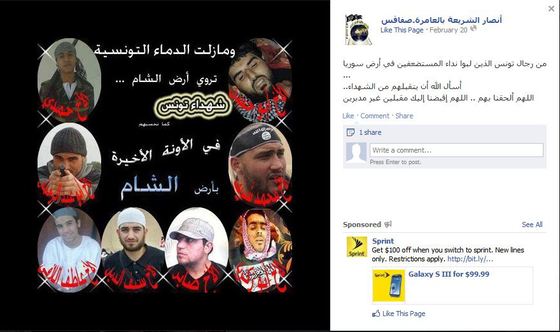
Tunisian 'martyrs' celebrated by Ansar al Sharia

A poster honoring eight Tunisians who died fighting in Syria.

In early February, a video of an interview with Ansar al Sharia Tunisia's leader Seifallah ben Hassine (a.k.a. Abu Iyad al Tunisi) was released online after it had been banned by government officials. Hassine, who is wanted for instigating the Sept. 14, 2012 assault on the US Embassy in Tunis, was asked about the migration of young Tunisians to the jihadist battlefields in Syria and Mali. He responded by discouraging the practice, saying Tunisia's Salafi jihadists were needed at home and that the wars abroad have "emptied Tunisia of its young."

A review of Ansar al Sharia Tunisia's official Facebook page and other online sources tells a different story. Hassine's organization frequently celebrates the "martyrdom" of Tunisians, especially those who fought in Syria.

In Facebook entries posted this week, the group showcased Tunisians killed in Syria. And Ansar al Sharia's logos accompanied the young Tunisians' images, thereby indicating the organization's official seal of approval.

One post announces the death of a Tunisian who fought in Deir al Zour, a city located on the Euphrates River that the Al Nusrah Front is currently seeking to capture. The Facebook posting says that he fought for the Hamza Bin Abdul Muttalib Brigade.

Continue... & Read more: http://www.longwarjournal.org/archives/2013/03/in_early_february_a.php#ixzz2NVZ5LbKI
Enhanced by Zemanta

Wednesday, February 27, 2013

Ansar al-Sharia returns to Benghazi

(AFP/Intel Center) Once forced out of Benghazi by public anger,
Ansar al-Sharia is now resuming security patrols
The radical militia suspected of carrying out the terrorist attack on the US consulate is now back in Benghazi, residents say.


Five months after Benghazi residents drove out extremist militias from the city centre, members of the Islamist Ansar al-Sharia brigade are now returning.

Patrolling hospitals and manning checkpoints, Ansar al-Sharia elements are back at their old posts. The Islamist militia was driven out of its main bases in eastern Libya' s main city last September following public outrage over the terror attack on the US consulate in Benghazi.

"Ansar al-Sharia elements are back to secure vital areas in Benghazi without being asked to," 36-year-old employee at Benghazi Medical Centre Marawan al-Jahani said.

"However, they are still not wanted in the streets of Libya. Truthfully, Libyan people are religiously moderate, open minded and don't accept any extremism," he added.
Some members of the extremist militia were also present during celebrations marking the February 17th revolution, securing vital areas in place of police.

The militia also resumed outreach programmes in an effort to win over a local populace wary of the continued presence of rogue revolutionaries.

According to The Globe and Mail, Ansar al-Sharia has picked up where the weak interim government left off, filling a security vacuum and providing local humanitarian services. But many Libyans remain sceptical of the Islamist aid.

24-year-old water company employee Ahmed Mansour called for serving the country and loving it warmly. "However, the fact that Ansar al-Sharia offers their services free of charge makes us wonder why Ansar al-Sharia in particular works with this spirit," he said.

"In my opinion, they have another purpose and are trying to proactively win people's trust. This group knows quite well that using direct force in Benghazi is not in its interest. Therefore, I believe that they have a hidden agenda that simple people can't see," Mansour continued.

"I don't want to cast doubts over their intentions, but it is still too early to praise anyone who wants to offer something to the nation and Benghazi without anything in return," he added.

Benghazi has been plagued by intermittent turmoil in recent months, with assassinations of security officials and sporadic bombings. While Ansar al-Sharia has denied culpability, Libyan authorities have been unable to curtail the violence or arrest those responsible for the attack on the US consulate.

The inaction over the Islamist violence comes despite intelligence and reconnaissance support from Libya's international partners. Drone over-flights are now a common occurrence in eastern Libya, where the aircraft provide information on the al-Qaeda threat for Libya and other countries.

Political scientist and former National Transitional Council member Fathi Baja told The Globe and Mail that "nobody" had authorised Ansar al-Sharia to resume operations or take up a security role.
"It's a tactic for returning to Benghazi. The government doesn't want a confrontation with them," he said.
 A specialised committee has been set up to monitor the various groups in charge of security in Benghazi, according to Mohammed al-Tayeb, the person in charge of the security file within the city's local council.
"We're only overseeing the process without interfering in the responsible entities' tasks," al-Tayeb told Magharebia.
Members of the Islamist Rafallah al-Sahati battalion are also reportedly returning to their old positions within Benghazi.
Faraj al-Mejbri, an employee in the administration of Rafallah al-Sahati, said his group never expected to be driven out of the city in the public rage over the consulate attack.
"We didn't imagine that we would be treated like al-Fadheel Bou Omar battalion was treated when the young people rose against it during the revolution and the obscene words used to describe us," al-Mejbri said.

"After that, there were many events and these Fridays never stopped. All of their demands were to remove the revolutionaries from the protection of state institutions although we are under state's legitimacy," he added.
He said that the militia was surprised by the reaction, saying they helped secure the congressional election.
"We're under the legitimacy of the defence ministry, unless the ministry itself doesn't have legitimacy in the first place," the Rafallah al-Sahati official added.
"Libyan army chief Youssef al-Mangoush is telling us that he can't form an army before three years, taking into consideration that the forces now on the ground are those of the revolutionaries," he added.

By Asmaa Elourfi for Magharebia in Benghazi – 26/02/13
Enhanced by Zemanta

Monday, February 25, 2013

AQIM Leader Condemns Destruction of Mali Mausoleums

map by Evan Centanni(www.polgeonow.com)
RFI journalist Nick Champeaux and a journalist from French newspaper Libération have discovered extraordinary papers in which the leader of Aqim, Abdel Malek Droukdel outlines his strategy for Mali.

The documents, dated 20 July 2012, four months after the jihadists took control of northern Mali, were found among others scattered on the floor of the offices of the ORTM national television station in Timbuktu.

The papers were intended to be read by other senior members of Aqmi (Al Qaeda in the Islamic Maghreb) and Ansar Dine and were headed "Roadmap relating to Islamic Jihad in Azawad [northern Mali]".

Before they fled Timbuktu, the Aqim leaders shredded a number of documents, including lists of names and telephone numbers. Among the papers scattered on the floor, were the 79 pages written by Abou Moussab Abdelwadoud, alias Abdel Malek Droukdel, head of Aqim.

These documents complete a dossier, part of which was found in February by a journalist working for Associated Press.

In the documents, Abdel Malek Droukdel focuses on how to set up an Islamic zone in northern Mali with the Touareg people, without drawing attention to Aqim's presence there.

His solution is outlined in a framework laid out in six chapters.

In the first chapter, entitled "Global vision of the Islamic jihadist project in Azawad", Droukdel condemns the destruction of mausoleums and the stonings carried out by some of his fellow jihadists. "You have made a serious mistake", he writes. "The population could turn against us, and we cannot fight against a whole people. You are in danger of destroying our experiment, of killing off our baby, our beautiful tree."

"We must avoid general solutions, which do not take the local environment into account", he suggests in a paper written after the first demolitions of mausoleums, which shocked the people of Timbuktu.

"Sharia law allows lashings of the whip as a punishment for adulterers, but first of all we must get people used to the idea and educate them in Islam, only then can we envisage using such punishments", he proposes.

The document appears to have been written after discussion with other Islamists.

Droukdel expresses support in the papers for the idea of an independent High Council for Islamic Affairs, to ensure the proper application of Sharia throughout the territory under Aqmi control.

The document gives a fascinating insight into how Droukdel intended to use the (secular- minded) MNLA (Azawad liberation movement), but also, to a lesser extent, Ansar Dine, the (Islamist) group led by Iyad Ag Ghali.

Throughout the document, Droukdel laments the split with the MNLA. Before the split, in June, the MNLA had signed an accord accepting the principle of the islamicisation of northern Mali.

"What more can we ask of them?" asks Droukdel only one month later in the document. "We can't ask MNLA members to become salafists and join the ranks of Ansar Dine overnight" he declares.

The Aqim leader apparently plans to attribute most of the ministerial posts to MNLA members, though not key ministries such as Religious Affairs, Justice and Education.

He proposes that the Defence Ministry include all the different political and religious movements.

Iyad Ag Ghali (Ansar Dine) would be given the post of leader of a transitional government, whose job would be to draw up a constitution for the Islamic State of Azawad.

However, jihadists would run the towns and cities, and Droukdel appears to have no intention of involving Ansar Dine in his international terrorist activities.

The overriding aim appears to be to create the broadest possible alliances, in order to resist any military intervention.

"Alliances are essential" he writes, noting that one of the advantages of an alliance is that his movement will not be wholly responsible if it fails in its objectives."

Read or Listen to this story on the RFI website.


from allAfrica/RFi

Enhanced by Zemanta

Tuesday, January 29, 2013

Suicide bomber kills two near Somali presidential palace

map by Evan Centanni (www.polgeonow.com)
(Reuters) - A suicide bomber blew himself up near the Somali presidential palace on Tuesday, killing at least two soldiers in a strike apparently aimed at the country's leaders, a palace guard at the scene said.

Officials working in the palace and guards said Somali President Hassan Sheikh Mohamud was abroad at the time of the blast and Prime Minister Abdi Farah Shirdon Saaid, whose house was near the site of the explosion, was safe.

The blast was the first this year in Mogadishu, where security has improved greatly since Al Shabaab - Islamist rebels allied to al Qaeda - were driven from the capital by African peacekeepers in late 2011.

The group - which wants to impose its strict version of Sharia or Islamic law - is fighting to topple Mohamud, whose election last year was the first such vote since warlords ousted military dictator Mohamed Siad Barre in 1991.

"The man blew up himself near a wall between the Ethiopian embassy and the Somali PM's residence," Ahmed Ali, a Somali soldier at the presidential palace told Reuters.

The two buildings are inside a sprawling compound that also houses the presidential palace.

"One guard died there and then. Another died of his wounds. They were all the guards of the PM," said Ali. "The man was an al Shabaab defector. He had a gate pass, an identity card of the national security."

Guards at the palace who declined to be named said the blast partially damaged a small room made of iron sheets where the prime minister's guards are stationed, but little else was damaged. Buildings and cars within the compound were untouched.

OUSTED FROM URBAN CENTRES

The guards said the bomber was known to them, and frequently visited the palace. When he came by on Tuesday morning, the guards took the suicide bomber through a routine inspection and found he was clad in an explosive jacket.

The guards tried to prevent him from detonating his device, but it went off - killing one instantly and wounding two others.

Al Shabaab was not immediately available for comment on the attack.

The group fled to southern Somalia after quitting Mogadishu but in late September Kenyan troops forced it to withdraw from the port of Kismayu, its last major urban stronghold in the Horn of Africa nation.

That appears to have ended it as a quasi-conventional military force, though Al Shabaab remains a threat and has vowed to step up suicide bombings and hit-and-run attacks.

On January 17 the group said it had executed a captive French agent after a French commando mission to rescue him failed.

from REUTERS
By Abdi Sheikh
MOGADISHU | Tue Jan 29, 2013 10:17am GMT
(Writing by James Macharia; Editing by Jon Boyle)

Enhanced by Zemanta

Monday, December 24, 2012

Mali Islamists Destroy More Timbuktu Mausoleums

Men work alongside one of Timburktu's historic mud mosques, in Timbuktu, Mali. (file photo)
Islamist militants are tearing down more ancient mausoleums in the northern Malian city of Timbuktu.

Witnesses and tourism officials say rebels from the Ansar Dine group began destroying the mausoleums Sunday with pickaxes.

The militants destroyed several mausoleums in the city in July, after the U.N. cultural agency, UNESCO, put Timbuktu on its list of sites that are in danger.

UNESCO has listed Timbuktu as a World Heritage site for its ancient mosques and shrines, some of which date back to the 15th century.

The sites are revered by many Muslims but Ansar Dine considers them sacrilegious.

Ansar Dine is one of three militant groups that seized control of northern Mali earlier this year, after renegade soldiers overthrew the government.

The groups are trying to enforce a strict form of Islamic law across the territory.  The U.N. and human rights groups have condemned the militants for abuses that include amputations and floggings of alleged criminals.

On Thursday, the United Nations Security Council has authorized the deployment of foreign troops to Mali.

The Economic Community of West African States
is making plans to send a force of between 3,000 and 4,000 soldiers to retrain the Malian army and help retake the north.

from VOA NewsDecember 23, 2012
---

from MAGHAREBIA:

 
Mali Islamists launch fresh attacks on Timbuktu shrines

23/12/2012

Islamists occupying Timbuktu were using pickaxes on Sunday (December 23rd) to destroy any remaining mausoleums in the ancient city, an Islamist leader told AFP.

"Not a single mausoleum will remain in Timbuktu, God doesn't like it. We are in the process of smashing all the hidden mausoleums in the area," said Abou Dardar, an Ansar al-Din leader.

In related news, al-Qaeda splinter group Movement for Tawhid and Jihad in West Africa (MUJAO) said Saturday that it cut off the hands of two people in Gao as part of its interpretation of Sharia, AFP reported. The terror group warned another eight people could face a similar fate.

"It's God's law and no one can stop us from applying it," said Moctar Barry, a leader of MUJAO, which controls the city of Gao.
Enhanced by Zemanta

Thursday, November 22, 2012

From al Qaeda in Italy to Ansar al Sharia Tunisia

Abu Iyad preaches during a rally in Tunisia in front of a flag commonly used by al Qaeda in Iraq. On the right (Iyad's left), in orange, is Sami Ben Khemais Essid. On the left (Iyad's right, also in orange), according to L'Espresso, is Mehdi Kammoun.
By Thomas Joscelyn - November 21, 2012 - LWJ

Two convicted members of an al Qaeda-affiliated terrorist group in Italy are now senior members of Ansar al Sharia Tunisia. The pair, Sami Ben Khemais Essid and Mehdi Kammoun, were arrested in 2001 and sentenced to several years in prison for their terrorist plotting as operatives in the Tunisian Combatant Group (TCG).

They were each subsequently deported to their native Tunisia, where they were imprisoned by President Ben Ali's regime. In the wake of the Arab Spring, Essid and Kammoun were freed.

The US government has previously identified Essid as the head of al Qaeda's operations in Italy. In early 2001, Essid plotted to attack the US Embassy in Rome, among other targets.

Essid's and Kammoun's role in Ansar al Sharia Tunisia was first reported by L'Espresso, a weekly Italian news magazine. L'Espresso identified the two in a video of Ansar al Sharia Tunisia's leader, Seifallah ben Hassine, also known as Abu Iyad. They can be seen wearing orange vests, flanking Abu Iyad on both sides.

The Long War Journal has found the same video online. A side-by-side comparison of a screen shot from the video and a known photo of Essid is shown below. Essid has subsequently been interviewed by an Algerian newspaper, which confirmed that he is now a leader in Ansar al Sharia Tunisia. A similar photo of Kammoun was not immediately available for comparison purposes.

Ansar al Sharia Tunisia orchestrated the Sept. 14 assault on the US Embassy in Tunis. The attack did extensive damage to US interests, including a school. Several people were killed during a subsequent confrontation between the rioters and Tunisian security forces.


Sami Ben Khemais Essid. On the left, Essid attends an Ansar al Sharia Tunisia rally. On the right, Essid as pictured by the US State Department.


Read more: http://www.longwarjournal.org/archives/2012/11/from_al_qaeda_in_ita.php#ixzz2CwJsfjPF
Enhanced by Zemanta

Monday, September 17, 2012

Boko Haram Spokesman Reported Killed in Nigeria

Nigerian soldiers say troops have killed a man suspected of being a spokesman for the Islamist sect Boko Haram and arrested two of its field commanders.

A soldier who participated Monday in the operation in the northern part of the country told VOA that troops, acting on a tip, stopped a car at a checkpoint and killed the spokesman who used the alias Abul Qaqa.  However, there has been no official confirmation.

In March, Nigerian authorities claimed to have captured Abul Qaqa, but it turned out to be another member of the sect.

Boko Haram has been blamed for more than 1,400 deaths in Nigeria's central and northern regions, with statements issued to journalists on behalf of the group in the name of Abul Qaqa.

Gunmen associated with the sect have frequently carried out guerrilla attacks, including the killing of a family of four at point-blank range Sunday after they were herded into a room, and another group of six that was killed in front of their home.

Boko Haram has clashed frequently with the Nigerian central government. Its name means "Western education is sacrilege," and its adherents have advocated use of strict Sharia law across Nigeria.

from VOA News
September 17, 2012

Enhanced by Zemanta

Sunday, September 9, 2012

Yemen army says four suspected militants have been killed


map by Evan Centanni (www.polgeonow.com)
Four suspected Islamist militants have been killed in a gunfight with Yemen’s army and allied tribal fighters in the impoverished country’s turbulent south, which has become al-Qaeda’s most formidable base, a local official said on Saturday.

Up to 50 militant fighters were battling government forces and their tribal allies near the town of Jaar, which the army recaptured in June after a 15 month occupation by Ansar al-Shariah.

The Islamist movement seized control of large swathes of southern Yemen during the turmoil caused by mass anti-government protests last year and gave shelter to al-Qaeda, flying the international militant group's flag in captured towns.

The United States has used unmanned drones to target the al-Qaeda group in Yemen, which has planned attacks on international targets including airliners and is described by Washington as the movement's most dangerous wing.

The local government official said the fighting continued late on Saturday.

On Friday, gunmen suspected of belonging to al-Qaeda had attempted to assassinate the commander of one of the tribal militias fighting alongside government forces in the south.

Tribes opposed to Ansar al-Shariah and al-Qaeda had played an important role in regaining control of Jaar and other southern towns during the summer.

Abdul Latif al-Sayed, a commander with the Popular Committees, survived the ambush on a road in Abyan Province but one of his bodyguards was killed, said another local official.

The attack was the fourth assassination attempt Sayed has survived, including a suicide bombing at a funeral last month that killed two of his brothers and 43 other people.

“The army, police and tribal fighters chased the gunmen who fled into one of the rugged valleys nearby where there were clashes between the two sides,” said the south Yemen government official, who declined to be named.

Mass anti-government protests erupted early last year, causing fighting between tribes and different factions of the army, before former President Ali Abdullah Saleh stepped down in February to allow a transition towards democracy.

Aid groups have warned of a major humanitarian crisis in the Arabian Peninsula state, where half the population lives under the poverty line.

As well as fighting the insurgency by Islamists in Abyan, the government also faces conflict with southern secessionists and with the Houthi group of Zaidi Shiite Muslims in north Yemen.


from AL ARABIYA
Last Updated: Sat Sep 08, 2012 19:07 pm (KSA) 16:07 pm (GMT)

Enhanced by Zemanta

Sunday, July 15, 2012

Mali rebels say drop separatist goal

BAMAKO, July 15 (Reuters) - Tuareg-led Mali rebels who seized the north of the West African country in April declared on Sunday they had dropped claims for a separate state after the rebellion was hijacked by al Qaeda-linked Islamists now holding sway in the north.

"We are seeking cultural, political and economic independence but not secession," Ibrahim Ag Assaleh, a senior member of the National Movement for the Liberation of Azawad (MNLA), told Reuters by telephone.

Azawad is the name which the MNLA gives to the northern territory of Mali in which it declared an independence that has been ignored by a world more concerned with the threat of Mali become a launchpad for jihadi activities.

A second MNLA official, Hama Ag Mahmoud, told Reuters in the Mauritanian capital Nouakchott: "Independence has been our line since the start of the conflict but we are taking on board the view of the international community to resolve this crisis."

Islamist groups including the local Ansar Dine have imposed strict sharia, Islamic law, across the north and destroyed UNESCO-listed shrines to local saints in the ancient town of Timbuktu, arguing that such worship is un-Islamic.

Contacted by telephone in Timbuktu, Ansar Dine spokesman Sanda Ould Boumana said he was not aware of any change in the MNLA position but added: "What I can tell you is that it is us who control the three regions of the north."

(Reporting by Tiemoko Diallo in Bamako; Mark John in Dakar; Writing by Mark John; Editing by Alison Williams)

from REUTERS
Sun Jul 15, 2012 1:05pm GMT

Enhanced by Zemanta

Sunday, June 10, 2012

Nigeria: Gunmen and suicide bomber attack churches on Sunday

Gunmen in Nigeria have attacked two churches during Sunday services, killing and wounding a number of worshippers.

Five gunmen opened fire in Biu in Borno state, killing one woman and injuring three other people.

In the central city of Jos, a suicide bomber blew himself up outside a church, causing a number of casualties.

No-one has admitted the latest attacks, but radical Islamic sect Boko Haram has targeted churches before.

One witness at the church in Biu said that "gunmen came to the premises of the church and started firing at people outside the church before going into the main building to carry on their killings", Reuters news agency reported.

"Many people have been killed and wounded," witness Hamidu Wakawa was quoted as saying.

Moments after the suicide bombing in Jos, Christian youths set up roadblocks and had to be dispersed by police, according to one witness.

"Angry youths have gone wild, even attempting to prevent the security personnel from getting to the scene of the incident. They had to force their way out by shooting in the air to disperse them," Emmanuel Davou was quotyed by Reuters as saying.

The explosion killed two worshippers and the suicide bomber, while wounding more than 40 others, a police officer was quoted by the Associated Press as saying.

Boko Haram has carried out numerous attacks in northern Nigeria, killing hundreds of people since 2009.

The group - whose name means "No to Western education" - wants to impose Sharia law across Nigeria.

It has targeted churches, schools, police stations, and other government buildings.

The group has said it was behind the suicide bombing of a church last weekend which left at least 12 people dead in Bauchi City.

from BBC

---

Enhanced by Zemanta

Friday, June 1, 2012

Mali: Briefing - Tuareg Separatists, Salafists Forge Alliance

Dakar — Two months after taking the northern strongholds of Timbuktu, Gao and Kidal, Mali's rival rebel movements have supposedly put aside ideological, religious and cultural differences to agree on the creation of a joint Council of the Islamic State of Azawad, independent of the rest of Mali.

The agreement signed in the northeastern city of Gao on 26 May, came after three weeks of talks between the Tuareg-dominated National Movement for the Liberation of Azawad (MNLA), which launched its insurgency against the government of Mali in mid-January, and Ansar Dine, which has championed the promotion of Sharia Law in the north of Mali.

Breakaway rejected by Bamako

Reaction from Bamako to the "self-dissolution" of the two rebel entities was swift and hostile. Government spokesman Hamadoun Touré said the government "categorically rejects any idea of the creation of a state of Azawad, even more so the creation of an Islamic state".

Speaking to IRIN, the parliamentary representative for Timbuktu, El Hadji Baba Haidara, said the new protocol proved the MNLA had used a "double identity", concealing its real intentions and alliances. "The MNLA tried to woo Western governments by preaching moderation and distancing itself from radical Islam," Haidara argued. "The agreement shows that the MNLA and Ansar Dine are one and the same. For how many centuries has Mali been a Muslim country? People in the north have never asked to be 'liberated' in this way."

Different movements, different goals?

The rebels' string of easy victories in the north in late March and early April came against a background of political breakdown and confusion in the south. The coup staged in Bamako by mutinous soldiers on 22 March removed outgoing President Amadou Toumani Touré weeks before elections were to have been held. But the junta which replaced Touré, headed by Capt Amadou Sanogo, quickly faced regional islolation and international condemnation. With the Malian military distracted, the rebels moved quickly to occupy poorly-defended towns and their surroundings.

It was the MNLA which confidently declared a ceasefire on 5 April, confirming that its military objectives had been attained. The following day, the MNLA formally declared the founding of the Republic of Azawad. But Ansar Dine combatants were much in evidence, particularly in Timbuktu. The MNLA had dismissed the rival movements as an irritant more than an ally, entering the conflict weeks after the MNLA had initiated hostilities and espousing a Salafist version of Islam that had little popular support in Mali.

Senior MNLA figures, including senior commander Mohamed Ag Najim, were openly disparaging of Ansar Dine. There was concern that Ansar Dine's leader, Iyad Ag Ghali, while a prominent figure in past struggles, was now a distraction, more concerned with Sharia Law than forming a new state. Ghali also had reported links to Al Qaeda in the Maghreb (AQIM) and its long-established smuggling and kidnapping networks. The MNLA's platform included a commitment to purging the new Azawad of these elements, with senior figures accusing the government in Bamako of having actively connived with AQIM.

Islamists take the upper hand

But as the state crumbled in the north, Ansar Dine's profile increased. Its fighters rapdily outmanoeuvred their MNLA counterparts in Timbuktu, and their leaders took a stronger lead in imposing their authority while also carrying out recruitment drives targeting the youth. The allegations of strong ties between Ansar Dine and AQIM grew stronger with reports of meetings between senior figures from the two movements. Adding extra fuel were unconfirmed reports of Nigerian militants from Boko Haram in northern Mali and even fighters from Pakistan.

In a recent interview, AQIM's Emir, Abdelmalek Droukdel, looked to be addressing Ansar Dine directly when he talked of a gradual approach in the imposition of Sharia law, arguing that "it would be a mistake to impose all the rules of Islam in one fell swoop".

The desecration by Ansar Dine supporters of the tomb of one of Timbuktu's most revered spiritual leaders, Sidi Mahmoud Ben Amar, on 4 May generated fierce reaction both locally and internationally, with UNESCO warning of the need to protect Mali's cultural heritage. Ansar Dine's critics say the movement continues to disrespect local sensitivities. They say the Salafist agenda goes well beyond tackling crime and banning alcohol, arguing that Ansar Dine's supporters have also transformed schools into 'madrassas', devoted to Koranic study, compelled women to wear the veil, and tried to ban both playing football and listening to the radio. Demonstrations in Gao on 14 May are reported to have been triggered in part by hostility to such moves.

MNLA ready to unite?

An MNLA-organized meeting of tribal elders and community leaders in Gao in late April restated many of the movement's main objectives and included a strong defence of the role of women in the creation of a new Azawad, but made no reference to Ansar Dine or Sharia Law.

But speaking to IRIN from Paris after the signing of the entente in Gao, MNLA spokesman Moussa Ag Acharatomane said reported differences between the two movements had been exaggerated: "Ansar Dine is a Tuareg movement, from our own soil, not foreigners ... We have always shared the same objectives, even if our methods were different. We are a revolutionary movement, but we never said we were without religion."

Ag Acharatomane strongly denied any links between Ansar Dine and AQIM, saying the new authorities in Azawad would ensure the prompt expulsion of foreign elements engaged in violence. He also rejected reports of the rapid implementation of Sharia. "I have just returned from Gao and I can confirm these stories about radios and football being outlawed are without foundation. A moderate, tolerant form of Islam is being practiced."

Both Ansar Dine and the MNLA have faced strong criticism in reports by Amnesty International and Human Rights Watch (HRW). In its 30 April report entitled Mali: War Crimes by Northern Rebels, HRW noted persistent complaints from civilians of looting, rape, wrecking of medical facilities and even summary executions, with the MNLA implicated in many of the accusations.

The movement hit back strongly, arguing that MNLA combatants had been "confused with other groups", but promised its own investigations into human rights violations throughout Azawad.

Despite the show of unity between Ansar Dine and the MNLA, there are hints of fresh tensions ahead. In its 14 May edition, Algerian daily newspaper El Watan reported the existence of a newly formed Mouvement républicain pour la restauration de l'Azawad (MRRA) - Republican Movement for the Restoration of Azawad, intent on mobilizing Tuaregs to expel AQIM from the north and push for a reintegration of Azawad into Malian national territory. The MNLA has frequently accused El Watan of idle speculation and fabrication.

Whatever happens in the north, the authorities in the south look ill-equipped to resolve the crisis. The departure of Mali's interim President Dioncounda Traoré to Paris to receive medical treatment for injuries sustained in an assault by demonstrators in Bamako has left Sanogo and an uneasy coalition of soldiers and civilians steering national policy. Hopes that a Traoré-led interim administration could pacify the country and leave the way clear for elections in 2013 look increasingly fragile.

Meanwhile, the USA and France have signalled fresh concern about the direction Mali appears to be heading in; the Economic Community of West African States (ECOWAS) has confirmed its readiness to deploy troops; and President Blaise Compaoré of Burkina Faso remains the mediator-in-chief.

Sources: Radio France Internationale (RFI), El Watan, Jeune Afrique, Tamurt.info

[ This report does not necessarily reflect the views of the United Nations ]


from allAfrica

Enhanced by Zemanta

Saturday, April 7, 2012

Yemeni al-Qaida claims responsibility for suicide bombing against intelligence center

ADEN, Yemen, April 6 (Xinhua) -- The Yemen-based al-Qaida branch claimed responsibility for a suicide bombing that targeted a center of the military intelligence agency in the southern port city of Aden on Friday morning.


http://sgt-jim.blogspot.com/2012/04/suicide-bombers-die-in-aden-blast.html

"Two Fighters of Partisans of Sharia were martyred before reaching the main target in Aden because of a mistake in timing the explosives," the al-Qaida spokesperson said a statement obtained by Xinhua.

"The two holly warriors were on their way to carry out a jihadist attack against an intelligence office belonging to the Yemeni government in Mansoura district," it said.

Two suicide bombers riding an explosives-laden motorbike blew themselves up on Friday morning outside the headquarters of the military intelligence agency in the Mansoura district in Aden, killing themselves only at the scene, a police officer told Xinhua.

The officer said that the al-Qaida suspects appeared to be in their early 20s.

The suicide attack came just a few hours after the country's interior ministry announced that Yemeni Government troops have killed more than 100 al-Qaida fighters during fierce battles with the terrorist group in the neighboring southern provinces of Lahj and Abyan in the past two days.

The southern port city of Aden, a main stronghold of the pro- secession groups in southern Yemen, has been plagued by violence since al-Qaida militants overran several towns in neighboring Abyan province last May. Explosions and assassinations conducted by pro-secession militants and al-Qaida fighters were frequently seen in the city during the past year.

Local observers and analysts fear that security situation in Aden may worsen as the Yemen-based al-Qaida branch threatens to overrun the port city, despite the tightened security measures adopted by Yemeni authorities.

Enhanced by Zemanta

Saturday, March 10, 2012

Officials: Yemen forces target militant hideouts, killing 36

Yemen governorates map
Image via Wikipedia
(CNN) -- Yemeni air forces targeted militant hideouts in the south, killing at least 18 suspected al Qaeda insurgents, security officials said Saturday.

In a separate action, 18 additional militants were killed in airstrikes, officials said.

The first airstrikes occurred in the Yemen province of al-Baitha in areas used as launching pads for militant attacks, the officials said.

"Al Qaeda is trying to build a stronghold in al-Baitha and it is in the beginning stages. We are trying to eliminate their presence while it is still possible and easy," one of the officials said.

Both officials did not want to be named because they are not authorized to speak to the media.

Smoke from the air raids covered the skies of al-Baitha hours after the attack. Security forces also formed new checkpoints in nearby districts.

Residents said military aircraft roam the skies of the province around the clock.

In a separate action, the air force carried out five airstrikes in the towns of Jaar and Zinjibar in Abyan province, killing 18 suspected Ansar al-Sharia militants, Yemeni security officials toldf CNN.

The attacks targeted caches of weapons and equipment seized by the militants earlier this week, the officials said.
Enhanced by Zemanta

Sunday, March 4, 2012

Boko Haram plans 'to eradicate Christians' from areas in Nigeria


Boko Haram, the radical Islamist terror group that has been linked to al Qaeda in the Islamic Maghreb as well as Shabaab, al Qaeda's affiliate in East Africa, is intent on turning their insurgency in the north of Nigeria into a full fledged war between Christans and Muslims. The terror group has bombed numerous churches in the country in the past two years, including a suicide attack at a church in Jos at the end of February. Leadership, a Nigerian news outlet, interviewed a Boko Haram spokesman who said that the group will "eradicate Christians from certain parts of the country" while fighting to establish "a proper Islamic state."
A Nigerian spokesman for the Islamic militant group Boko Haram told Bikyamasr.com on Sunday that they are planning a "war" on Christians in the next few weeks. According to the spokesman, speaking via telephone from northern Nigeria, the group "will launch a number of attacks, coordinated and part of the plan to eradicate Christians from certain parts of the country."
Boko Haram have taken responsibility for a number of bomb attacks on Christian churches across the country since a Christmas Day bombing left dozens of people killed.
The government has promised to crackdown on the group and has deployed military units across the country in an attempt to curtail the Islamic group's activities, arresting and killing a number of members in recent weeks.
But the spokesman said the government "cannot be prepared for what is to come."
He said, without giving specific details, "we will create so much effort to end the Christian presence in our push to have a proper Islamic state that the Christians won't be able to stay."
On Friday, the group reportedly killed three of its own members late on Friday in the northeastern state of Maiduguri, police and military sources confirmed.
"This was part of our planning and it is unfortunate," said the spokesman.

Read more: http://www.longwarjournal.org/threat-matrix/archives/2012/03/boko_haram_plans_to_eradicate.php
Enhanced by Zemanta

Tuesday, February 14, 2012

AQAP's Ansar al Sharia executes 3 US 'spies'


AQAP-AAS-executes-spies.jpg
Images of the three "spies" executed by al Qaeda in the Arabian Peninsula. Image from the SITE Intelligence Group.

Ansar al Sharia, al Qaeda in the Arabian Peninsula's political front, has released a videotape of the confessions of three Yemenis who were accused of spying for the US and placing tracking chips on vehicles that resulted in the deaths of 10 AQAP fighters in US-led airstrikes. The video, along with an accompanying statement by AQAP on the charges against the men and others also accused of spying for the US and Saudi intelligence, was translated by the SITE Intelligence Group.
The three men who confessed were reported yesterday to have been beheaded.
Below is a sample of AQAP/Ansar al Sharia's "charges" against one of the slain spies:
The accused, 'Abu Abdul Rahman al-Maribi Salih Ahmed Salih al-Jamili' admitted in front of the judicial committee to the accusations directed at him, and he received his just punishment. The following people are wanted for justice in this case: the one named Ali bin Saeed bin Ma'ili, the one named Ma'id bin Nasser bin Qamad, and the one named Khamis al-Mashi'i, for their participation in recruiting the one named Abu Abdul Rahman Salih Ahmed Salih al-Jamili and aiding him with money, techniques, and constant contact with the command center that is directing the American air force through the national security.
For more information on Ansar al Sharia, see LWJ report, US 'drones' kill 15 al Qaeda fighters in southern Yemen.

Read more: http://www.longwarjournal.org/threat-matrix/archives/2012/02/aqaps_ansar_al_sharia_executes.php?utm_source=twitterfeed&utm_medium=twitter#ixzz1mJ5hYPnX
Enhanced by Zemanta

Tuesday, January 31, 2012

Gunmen attack police station in Nigeria’s Kano city

According to Nigerian police officials, at least two civilians have died in an overnight attack on a police post in the northern Nigerian city of Kano.

In the meantime residents said, gunmen pened fire on a police station in Nigeria’s flashpoint city of Kano at dawn Monday, setting off a gun battle with police.

The gunmen are suspected to be Islamist militants from Boko Haram, which recently carried out multiple bomb attacks in Kano, killing 185 people.

Kano state and its capital city of 10 million people have been under siege by gunmen from Boko Haram, which wants to impose sharia law across Nigeria.

Boko Haram, a movement loosely modeled on the Afghan Taliban whose name translates as “Western education is sinful”, has been behind almost daily killings in its home base in the largely Muslim northeast. Its violence has spread west into other parts of the north and the capital Abuja since last year.

from KHAAMA
Enhanced by Zemanta

Thursday, January 19, 2012

Explosion Kills 6 People in Somali Capital

The battle occurred in the Somali capital of M...
Image via Wikipedia
A bomb exploded in Somalia's capital Thursday, killing six Somalis, including two police officers, shortly after a group of international journalists was in the area.

United Nations officials said the bomb, believed to be a homemade explosive device, appeared to be targeting a police checkpoint close to a crowded area of makeshift shelters for refugees.

The journalists had just visited a feeding site near the shelters, during a U.N.-sponsored trip to observe international relief efforts. Drought and chronic violence have made Somalia one of the worst humanitarian crises on the planet.

Meanwhile, two Somali insurgents hurled hand grenades at the U.N. compound on Thursday in a separate attack in the restive capital. Officials say the grenades missed the compound.

In response to the worsening violence, the international aid group Doctors Without Borders says it is closing its two largest medical centers in Mogadishu. Two of its workers were killed in the capital last month.

The group said it is shutting down the 120-bed facilities in Mogadishu's Hodan district, where it has been treating malnutrition, measles and cholera.

The director of Doctors Without Borders, Christopher Stokes, said it is hard to stop those services in an area where the group is saving lives, but that the “brutal assassination” of its workers makes it impossible to continue.

Mogadishu is one of the world's most dangerous places for foreign workers.

Somalia has not had a stable government since 1991. The militant Islamist group al-Shabab is attempting to overthrow the U.N.-backed government and impose strict Sharia law over the country.


from VOANews

Enhanced by Zemanta

Search this blog