Showing posts with label Syria. Show all posts

Sunday, May 26, 2013

Rockets Land in Hezbollah Stronghold in Beirut

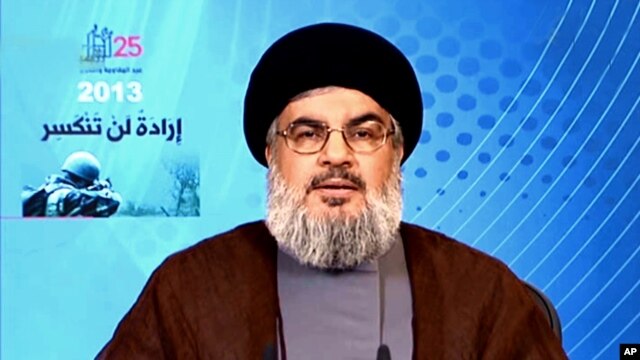
In this photo released by the Syrian official news agency SANA, Hezbollah chief Hassan Nasrallah, gives a televised speech from an unknown location, May 25, 2013
Lebanese security officials say two rockets have hit a Beirut neighborhood that is a stronghold of Hezbollah militants.

Reports say the rockets landed in the southern part of the Lebanese capital Sunday, wounding at least three people. It was not clear who was responsible for firing them.

The rocket attacks came a day after Hezbollah chief Hassan Nasrallah vowed his group will not stand by while the neighboring government of Syrian President Bashar al-Assad is attacked.

Nasrallah said in a speech Saturday that Hezbollah is fighting in Syria to protect Lebanon from the threat of radical Islamists.  It was the first time Nasrallah has publicly confirmed Hezbollah's fighting presence in Syria.

The speech was given as Syrian troops and Hezbollah fighters carried out the heaviest barrage of gunfire in a week-long battle to re-take the strategic town of Qusair from rebel fighters.

from VOA News
May 26, 2013

A policeman inspects damaged cars after two rockets hit houses and parked cars in Beirut suburbs May 26, 2013 (Reuters / Mohammed Azakir)
Enhanced by Zemanta

Sunday, May 12, 2013

Bombs Near Turkish-Syrian Border Kill 40

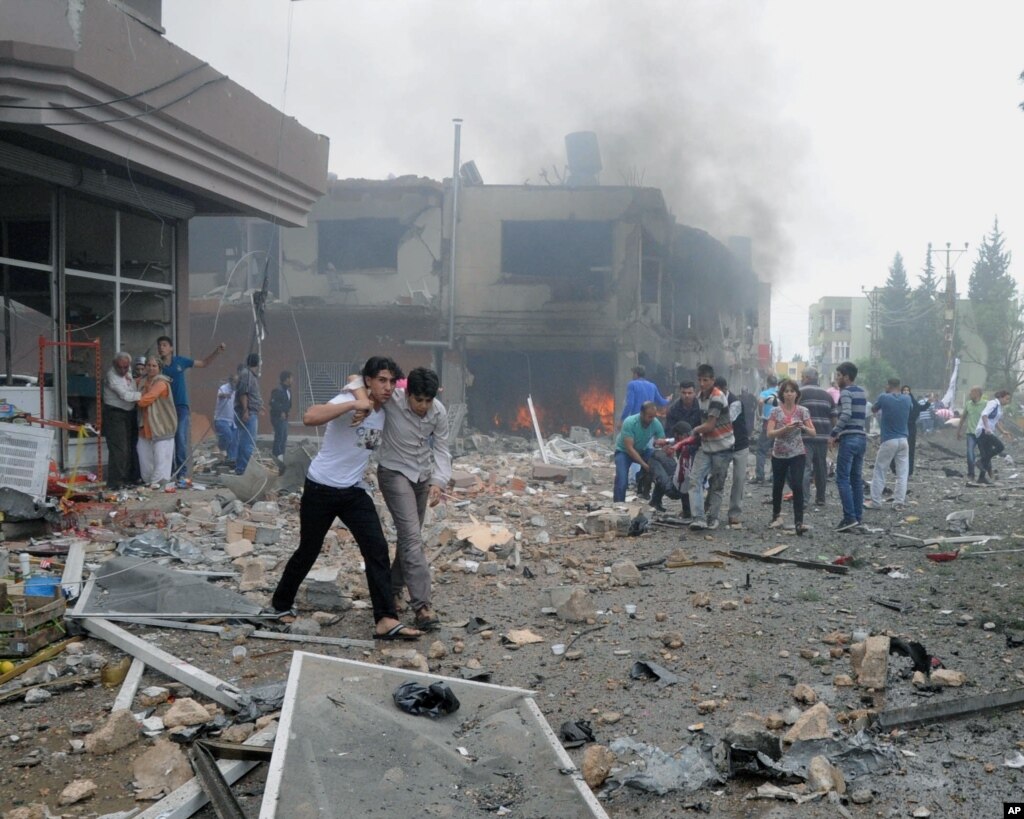
People carry injured people from one of explosion sites after several explosions killed at least 40 people and injured dozens in Reyhanli, near Turkey's border with Syria, May 11, 2013.
ISTANBUL — Twin car bombs in a Turkish town near the Syrian border have killed at least 40 people and wounded more than 100 others, and top Turkish officials are pointing fingers at the Syrian government.

Turkey's interior minister, Muammar Guler, said car bombs went off in the town of Reyhanli, just a few kilometers from a Syrian border crossing. Massive explosions devastated nearby buiildings, and ambulances rushed to the site Saturday to treat scores of victims.

Deputy Prime Minister Bulent Arinc said the government of Syrian President Bashar al-Assad was "the usual suspect" in the attacks, particularly because Syrians taking refuge from the civil war in Turkey's Hatay province clearly "have become targets" for the regime in Damascus.

No one claimed responsibility for the carnage, nor was there any comment on the explosions from authorities in the Syrian capital.

In addition to tensions involving Syria, Turkish Prime Minister Recep Tayyip Erdogan indicated the blasts also may have been related to his government's peace talks with Kurdish rebels, an effort aimed at ending nearly 30 years of conflict.

Erdogan said "Hatay is also a very sensitive province," home to 20,000 to 25,000 refugees. "There may be those who want to agitate these sensitivities," he said.

Turkey has harshly cricitized Syria's President Assad throughout the course of the civil war there. Two years of bloodshed in Syria are believed to have killed about 70,000 people and have made hundreds of thousands of civilians homeless.

The U.S. embassy in Ankara condemned the attack in Turkey Saturday and vowed to stand with authorities in Ankara to "identify the perpetrators and bring them to justice."

from VOA News
by Dorian Jones
May 11, 2013

Enhanced by Zemanta

Friday, April 19, 2013

UAE Arrests Al-Qaida-Linked 'Terrorist Cell'

Das which is named on this map can be seen to ...
 (Photo credit: Wikipedia)
Authorities in the United Arab Emirates have arrested seven people they say are part of an al-Qaida-linked terrorist cell.
 

The official WAM news agency said Thursday the group was "planning to carry out acts" in the UAE, as well as to recruit others and promote al-Qaida.

It said the seven people arrested were of "Arab nationalities" but did not give additional details.

The statement also said the group was providing money and logistical support to help al-Qaida further its activities in the region.

Middle East Policy Council Executive Director Thomas Mattair says support for Islamist extremism is rife throughout the region. He says counter-terrorism efforts, while successful in some areas, tend to drive recruits across borders.

"The Saudis, the Emiratis, they cooperate with us strenuously to root out these people and there have been successes in both countries," he said. "But the result is that a lot of [the terrorists] have been driven into Yemen, and that's really where the problem is most critical. They could have been transiting the UAE on their way somewhere else, possibly to Syria."

Mattair says when Sunni Arabs across the region see their co-religionists under siege in Syria, which drives some into the hands of extremist groups.

In December, UAE authorities arrested what they called a "deviant group" in connection with a terrorist cell planning attacks in the Gulf kingdom, Saudi Arabia and nearby states.

Mattair says that a serious U.S. commitment to helping push the Israeli-Palestinian conflict to resolution would deprive al-Qaida of a major source of propaganda.

Mattair says al-Qaida recruitment videos feature Palestinians or Iraqis who it says have been killed and that the group "blames [their deaths] on the United States."

from VOA News
April 18, 2013

Enhanced by Zemanta

Tuesday, March 26, 2013

Syrian Jihadist Fighters Getting Western Weapons

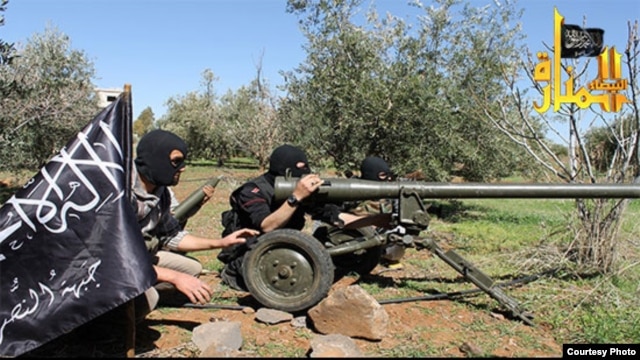
Syria's al-Nusra rebels posted this photo of its fighters using an M-60 anti-tank weapons March 24.

A Syrian rebel group the Obama administration considers a terrorist organization is managing to obtain modern anti-tank weapons meant for other groups fighting to oust President Bashar al-Assad, according to regional experts.

The Jihadist Jabhat al-Nusra militia is managing to secure weapons being supplied by Saudi Arabia and Qatar to rebel brigades affiliated to the Free Syrian Army, the experts say. The Obama administration considers al-Nusra a terrorist organization because of suspected links with al-Qaida.

The weapons include the Croatian-made M79 portable 90 mm anti-tank gun and M60 recoilless anti-tank weapons. Regional experts say Saudi Arabia and Qatar had been supplying such weapons to rebel units more acceptable to the West, mainly secular or nationalist-focused groups such as the Free Syrian Army (FSA) brigades fighting to oust the Assad government.

Croatian-made weapons

According to the experts, the weapons are now appearing in the hands of al-Nusra fighters in videos posted by group on Jihadist websites.

In February, the New York Times first reported that the Saudis were supplying Syrian rebels with arms bought from Croatia. The supply operation was prompted by the fear in the West, and among Gulf allies, that Jihadist groups were better equipped than other rebel units and were increasingly able to dominate the anti-Assad movement.

The newspaper reported Monday that U.S. Central Intelligence Agency consultants were helping Arab nations and Turkey in getting heavy weapons to the Syrian rebels despite Washington’s public stance against supplying such weapons itself.

Citing air traffic data and interviews with unnamed officials and rebel commanders, the Times said the weapons airlift to the rebels had grown to include more than 160 military flights by Jordanian, Saudi and Qatari cargo planes landing at Esenboga Airport near Ankara, and at other Turkish and Jordanian airports.

Reports of CIA assistance

Croatian weaponry believed to be part of those airlifts had been seen being used earlier this year by other Jihadist groups fighting in Syria, but al-Nusra videos posted on the internet this weekend showed for the first time their fighters using the M79 and M60 antitank weapons.

“Neither of these weapons are locally available, either from the black market or looted from the Syrian army because they don't have them,” said British-based weapons researcher, Eliot Higgins, who first spotted the videos. “That's what made them so easy to track; they stand out like sore thumbs in Syria.”

Since announcing its formation in Syria in early 2012, Jabhat al-Nusra has grown rapidly and is considered one of the most effective forces opposing the Assad government.

The rise of al-Nusra, which has homegrown fighters in its ranks as well foreign jihadists drawn from elsewhere in the Middle East, North Africa, and Central Asia, has complicated Western considerations about whether and how to supply arms to the Syrian rebels.

British and French want stepped-up shipments

The British and French governments have been pushing to increase the flow of weapons to the Syrian rebels, but other European nations have resisted, arguing that the equipment could fall into the hands of jihadist groups such as al-Nusra. Critics of the Anglo-French position said the intended recipients of the weapons, the FSA rebel units, worked too closely with al-Nusra to keep the weapons to themselves.

“We were concerned that the FSA is not really a cohesive force with a single command-and-control structure, but is far more a loose alliance of rebel brigades,” says a German diplomat based in Brussels. “We didn’t believe the FSA could or would even bother to police who received any European-supplied weaponry. FSA units fight alongside al-Nusra and other Jihadists.”

Al-Nusra, like other rebel units, also uses weapons it seizes from captured Syrian army facilities.

This past Saturday, al-Nusra fighters joined other rebel units in overrunning an air defense base in southern Syria’s Daraa Province near the border with Jordan. Videos posted by al-Nusra appeared to show rebel fighters carting off portable surface-to-air missiles, often called SAMS or MANPADS, for “Man-Portable-Air-Defense-System.”

Syrian rebels have been urging the West and Gulf countries for months to supply the rebellion with such anti-aircraft missiles, but the Obama administration has said “no.” It also has urged allied not to supply such missiles, fearing they would fall into the wrong hands.

But with each capture of Syrian army bases, though, there are opportunities for rebels, Jihadists included, to seize anti-aircraft missiles, Western security officials say.

from VOA News
by Jamie Dettmer, March 25, 2013

Enhanced by Zemanta

Thursday, March 21, 2013

Swedish jihadist killed in Syria while fighting for the Muhajireen Brigade

Abu Kamal (photo from SITE)
By

A Swedish Muslim who entered Syria to wage jihad against President Bashir al Assad's regime was killed while fighting alongside the Muhajireen Brigade (Emigrants Brigade), a group of foreign fighters who are linked to al Qaeda's affiliate in the country.


The Swede, who was identified by his nom de guerre, Abu Kamal As Swedee, was reported killed in a English-language video martyrdom statement that was posted on jihadist-run Facebook and Twitter pages on March 13. The video was discovered by France 24.


Like many foreign jihadists, Abu Kamal traveled to Turkey before entering Syria. Abu Kamal "joined Jaysh Al Hur [Free Army] known as the Free Syrian Army," the supposedly secular group that is known to fight alongside al Qaeda's affiliate in Syria, the Al Nusrah Front. But he became disenchanted with the group as "most of them didn't pray, listened to music, and smoked cigarettes," and returned to Turkey to "meet his old friend Abu Sulayman whom he grew up with [sic]."

Abu Kamal and his friend "met some brothers from the Muhajireen Brigade," includng a "Chechnyan [sic]," or a fighter from the Russian republic of Chechnya, and was convinced that he "felt right at home with the group that consisted of brothers who came to fight for the sake of Allah from around the world."

The Muhajireen Brigade is commanded by a jihadist from the Russian Caucasus who is known as Abu Omar al Chechen. The Chechen commander was praised by the Islamic Caucasus Emirate, a jhadist group that is allied with al Qaeda. Chechen fighters are thought to play a significant role in the Muhajireen Brigade, which has conducted joint operations with the Al Nusrah Front.

Continue & Read more: http://www.longwarjournal.org/archives/2013/03/swedish_jihadist_kil.php#ixzz2OAIHj4OL
Enhanced by Zemanta

Thursday, March 14, 2013

Tunisian 'martyrs' celebrated by Ansar al Sharia

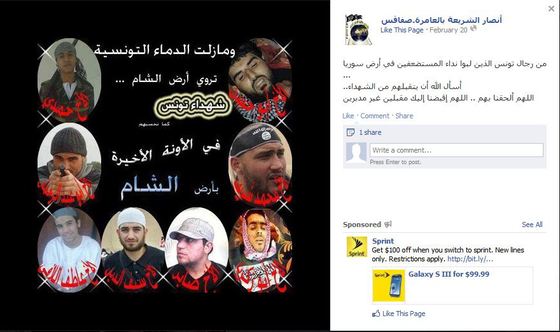
A poster honoring eight Tunisians who died fighting in Syria.

In early February, a video of an interview with Ansar al Sharia Tunisia's leader Seifallah ben Hassine (a.k.a. Abu Iyad al Tunisi) was released online after it had been banned by government officials. Hassine, who is wanted for instigating the Sept. 14, 2012 assault on the US Embassy in Tunis, was asked about the migration of young Tunisians to the jihadist battlefields in Syria and Mali. He responded by discouraging the practice, saying Tunisia's Salafi jihadists were needed at home and that the wars abroad have "emptied Tunisia of its young."

A review of Ansar al Sharia Tunisia's official Facebook page and other online sources tells a different story. Hassine's organization frequently celebrates the "martyrdom" of Tunisians, especially those who fought in Syria.

In Facebook entries posted this week, the group showcased Tunisians killed in Syria. And Ansar al Sharia's logos accompanied the young Tunisians' images, thereby indicating the organization's official seal of approval.

One post announces the death of a Tunisian who fought in Deir al Zour, a city located on the Euphrates River that the Al Nusrah Front is currently seeking to capture. The Facebook posting says that he fought for the Hamza Bin Abdul Muttalib Brigade.

Continue... & Read more: http://www.longwarjournal.org/archives/2013/03/in_early_february_a.php#ixzz2NVZ5LbKI
Enhanced by Zemanta

Thursday, February 21, 2013

Car Bomb Kills 31 in Syrian Capital

A handout picture released by the official Syrian Arab News Agency (SANA) shows Syrians carrying an injured man after a powerful car bomb exploded near the headquarters of Syria's ruling Ba'ath party in the center of Damascus, February 21, 2013.
Syrian activists say at least 31 people have been killed in a car bombing near the headquarters of the country's ruling Ba'ath Party in central Damascus.
The Britain-based Syrian Observatory for Human Rights said Thursday most of the dead were civilians.

Syrian state media called the blast a "terrorist bombing" that struck a densely populated area near the al-Mazraa neighborhood.

Russian news agencies also said the bombing blew out windows at the Russian embassy.

Meanwhile, the Syrian opposition is holding a meeting Thursday in Cairo to discuss an initiative to hold peace talks with President Bashar al-Assad's government.

On Wednesday, Syrian activists said rebels shot down a warplane outside Damascus, shortly after an airstrike killed at least 20 people in the same area.

Amateur video circulated by the Syrian Observatory for Human Rights showed a warplane firing rockets and then plummeting to the ground in Hamouriya after apparently being hit by rebel machine gun fire.  The shoot-down could not be independently verified.

from VOA News
February 21, 2013

Enhanced by Zemanta

Wednesday, January 16, 2013

Explosions kill 83 at Syrian university as exams begin

A handout picture released by the Syrian Observatory Human Rights allegedly shows the scene of an explosion outside Aleppo University, between the university dormitories and the architecture faculty, Jan. 15, 2013. 82 people were killed and 160 others injured when a big blast rocked a university in Syria's northern city of Aleppo on Tuesday. (Xinhua)
(Reuters) - Two explosions tore through one of Syria's biggest universities on the first day of student exams on Tuesday, killing 83 people and wounding dozens, a monitoring group said.

Bloodshed has disrupted civilian life across Syria since a violent government crackdown in early 2011 on peaceful demonstrations for democratic reform turned the unrest into an armed insurgency bent on overthrowing President Bashar al-Assad.

More than 50 countries asked the United Nations Security Council on Tuesday to refer the crisis to the International Criminal Court, which prosecutes people for genocide and war crimes. But Russia - Assad's long-standing ally and arms supplier - blocked the initiative, calling it "ill-timed and counterproductive.

Each side in the 22-month-old conflict blamed the other for Tuesday's blasts at the University of Aleppo, located in a government-held area of Syria's most populous city.

Some activists in Aleppo said a government attack caused the explosions, while state television accused "terrorists" - a term they often use to describe the rebels - of firing two rockets at the school. A rebel fighter said the blasts appeared to have been caused by "ground-to-ground" missiles.

The Syrian Observatory for Human Rights, a Britain-based monitoring group, said 83 people were killed and dozens wounded, but it could not identify the source of the blasts.

"Dozens are in critical condition," the Observatory said in a statement, citing doctors and students.

State television showed a body lying on the street and several cars burning. One of the university buildings was damaged.

Video footage showed students carrying books out of the university after one of the explosions, walking quickly away from rising smoke. The camera then shakes to the sound of another explosion and people begin to run.

"A cowardly terrorist act targeted the students of Aleppo University as they sat for their mid-term examinations," Syria's United Nations ambassador, Bashar Ja'afari, told the U.N. Security Council in New York. He said 82 students had died and 162 more were wounded.

If confirmed, the government's report of a rocket attack would suggest rebels in the area had been able to obtain and deploy more powerful weapons than previously used.

The nearest rebel-controlled area, Bustan al-Qasr, is more than a mile away from the university.

Activists rejected the suggestion that insurgents were behind the attack, however, and instead blamed the government.

"The warplanes of this criminal regime do not respect a mosque, a church or a university," said a student who gave his name as Abu Tayem.

GRINDING TOWARD STALEMATE

The rebels have been trying to take Aleppo - once a thriving commercial hub - since the summer, but have been unable to uproot Assad's better-armed and more organised forces.

International efforts to find a political solution to Syria's civil war have similarly resulted in stalemate, even as the conflict's death toll surged above 60,000.

The crisis has driven hundreds of thousands of people to flee the country, many to neighbouring Jordan, Lebanon and Turkey, where a fire at a camp in the country's southeast killed a pregnant Syrian woman and her three children on Tuesday.

Inside Syria, neither the military nor the insurgents have been able to sustain clear momentum.

The rebels remain poorly equipped and disorganised compared with Assad's forces, despite winning support from some regional powers like Turkey and Saudi Arabia.

The government also benefits from superior air power, used to pummel rebel-held areas around Damascus and elsewhere.

Rebel efforts to assault the capital also appear to have ground toward a stalemate. A witness in a rebel-controlled district of Damascus said on Tuesday the front line between the two sides was quiet.

The streets were still full of civilians, the witness said, despite the sound of shells hitting nearby buildings. He said people were walking around, buying sweets and sandwiches.

from REUTERS
By Mariam Karouny
BEIRUT | Wed Jan 16, 2013 2:07am GMT
(Additional reporting by Oliver Holmes in Beirut and Steve Gutterman in Moscow; Writing by Alexander Dziadosz; Editing by Mark Heinrich)

Enhanced by Zemanta

Thursday, December 13, 2012

16 Killed in Damascus Car Bombing

A damaged area is pictured after a car bomb in Qatana, near Damascus December 13, 2012 in this handout photograph released by Syria's national news agency SANA.
A car bomb has killed 16 people in a suburb outside the Syrian capital, Damascus, while a senior Russian diplomat says Syria's opposition may win in its battle against President Bashar al-Assad.

The bombing Thursday in Qatana comes a day after an explosion targeting the main entrance of Syria's interior ministry in Damascus killed five people.

In Moscow, Russian Deputy Foreign Minister Mikhail Bogdanov acknowledged for the first time that Assad is increasingly losing control of the country's territory, and that an opposition victory cannot be ruled out.

Quoted by Russian media, he also accused Western nations of distorting Russia's position on Syria in order to weaken its influence in the Middle East.

Moscow opposes Western demands to impose regime change on the Syrian president, a longtime Russian ally.

On Wednesday, a senior U.S. official said the Syrian government recently fired Scud missiles at insurgents.  There was no indication as to whether the missiles carried chemical weapons. 

The use of Scud missiles could be seen as an escalation of the nearly two-year conflict in Syria.

Meanwhile, a group of more than 100 nations calling for Assad to step down formally recognized a newly formed opposition coalition as the legitimate representative of the Syrian people.

The director of the Brookings Doha Center, Salman Shaikh, told VOA from Morocco that the new coalition's leadership was "satisfied" with the outcome of the so-called Friends of Syria meeting.

"It's safe to say this is the most significant Friends [of Syria] meeting there's been.  In fact, it's probably the first significant Friends [of Syria] meeting there has been," Shaikh said.

He said various countries taking part pledged $143 million in aid for the Syrian opposition, including a $100-million aid package from Saudi Arabia.

U.S. Deputy Secretary of State William Burns said in Morocco the sooner the Syrian president "steps aside, the better for all Syrians."

from VOA News
December 13, 2012

Enhanced by Zemanta

Syrian jihadists, including al Qaeda's Al Nusrah Front, form Mujahideen Shura Council

picture from http://www.trackingterrorism.org

On the same day the US government announced that al Qaeda in Iraq's Al Nusrah Front was a terrorist organization, Al Nusrah and nine other jihadist groups banded together in the Syrian province of Deir al Zour and formed a Mujahideen Shura Council.
The 10 jihadist groups, headed by the Al Nusrah Front, released a statement yesterday announcing the council's formation "on jihadist forums and pro-Syrian resistance social networking sites," according to the SITE Intelligence Group, which obtained and translated the message.
"The jihadi Islamic brigades in the city of proud Deir al Zour in the Levant of Islam and garrison announce the establishment of the Mujahideen Shura Council in Deir al-Zour," the statement said, according to SITE. The groups that joined the Mujahideen Shura Council in Deir al Zour are listed at the beginning of the statement, in the following order:
1. Al Nusrah Front
2. Al Ansar Brigades
3. Al Abbas Brigades
4. La Ilaha Ila Allah [There is No God but Allah] Battalion
5. Al Hamza Brigade
6. Al Sa'qah Brigade
7. Jund al Aziz Brigade
8. Izzuddin al Qassam Brigade
9. Abu al Qassam Brigade
10. Brigade of the Da'wa [Preaching] and Jihad Front
The Mujahideen Shura Council in Deir al Zour was formed to "unite the ranks of the jihadi brigades in the Cause of Allah, organize the efforts and the attacks against the soldiers of disbelief and apostasy, and distinguish the ranks of truth from falsehood," the group stated.
"We call upon our sincere mujahideen brothers all over the strong Levant to unite their ranks in groups, pure of the filth of suspicious groups and the infiltration of people who have no qualities or faith, in order to clarify their banner and purify their path," the statement continued.

Read more and the full report: http://www.longwarjournal.org/archives/2012/12/syrian_jihadists_inc.php#ixzz2EvsFoYyh
Enhanced by Zemanta

Thursday, November 29, 2012

Car bombs kill 34 in pro-Assad Damascus suburb

Photo taken on Nov. 28, 2012 shows the wreckage of a vehicle at a blast site at the main square in Jaramana, suburb of Damascus, Syria. (Xinhua/Hazim)
(Reuters) - Two car bombs killed at least 34 people in a district of Damascus loyal to President Bashar al-Assad on Wednesday in the deadliest attack on the Syrian capital in months.

The explosions struck the eastern neighbourhood of Jaramana, home to many of Syria's Druze minority as well as Christians who have fled violence elsewhere, ripping through shops and bringing debris crashing down on cars.

Once a bastion of security in Assad's 20-month campaign to crush an uprising against his rule, Damascus has been hit with increasing regularity as the rebels grow bolder.

State media said a bomb also detonated in the southern town of Bosra al-Sham, near Deraa, where the revolt began with peaceful street protests in March 2011. It also said eight "terrorists" were killed near Damascus while they tried to booby-trap a car with a bomb.

Authorities severely limit independent media in Syria and it was not immediately possible to verify reports. The government said 34 people were killed in Damascus but did not give a casualty count for the Bosra al-Sham bombing.

The attacks followed two weeks of military gains by rebels who have stormed and taken army bases across Syria, exposing Assad's loss of control in northern and eastern regions despite the devastating air power which he has used to bombard opposition strongholds.

read more/full story from REUTERS
By Dominic Evans
BEIRUT | Wed Nov 28, 2012 7:26pm GMT


more photos from XINHUA here
Enhanced by Zemanta

Saturday, November 24, 2012

Al Nusrah Front claims suicide attack at hospital, joint operation with Chechen fighters

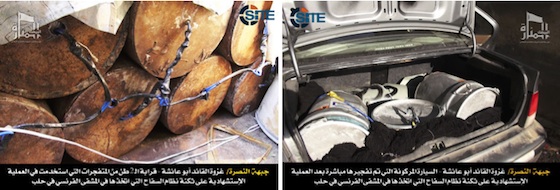
The Al Nusrah Front shows the suicide car bomb used to attack
the French hospital in Aleppo. Images from the SITE Intelligence Group
By Bill Roggio - November 23, 2012 - LWJ

The Al Nusrah Front shows the suicide car bomb used to attack the French hospital in Aleppo. Images from the SITE Intelligence Group.

The Al Nusrah Front for the People of the Levant, an al Qaeda-linked jihadist group that is fighting Bashir al Assad's regime in Syria, has claimed credit for yet another suicide attack as well as another joint operation with Chechen fighters.

Al Nusrah claimed the attacks in a series of three statements released on jihadist websites on Nov. 21. The statements were translated by the SITE Intelligence Group.

The suicide attack took place at a hospital in the contested city of Aleppo. Al Nusrah said the "French hospital" was being used as "the headquarters of the army and the tyrant's [thugs]." The terror group did not provide a date for the attack.

The suicide attack was executed by "the knight Abu 'Aun al Shamali," who used a car bomb "laden with 2 tons of explosives." The statement was accompanied by pictures of the car bomb as well as the explosion at the hospital. Al Nusrah then detonated a car bomb parked outside the hospital and launched "an armed attack by a group of mujahideen on what remained of the headquarters."

Al Nusrah has been the most active jihadist group in Syria. It has claimed credit for 36 of the 44 reported suicide bombings in Syria that the The Long War Journal has tallied since December 2011 [see list below]. Since the end of August, Al Nusrah has claimed credit for launching 18 suicide attacks.


Read more: http://www.longwarjournal.org/archives/2012/11/al_nusrah_front_clai_8.php#ixzz2D8j7xhm4
Enhanced by Zemanta

Sunday, November 11, 2012

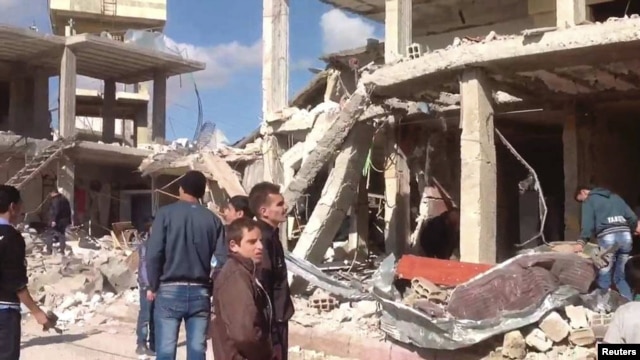
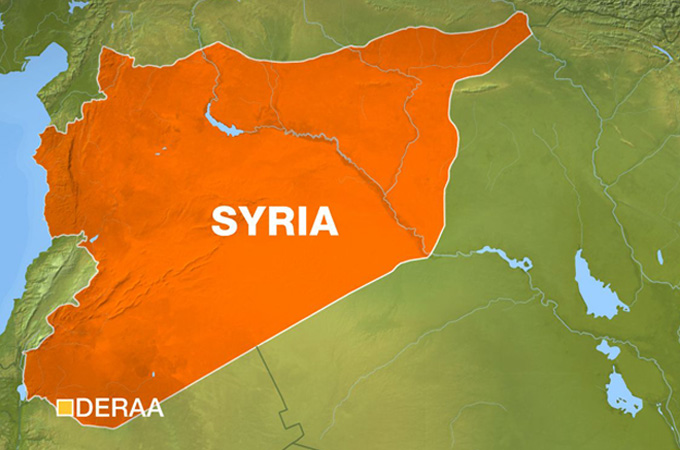
Suicide bombers kills 20 Syria troops


A pair of suicide bombers killed an estimated 20 Syrian soldiers in an attack in the city of Daraa, near the Jordanian border. Today's suicide attack is the 40th of its kind in Syria in less than a year.
The suicide bombers attacked a military camp in Daraa that is used by the military and intelligence forces fighting for Syrian President Bashir al Assad. Members of the Syrian Observatory for Human Rights told Al Jazeera and Reuters that the dual suicide attack was followed up with mortars and gunfire.
The Syrian Arab News Agency, the state-run news service loyal to Assad, claimed that "terrorists on Saturday detonated three car bombs in the city of Daraa, causing the martyrdom of 7 citizens." SANA claimed that the bombings took place in two separate areas, against civilians.
The suicide attack is the second reported in Syria in the past week. On Oct. 5, a suicide bomber reportedly killed 50 Syrian soldiers in an attack on a military base in Hama in the north.
No terrorist group has claimed credit for today's suicide attack in Daraa or Monday's bombing in Hama.
Several Islamist groups operate in Syria, including the Al Nusrah Front, Al Qaeda in Iraq, the Abdullah Azzam Brigades, the Al Baraa Ibn Malik Martyrdom Brigade, and the Omar al Farouq Brigade.
The al Qaeda-linked Al Nusrah Front has been the most active in Syria. It has has claimed credit for 31 of the 40 known suicide bombings in Syria that the The Long War Journal has tallied since December 2011. Since the end of August, Al Nusrah has claimed credit for launching 13 suicide attacks. For more information on the suicide attacks in Syria, see LWJ report, Suicide bombings become commonplace in Syria , and Threat Matrix report Al Nusrah Front claims 4 more suicide attacks in Syria.
The Al Nusrah Front is known to conduct joint operations with the Free Syrian Army, which is often upheld as the secular resistance to Assad's regime. Recently, on Oct. 11, Al Nusrah, the Free Syrian Army, and Chechen fighters overran a Syrian air defense and Scud missile base in Aleppo. Al Nusrah has become more appealing to Syrian rebels as they are better organized and have expertise from waging jihad in Iraq and elsewhere, and have integrated their operations with the Free Syrian Army.
Foreign jihadists have begun to pour into Syria to wage jihad against Assad's regime. Fighters from Morocco, Algeria, Tunisia, Libya, Egypt, Jordan, and the Palestinian Territories are known to have been killed in Syria. Recently, two of Abu Musab al Zarqawi's cousins were detained by Jordanian security forces after fighting in Syria.
Jihadists from the UK may be flocking to the Syrian battlefields as well. Earlier this week, The Times reported that authorities had identified a Bangladeshi resident of London as the leader of a group of British jihadists seeking to fight in Syria. Scotland Yard has seized computers and mobile phones from members of the group, which consists mainly of Londoners and includes seasoned Chechen fighters.

Read more: http://www.longwarjournal.org/archives/2012/11/suicide_bombers_kill_9.php#ixzz2BrutKyU6
Enhanced by Zemanta

Saturday, October 27, 2012

Al Qaeda's Zawahri calls for kidnap of Westerners

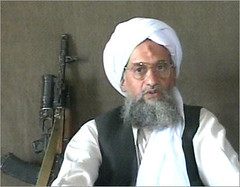
Ayman al Zawahiri
Ayman al Zawahiri (Photo credit: fotosinteresantes)
(Reuters) - Al Qaeda leader Ayman al-Zawahri has called on Muslims to kidnap Westerners, join Syria's rebellion and to ensure Egypt implements sharia, SITE Monitoring reported on Saturday, citing a two-part film posted on Islamist websites.

The Egypt-born cleric, who became al Qaeda leader last year after the death of Osama bin Laden, spoke in a message that lasted more than two hours.

"We are seeking, by the help of Allah, to capture others and to incite Muslims to capture the citizens of the countries that are fighting Muslims in order to release our captives," he said, praising the kidnapping of Warren Weinstein, a 71-year-old American aid worker in Pakistan last year.

Zawahri's message was first released on Wednesday, SITE said, just two weeks after the cleric issued a filmed statement calling for more protests against the United States over a California-made film mocking the Prophet Mohammad.

In his new message, he called on Muslims to ensure Egypt's revolution continued until sharia law was implemented and urged fellow Muslims to join the uprising against President Bashar al-Assad in Syria.

The release of his message had been delayed, he said, because of the "conditions of the fierce war" in Afghanistan and Pakistan where he said U.S.-led forces had intensified a bombing campaign.

U.S. President Barack Obama, whom Zawahri described as a "liar" and "one of the biggest supporters of Israel", has stepped up the use of unmanned drones to target militants in both countries as well as in Yemen.

"A LICENCE TO KILL"

In a further attack on Western governments and international institutions, Zawahri accused world powers of giving Syrian President Assad "a licence to kill" his opponents.

"The U.N., Kofi Annan and the Arab League give the al-Assad regime one opportunity after another to end the rising of jihadi, popular resistance against his oppression, injustice, corruption and spoiling," SITE reported Zawahri as saying.

Syria's anti-government rebels include Islamist groups that draw on foreign fighters.

"I incite Muslims everywhere, especially in the countries that are contiguous to Syria, to rise up to support their brothers in Syria with all what they can and not to spare anything that they can offer," he said.

Zawahri, who led the Egyptian Islamic Jihad movement before joining al Qaeda, called on President Mohamed Mursi, the country's new Islamist leader, to explain his policies on Israel, Egyptian Christians and sharia law.

Islamist militants want Egypt to introduce sharia and to tear up a 1979 peace treaty with Israel and were dismayed when Mursi said he would appoint a Coptic Christian vice president.

"The battle in Egypt is very clear. It is a battle between the secular minority that is allied with the church and that is leaning on the support of the army, who are made up by (former President Hosni) Mubarak and the Americans ... and the Muslim ummah (nation) in Egypt that is seeking to implement sharia," he said.

from REUTERS
DUBAI | Sat Oct 27, 2012 9:44am BST
(Reporting By Angus McDowall; Editing by Myra MacDonald and Andrew Osborn)

Enhanced by Zemanta

Thursday, October 4, 2012

Turkey hits targets inside Syria after border deaths

Turkish artillery has renewed firing at targets in Syria after shells from across the border on Wednesday killed five Turkish nationals.

Several Syrian troops were killed by Turkish fire, activists from the Syrian Observatory for Human Rights said.

Turkey's border town of Akcakale was shelled, apparently by Syrian government forces, on Wednesday, killing a woman and three children.

The UN Security Council is due to meet later to condemn Syria's actions.

Ankara's response marks the first time it has fired into Syria during the 18-month-long unrest there.

Turkey also asked the UN Security Council to take "necessary action" to stop Syrian "aggression".

Meanwhile, Nato envoys held an urgent meeting in Brussels at the request of Turkey, who is a member of the military alliance.

The bloc issued a statement saying it "continues to stand by Turkey and demands the immediate cessation of such aggressive acts against an ally, and urges the Syrian regime to put an end to flagrant violations of international law".

The government in Ankara is expected to ask parliament shortly to authorise cross-border military operations in Syria, Turkish media report.

The Turkish armed forces have in the past moved into northern Iraq in pursuit of Kurdish militants who had bases there.

Read more: http://www.bbc.co.uk/news/world-middle-east-19822253

from BBC
4 October 2012 Last updated at 07:57 GMT

Enhanced by Zemanta

Friday, August 24, 2012

Turkish troops kill 21 PKK militants in clashes

PKK fighters stand near the Qandil mountains near the Iraq-Turkish border. — File Photo by Reuters
DIYARBAKIR: Turkish soldiers killed five Kurdish rebels who attacked state buildings in a town in southeast Turkey on Thursday evening, bringing to 21 the number of militants killed since they launched a deadly bomb attack on an army convoy a day earlier.
The clashes underscore a growing cycle of violence in the remote, mountainous province of Hakkari bordering Iraq and Iran, a development which Turkish officials and analysts are linking to the conflict in nearby Syria.

Security officials said Kurdistan Workers Party (PKK) rebels launched simultaneous raids on Thursday on two military posts in Hakkari’s Semdinli district, the scene of frequent clashes between rebels and government forces over the last month.

At least one soldier had been killed in those attacks.

Later on Thursday evening, the PKK attacked a police station and state offices in the centre of Semdinli and five militants were killed in those attacks, the officials said.

The attacks came only hours after government officials said Turkish troops had killed 16 PKK fighters in an offensive targeting militants who killed five soldiers and wounded seven on Wednesday in a bomb attack on their convoy in Semdinli.

Officials said the army had sent in troop reinforcements and helicopter gunships after Wednesday’s attack.

In a sign of Ankara’s concern over the violence in the mainly Kurdish region, the commander of the military’s land forces arrived in Hakkari on Thursday. General Hayri Kivrikoglu said the army’s operations would continue “without pause”.

“We always stand by our people. Our people should not worry.

The Turkish armed forces will continue in its duty to protect the security of the people and the region,” Kivrikoglu was quoted as saying on state media Anatolian’s website.

It was not immediately clear whether Kivrikoglu was still in Hakkari when the militants launched their latest attacks.

More than 40,000 people have been killed in the conflict between the PKK and Turkish forces since the militants launched their insurgency 28 years ago with the aim of carving out a separate state in mainly Kurdish southeastern Turkey.

The PKK has since scaled back its demands to political autonomy and more cultural rights for Turkey’s estimated 14 million ethnic Kurds.

Since June last year, nearly 800 people have died in the conflict, including about 500 PKK fighters, more than 200 security personnel and about 85 civilians, according to estimates by think-tank International Crisis Group.

The conflict is focused in the mountainous region bordering Iraq and Iran, but the PKK has also carried out attacks in Turkish cities. Officials blamed it for a car bombing on Monday which killed nine people in the city of Gaziantep, near Turkey’s southeastern border with Syria.

The PKK, listed as a terrorist organisation by Turkey, the United States and the European Union, has denied involvement in that attack.

Prime Minister Tayyip Erdogan has accused Syrian President Bashar al-Assad of backing PKK fighters and has warned of military intervention in Syria if the group uses Syrian territory to threaten Turkey.

Although the Turkish southeast is a frequent scene of Kurdish rebel attacks, Wednesday’s bombing that killed nine people in previously unaffected Gaziantep city has sparked national fury, as well as suspicions of a Damascus hand behind the incident.

“It’s known that the PKK works hand in hand with Syria’s intelligence organisation Al-Mukhabarat,” claimed ruling Justice and Development Party (AKP) deputy chairman Huseyin Celik following the blast, referring to the rebel Kurdistan Workers’ Party.

Syrian President Bashar al-Assad “is inclined to see Turkey’s enemy the PKK as a friend on the basis that ‘my enemy’s enemy is my friend,’” he told the daily Hurriyet.

The Kurdish separatist movement has denied charges that it was involved in the bombing that left civilian casualties, including four children, but Ankara insists it reflected the handiwork of the rebels.

Assad is orchestrating the PKK attacks to send a “warning” to the Turkish government to reconsider its policies of assisting his own enemies, columnist Deniz Zeyrek wrote in the daily Radikal.

Another columnist, Asli Aydintasbas of the daily Milliyet, also suggested that the PKK targeted Gaziantep in a blow at the Turkish government’s Syria policy.

Speaking to the Turkish daily Cumhuriyet in early July, Assad rejected claims that his regime was using the PKK to undermine Ankara, while making it clear that it was angry with Turkey.

from DAWN
Enhanced by Zemanta

Wednesday, June 27, 2012

Gunmen storm pro-government Syrian TV channel - state TV

(Reuters) - Gunmen stormed the headquarters of a pro-government Syrian TV news channel on Wednesday morning, planted explosives and killed three employees, state media said.

"The terrorists planted explosive devices in the headquarters of al-Ikhbariya following their ransacking of the satellite channel studios, including the newsroom which was entirely destroyed," the state media said.

"Three colleagues were killed as a result of the brutal terrorist attack," it added, without giving details.

The Syrian press is tightly regulated by the Ministry of Information. Although Ikhbariya is privately owned, opponents of President Bashar al-Assad say it is a government mouthpiece.

During the 16-month-old pro-democracy revolt against the Assad family's four-decade rule, Ikhbariya has been pushing to counter what it says is a campaign of misinformation by western and Arab satellite channels on the uprising, which it describes as a foreign-backed terrorist conspiracy.

Ikhbariya resumed broacasting shortly after the attack.

(Reporting by Oliver Holmes, editing by Tim Pearce)
BEIRUT | Wed Jun 27, 2012 7:12am BST


Enhanced by Zemanta

Friday, April 27, 2012

7 killed, 20 wounded in blast in Damascus

Damascus Governorate on Syria Map with Governo...
Damascus Governorate on Syria Map with Governorates.  (Photo credit: Wikipedia)
DAMASCUS, April 27 (Xinhua) -- At least 7 people were killed and 20 others injured when an explosion occurred Friday near a mosque in the heart of the Syrian capital Damascus, the latest in a string of explosions that rattled the city on the weekend, the state-run SANA news agency reported.

The blast ripped through al-Midan neighborhood near Zain al- Abidin mosque, said the report.

Preliminary speculations indicated that a suicide bomber detonated himself near a security agent's bus, pro-government media said.

After the explosion unknown gunmen opened fire at people who gathered around the scene, said SANA.

Al-Midan area was hit by a deadly explosion on Jan. 6. The explosion ripped through a busy intersection in the neighborhood and killed at least 25 people.

Friday's blast came following a number of explosions that occurred Friday morning in Syria.
Enhanced by Zemanta

Tuesday, April 24, 2012

Car bomb wounds 3 in central Damascus

A pool of blood is pictured next to a damaged car after a bomb exploded in Damascus in this handout released by Syria's national news agency SANA April 24, 2012. REUTERS Photo
A car bomb exploded in central Damascus on Tuesday, wounding three people, state television reported, blaming an "armed terrorist group".

"An armed terrorist group detonated the car bomb near the Yelbugha complex in the Marjeh district of Damascus, wounding three people and causing damage to nearby buildings," the television said.

The blast came as the Syrian Observatory for Human Rights said violence across the country killed nearly 60 people on Monday, despite a fragile ceasefire that went into effect April 12.

The Syrian capital has been the scene of several car bombs in recent months that have mainly targeted security installations.


Enhanced by Zemanta

In Syria, Lebanon’s Most Wanted Sunni Terrorist Blows Himself Up

Lebanese terror leader Abdel Ghani Jawhar detonated himself accidentally in Syria, raising questions about the kind of company the rebels are keeping

By Aryn Baker and Rami Aysha/Beirut
from globlaspin

Abdel Ghani Jawhar
When one of Lebanon’s most wanted terrorists kills himself while planting a bomb it is cause for at least some sort of grim celebration. But when the chief bomb-maker of the country’s most notorious terror group self detonates while helping rebels fight in Syria, it is cause for concern.

TIME has learned that Abdel Ghani Jawhar, one of the leaders of the Sunni fundamentalist terror group Fatah al-Islam, died in the Syrian city of Qsair on Friday night. The founding cleric of Fatah al Islam, Sheikh Osama al Shihabi, confirmed Jawhar’s death to TIME with a quote from the Koran: “‘We are for God and to him we return.’ We as Mujahideen are used to being killed and if God wants to give those killed dignity he gives them martyrdom. This is the path of righteousness.”

This is not the first time that Jawhar is thought to have been killed; several previous death announcements have been retracted over the years. News of his death has been relayed by multiple—and unrelated—sources in both Syria and Lebanon. According to a fellow fighter, who goes by the nom de guerre Abu Ali, Jawhar had been preparing an explosive device to be used against the Syrian army, which had been attempting to enter the rebel-dominated town not far from Homs. As Abu Ali narrated the tale over Skype, the sound of bombs and explosions could be heard in the background. Jawhar’s bomb went off prematurely, says Abu Ali. “He was killed directly. We wanted to send his body back to Lebanon but we couldn’t because it was torn into pieces.” Instead Jawhar’s fellow fighters were forced to bury what was left of him in a neighboring garden because it was impossible to reach the graveyard during heavy fighting.

According to Abu Ali and another fellow fighter, Jawhar arrived in Qsair two weeks ago with a group of 30 Lebanese fighters. While many were members of Fatah al-Islam, they were not traveling under the terror group’s banner. Instead they called themselves mujahideen, holy warriors seeking to help fellow Muslims under attack by the Syrian regime. Jawhar, an explosives expert and a charismatic commander, sought to train fellow fighters how make bombs. In the short time he had been in Qsair, says Abu Ali, he was able to set up dozens of improvised explosive devices destined for members of the Syrian security forces. “His aim was to make a tour in all the districts of Syria to teach the fighters on how to fight a guerrilla war.”

For his efforts, Abu Ali calls Jawhar a hero and a martyr. For Syrian rebels seeking international assistance in their battle to force Syrian President Bashar Assad out of office, it’s a public relations headache. The Free Syrian Army, as well as other Syrian resistance groups, has long sought to downplay regime accusations that the rebels are aligned with Islamic fundamentalists and pro-al-Qaeda groups. While Fatah al-Islam has denied any association with al-Qaeda, there are links between the group and individual members. The implication that an al-Qaeda affiliated group is helping Syrian rebels build bombs and foment a guerrilla war could radically alter perceptions in the West, bringing to a halt discussions of arming the rebels and establishing a no-fly zone. “The death of Jawhar on Syrian soil emphasizes the fears of the international community that if they gave weapons to the Syrian rebels they will end up in the hands of radical groups,” says Lebanese University professor and Fatah al-Islam expert Talal Atrissi. “The Syrian opposition will be embarrassed from the fact that such a man is fighting alongside the rebels.”
Enhanced by Zemanta

Search this blog