Thursday, February 9, 2012

R.I.P. - Sgt. 1st Class Billy A. Sutton

DOD Identifies Army Casualty


            The Department of Defense announced today the death of a soldier who was supporting Operation Enduring Freedom.

            Sgt. 1st Class Billy A. Sutton, 42, of Tupelo, Miss., died Feb. 7 in Uruzgan province, Afghanistan.   He was assigned to the 223rd Engineer Battalion, 168th Engineer Brigade, Mississippi National Guard, West Point, Miss.

            For more information the media may contact Tim Powell at 601-313-6184.

---
from WTVA

TUPELO, Miss. (WTVA) -- A Mooreville soldier has died while serving in Afghanistan.

The U.S. Department of Defense reports Sgt. 1st Class Billy A. Sutton, 42, died Feb. 7 in Uruzgan, Afghanistan.  

He was assigned to the 223rd Engineer Battalion, 168th Engineer Brigade, based in West Point.

A National Guard spokesman says Sgt. Sutton was a part of the 288th Engineer Sapper Company which deals with explosives.

The 223rd deployed for active duty in October and his unit was reportedly expected to return to the U.S. in the fall of 2012.
Enhanced by Zemanta

NATO air raid kill 8 Afghan civilians in Kapisa province

Map of Kapisa Province.
Image via Wikipedia
According to local authorities in eastern Afghanistan, at least 8 Afghan civilians were killed following an air raid by International Coalition forces in eastern Kapisa province.

The officials further added, the incident took place in Nejrab district of eastern Kapisa province.

A number of local residents said, the civilians were killed while they were feeding their animals on a mountain in Giawa in Nejrab district.

In the meantime Kapisa provincial security chief Abdul Hamid said, the identities of those killed during the air raid is not recognized yet.

He also said, investigations have been put in place to find out the facts behind the incident.

from KHAAMA
Enhanced by Zemanta

Explosion in Helmand kill and injure 3 Afghan police

According to local authorities in southern Afghanistan, at least 3 Afghan National police service members were killed and injured following an explosion in southern Helmand province on Thursday.

The officials further added, the incident took place around 10:30 am local time killing at least 2 Afghan police and injuring 1 other.

Provincial governor spokesman Daud Ahmadi confirming the report said, the incident took place after an explosive device planted in a road culvert went off at Lashkargah city.

Mr. Ahmadi further added, Afghan police forces were struggling to defuse the roadside bomb when the explosion took place.

No group including the Taliban militants have so far claimed responsibility behind the incident.

Taliban militants frequently use improvised explosive device and roadside bombs to target Afghan and coalition security forces.

from KHAAMA
Enhanced by Zemanta

US Predators strike again in Miramshah


Unmanned US drones struck in Pakistan's Taliban-controlled tribal agency of North Waziristan for the second time in 24 hours, killing four "militants," including a senior Taliban leader linked to al Qaeda.

The Predators or the more heavily armed Reapers fired a pair of missiles at a compound in Miramshah, the main town in North Waziristan today, according to AFP and Geo News.

Pakistani intelligence officials said that Badr Mansoor, a Taliban commander with close ties to al Qaeda, was killed in the strike. Mansoor rain training camps in the area and sent fighters to battle NATO and Afghan forces across the border, according to AFP. One Pakistani official told AFP that Mansoor was al Qaeda's chief in Pakistan. A US intelligence official said he was a member of al Qaeda's leadership council for Pakistan.

The Haqqani Network, a Taliban group that operates in North Waziristan as well as in eastern Afghanistan, administers the area where today's attack took place. Al Qaeda leaders and operatives, who are closely allied with the Haqqani Network, shelter in the area, as do other terror groups.
The strike is the second in 24 hours. Earlier today, the CIA-operated drones killed 10 Haqqani Network and Central Asian fighters in an attack on a compound in the village of Tappi, just outside of Miramshah.

The US has carried out five strikes in North Waziristan since Jan. 11. All five strikes took place in and around Miramshah. The Jan. 11 strike was the first in 55 days. The program was put on hold following a clash between US forces and Pakistani Frontier Corps troops on the border of the Afghan province of Kunar and the Pakistani tribal area of Mohmand on Nov. 25-26. The US troops struck in Pakistan after taking mortar and machine gun fire on the Afghan side of the border from Pakistani troops. Twenty-four Pakistani Frontier Corps troops were killed. The pause was the longest since the program was ramped up at the end of July 2008 [see LWJ report, US drone strikes in Pakistan on longest pause since 2008].

The Jan. 11 strike killed Aslam Awan, a deputy to the leader of al Qaeda's external operations network. Awan was a Pakistani citizen from Abbottabad, the same town where Osama bin Laden was killed by US forces in a cross-border raid in May 2011. Awan is the most senior al Qaeda leader killed in a drone strike since mid-October, when Abu Miqdad al Masri, a member of al Qaeda's Shura Majlis who also was involved in al Qaeda's external operations, was killed. [For a list of senior terrorist leaders and operatives killed in drone strikes, see LWJ report, Senior al Qaeda and Taliban leaders killed in US airstrikes in Pakistan, 2004 - 2012.]

Abu Zubaydah al Lubnani, a Lebanese al Qaeda operative who operates along the Afghan-Pakistani border, has said that while the drones have "delayed some operations or even stopped them," the terror group is still functioning in the region.

"I want here to confirm that Qaedat al-Jihad is still standing in Khorasan, solid and strong, despite what hit it, and it is still producing operations and it doesn't know the path of despair...," Lubnani said in statement that was recently released on jihadist forums. The statement was translated by the SITE Intelligence Group.

Read more: http://www.longwarjournal.org/archives/2012/02/us_predators_strike_34.php#ixzz1ltne2gRk
Enhanced by Zemanta

Feb.09., 2012. - ISAF Joint Command Morning Operational Update

KABUL, Afghanistan (Feb. 09) – In Panjwa’i district, Kandahar province, a combined Afghan and coalition security force discovered a drug cache during an operation yesterday.

The cache consisted of approximately 2,534 pounds (1,152 kilograms) of marijuana.

The security force confiscated the drugs and destroyed them without incident.

In other International Security Assistance Force news throughout Afghanistan:

South
An Afghan and coalition security force captured a Taliban facilitator during an operation in Nawa district, Helmand province, today. The leader provided insurgent fighters with weapons and coordinated attacks in Washer and Nahr-e Saraj districts. One additional suspected insurgent was detained.

East
In Shinwar district, Nangarhar province, an Afghan and coalition security force captured a Taliban leader during an operation today. The leader specialized in explosives and conducted multiple attacks in Shinwar district. Several suspected insurgents were also detained during the operation.
Enhanced by Zemanta

Wednesday, February 8, 2012

Suicide bomber kills 9 in Mogadishu


A Shabaab suicide bomber killed nine Somalis today in an attack outside a hotel in Mogadishu. From Reuters:
A suicide car bomber killed at least nine people Wednesday near a hotel where lawmakers often gather in the Somali capital Mogadishu, police said. Police officer Hassan Ali told Reuters the attacker rammed his vehicle into a cafe by the Hotel Muna, which was also stormed by al Shabaab militants in August 2010 in an attack that killed more than 30 people.
"So far we have carried nine dead civilians and 34 others injured. Up to now we have not seen casualties of any legislators. The death toll may rise," said Ali.
Police and the spokesman for African Union troops in Somalia said initial reports showed that the attacker first opened fire on people sitting near the hotel before detonating the car.
The Aug. 24, 2010 suicide assault on the Hotel Muna was a particularly brazen effort by Shabaab, and was one of several in which Shabaab used a complex attack to target Somali officials. Shabaab has emulated the tactics of other al Qaeda affiliates and allies, including al Qaeda in the Arabian Peninsula, al Qaeda in the Islamic Maghreb, al Qaeda in Iraq, and the Afghan and Pakistani Taliban.
Shabaab has carried out more than 30 major suicide attacks in Somalia since September 2006, when its predecessor, the Islamic Courts Union, usurped control of the government (the Islamic Courts was ousted from power in an invasion by Ethiopian forces in December 2006). Several of the attacks have been carried out by American and British citizens who had left their home countries to join Shabaab.
Shabaab has also executed one suicide attack outside Somalia. A double suicide bombing on July 11, 2010 in Kampala, Uganda, killed 74 people. The suicide cell that carried out the attack, the Saleh ali Nabhan Brigade, is named after the al Qaeda leader who served as Shabaab's military commander before he was killed in a US special operations raid in September 2009.

Read more: http://www.longwarjournal.org/threat-matrix/archives/2012/02/suicide_bomber_kills_9_in_moga.php?utm_source=twitterfeed&utm_medium=twitter#ixzz1lpG3paa9
Enhanced by Zemanta

Pakistani militant detained in southern Kandahar province

According to local authorities in southern Afghanistan, a Pakistan militant suspected was detained along with explosives in southern Kandahar province.

Provincial governor media office following a press release said, Afghan police forces arrested the suspected militant along with a motorcycle packed with explosives at the first district of southern Kandahar province on Tuesday.

The source further added, the detained militant is resident of Quetta and was recognized as Mohammad Bakhsh.

Kandahar provincial governor media office following the press release also added, Afghan police forces seized another motorcycle packed with explosives in a separate operation at Zherai district of southern Kandahar province while Afghan police force seized at least 20 kgs  of explosives in 8 district of southern Kandahar city.

In the meantime officials in eastern Ghazni province announced at least two armed militants were killed following clashes with the Afghan security forces in Qarabagh district.

Armed militant groups yet to comment regarding the reports.

from KHAAMA
Enhanced by Zemanta

Bomb blast kills 2 soldiers in NW Pakistan

Seven agencies of Federally Administered Triba...
Image via Wikipedia
ISLAMABAD, Feb. 8 (Xinhua) -- At least two soldiers were killed and two others injured when their vehicle hit a landmine in Mohmand tribal region in northwest Pakistan on Wednesday, local media reported.

The vehicle carrying an unknown number of paramilitary troops was on routine patrol in Aleem Gar area in Mohmand, one of the seven tribal regions bordering Afghanistan.

No group has claimed responsibility for the attack.

Earlier on January 21, four soldiers were injured in a remote- controlled bomb blast in the very same area.

---
PESHAWAR: Two security personnel were killed and one was injured when an explosion took place during a routine checking in the Safi district of Mohmand Agency, said officials.
According to sources, the two men who were killed were part of the Khasadar force who were on a routine checking in the Alenger area. The injured was shifted to a hospital.
The explosion seemed to be either because of a landmine or an IED (Improvised Explosive Device).
The Safi district is considered to be the homeland of the Taliban in Mohmand Agency prior to the security forces operation that cleared the area.

ftom tribune.com.pk

Enhanced by Zemanta

Al Qaeda releases photos of slain Khorasan commanders

AQ_Khorasan550.jpg
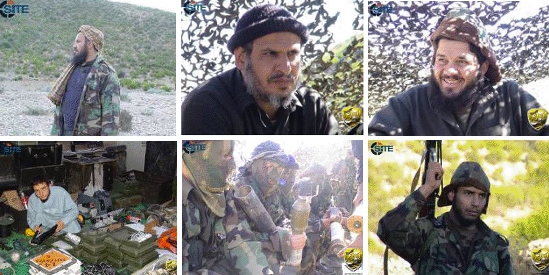
Top left: Abu Laith al Libi; top center: Abdullah Saad al Libi; top right: Abu Abu Abdullah al Shami; bottom left: Abdul Khabir al Turkistani; bottom center: al Qaeda in the Khorasan fighters; bottom right: Soraqa al Kuwaiti. Images from the SITE Intelligence Group.
A jihadist media outlet has released "several previously-unreleased" photographs of senior al Qaeda military leaders and fighters who have been killed during fighting in Afghanistan or in US drone airstrikes in Pakistan's Taliban-controlled tribal agencies.
Pictures of Abu Laith al Libi and Abdullah Said al Libi, two top military commanders; Abu Abdullah al Shami, a leader who escaped from Bagram; and Soraqa
al Kuwaiti and Abdul Khabir al Turkistani, two jihadist fighters, were published on Feb. 4 by the Al Ibda' Foundation for Media Production. The photographs were published as part of a new series called "Pictures from Khorasan, 1," according to the SITE Intelligence Group, which provided a translation of the statement along with the photographs.
Abu Laith al Libi
Abu Laith al Libi was a top-tier al Qaeda leader and a revered military commander. He led al Qaeda's 055 Brigade (or 55th Brigade), the military formation that eventually grew into the Lashkar al Zil, or Shadow Army. Brigade 055 fought alongside the Taliban against the Northern Alliance in the 1990s up until the Sept. 11 2001 attacks on the US. The unit was decimated during the US attack on Taliban and al Qaeda forces in 2001-2002, and was disbanded. Laith reformed the unit, which later became one of six brigades of al Qaeda's Shadow Army, which operates in Afghanistan and Pakistan.
In addition, Abu Laith was the senior leader of the Libyan Islamic Fighting Group and also served as a chief spokesman for al Qaeda. As leader of the Libyan Islamic Fighting Group, he announced the terror group's merger with al Qaeda in November 2007.
US Predators and Reapers killed Abu Laith in an airstrike in the Mir Ali area of North Waziristan on Jan. 29, 2008. Al Qaeda announced his death.
Abdullah Said al Libi
Abdullah Said al Libi was a Libyan national who is thought to have served in his country's military before joining al Qaeda. Once in al Qaeda, he rose in the ranks of the terror group's military, and eventually took command of the Lashkar al Zil.
In April 2009, Abdullah Said laid out the strategy for al Qaeda and the Taliban to retake control of the Khorasan, a region encompassing large areas of Afghanistan, Pakistan, Uzbekistan, Tajikistan, and Iran. In the statement, he is identified as the leader of the Qaidat al-Jihad fi Khorasan, or the Base of the Jihad in the Khorasan.
Abdullah Said was killed in a US drone strike sometime in late 2009 or early January 2010. Mustafa Abu Yazid, al Qaeda's former leader of Afghanistan, who was killed in a later drone strike, mentioned his name while noting the deaths of other top al Qaeda leaders. Yazid said the suicide attack on a CIA base in Khost, Afghanistan, which killed seven CIA operatives and employees along with a Jordanian intelligence official, was designed to "avenge" the deaths of Abdullah Said, former al Qaeda operations chief Saleh al Somali, and former Pakistani Taliban leader Baitullah Mehsud.
Bagram%204.jpg
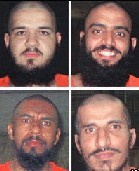
The Bagram Four: Abu Abdallah al Shami [upper left]; Abu Nasir al Qahtan [upper right]; Abu Yahya al Libi [lower left]; Omar al Farouq [lower right].
Abu Abdullah al Shami
Abu Abdallah al Shami was a Syrian national who served as a senior military commander in eastern Afghanistan. He was one of four senior al Qaeda operatives who escaped from Bagram prison on July 10, 2005. Al Qaeda said that al Shami was killed in a US airstrike in Afghanistan sometime in July 2008.
Al Shami escaped from Bagram with top al Qaeda leaders Abu Yahya al Libi, Abu Nasir al Qahtani, and Omar Farouq. Of the four, only Abu Yahya remains free. Yahya is now considered to be al Qaeda's second in command, following the death of Atiyah al Libi in a US airstrike in Pakistan last fall.
British special forces killed Omar Farouq in Basrah, Iraq, in September 2006 after he tried to be reassigned to facilitate the flow of money, weapons, and fighters for al Qaeda in Iraq. Prior to his capture by Indonesian security forces in 2002, Farouq was considered to be al Qaeda's point man in Southeast Asia. In 1994, he helped set up the first al Qaeda training camp in Southeast Asia, in Mindanao in the Philippines. Five years later, in 1999, he took credit for bombing both a mosque and the Philippine ambassador's house in Jakarta.
US forces recaptured Abu Nasir al Qahtani in Khost province in November 2006. Like Shami, Qahtani was a senior al Qaeda military commander in eastern Afghanistan. After his escape from Bagram, Qahtani fled to North Waziristan to continue attacks against NATO and Afghan forces inside Afghanistan. He joined forces with al Qaeda operative Abu Wafa, who operates from the North Waziristan tribal agency in Pakistan. Wafa and Qahtani were active in the Afghan provinces of Khost, Paktia, and Paktika. Qahtani also released propaganda and training videos for terrorists operating in both Afghanistan and Iraq. Qahtani's brother, Abu Dejana al Qahtani, was also killed in eastern Afghanistan in May 2008.
Abdul Khabir al Turkistani and Soraqa al Kuwaiti
Little is known about Abdul Khabir al Turkistani and Soraqa al Kuwaiti. Al Turkistani is pictured in a room filled with explosives and bomb-making materials. Al Kuwaiti is a "deceased fighter who appeared in the fifth episode of As Sahab's video series 'Diaries of a Mujahid,'" according to the SITE Intelligence Group. As Sahab is al Qaeda's official media production outlet.
Enhanced by Zemanta

Feb.08., 2012. - ISAF Joint Command Morning Operational Update

KABUL, Afghanistan (Feb. 08) – An Afghan and coalition security force captured two Taliban leaders during an operation in Lashkar Gah district, Helmand province, today.
One leader planned attacks in Kandahar province, while the second leader conducted roadside bomb and direct-fire attacks against coalition forces.

The security force confiscated bomb-making materials and detained multiple suspected insurgents during the operation.
In other International Security Assistance Force news throughout Afghanistan:
South
In Marjah district, Helmand province, an Afghan and coalition security force conducted an operation in search of a Taliban weapons facilitator today. The facilitator acquires heavy weaponry and ammunition for use by insurgent fighters. Two suspected insurgents were detained during the operation.

East
An Afghan led and coalition supported security force captured a Haqqani Network facilitator during an operation in Terayzai district, Khost province, today. The facilitator coordinated roadside bomb attacks against Afghan forces and moved rockets and explosives in Khost province. The security force confiscated bomb-making materials and detained one additional suspected insurgent during the operation.
 

Enhanced by Zemanta

Search this blog
