Showing posts with label Free Syrian Army. Show all posts

Tuesday, March 26, 2013

Syrian Jihadist Fighters Getting Western Weapons

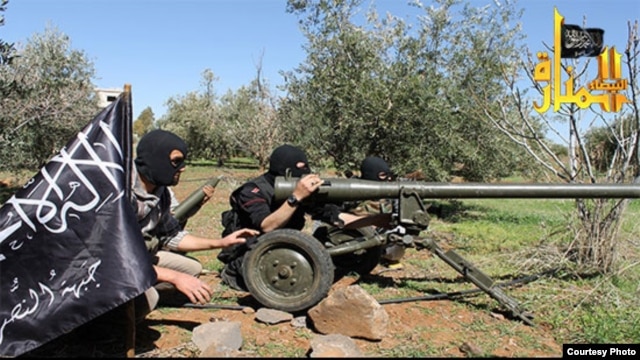
Syria's al-Nusra rebels posted this photo of its fighters using an M-60 anti-tank weapons March 24.

A Syrian rebel group the Obama administration considers a terrorist organization is managing to obtain modern anti-tank weapons meant for other groups fighting to oust President Bashar al-Assad, according to regional experts.

The Jihadist Jabhat al-Nusra militia is managing to secure weapons being supplied by Saudi Arabia and Qatar to rebel brigades affiliated to the Free Syrian Army, the experts say. The Obama administration considers al-Nusra a terrorist organization because of suspected links with al-Qaida.

The weapons include the Croatian-made M79 portable 90 mm anti-tank gun and M60 recoilless anti-tank weapons. Regional experts say Saudi Arabia and Qatar had been supplying such weapons to rebel units more acceptable to the West, mainly secular or nationalist-focused groups such as the Free Syrian Army (FSA) brigades fighting to oust the Assad government.

Croatian-made weapons

According to the experts, the weapons are now appearing in the hands of al-Nusra fighters in videos posted by group on Jihadist websites.

In February, the New York Times first reported that the Saudis were supplying Syrian rebels with arms bought from Croatia. The supply operation was prompted by the fear in the West, and among Gulf allies, that Jihadist groups were better equipped than other rebel units and were increasingly able to dominate the anti-Assad movement.

The newspaper reported Monday that U.S. Central Intelligence Agency consultants were helping Arab nations and Turkey in getting heavy weapons to the Syrian rebels despite Washington’s public stance against supplying such weapons itself.

Citing air traffic data and interviews with unnamed officials and rebel commanders, the Times said the weapons airlift to the rebels had grown to include more than 160 military flights by Jordanian, Saudi and Qatari cargo planes landing at Esenboga Airport near Ankara, and at other Turkish and Jordanian airports.

Reports of CIA assistance

Croatian weaponry believed to be part of those airlifts had been seen being used earlier this year by other Jihadist groups fighting in Syria, but al-Nusra videos posted on the internet this weekend showed for the first time their fighters using the M79 and M60 antitank weapons.

“Neither of these weapons are locally available, either from the black market or looted from the Syrian army because they don't have them,” said British-based weapons researcher, Eliot Higgins, who first spotted the videos. “That's what made them so easy to track; they stand out like sore thumbs in Syria.”

Since announcing its formation in Syria in early 2012, Jabhat al-Nusra has grown rapidly and is considered one of the most effective forces opposing the Assad government.

The rise of al-Nusra, which has homegrown fighters in its ranks as well foreign jihadists drawn from elsewhere in the Middle East, North Africa, and Central Asia, has complicated Western considerations about whether and how to supply arms to the Syrian rebels.

British and French want stepped-up shipments

The British and French governments have been pushing to increase the flow of weapons to the Syrian rebels, but other European nations have resisted, arguing that the equipment could fall into the hands of jihadist groups such as al-Nusra. Critics of the Anglo-French position said the intended recipients of the weapons, the FSA rebel units, worked too closely with al-Nusra to keep the weapons to themselves.

“We were concerned that the FSA is not really a cohesive force with a single command-and-control structure, but is far more a loose alliance of rebel brigades,” says a German diplomat based in Brussels. “We didn’t believe the FSA could or would even bother to police who received any European-supplied weaponry. FSA units fight alongside al-Nusra and other Jihadists.”

Al-Nusra, like other rebel units, also uses weapons it seizes from captured Syrian army facilities.

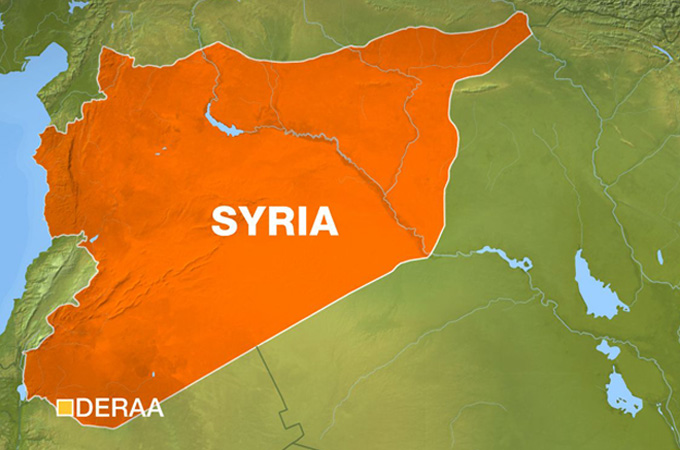
This past Saturday, al-Nusra fighters joined other rebel units in overrunning an air defense base in southern Syria’s Daraa Province near the border with Jordan. Videos posted by al-Nusra appeared to show rebel fighters carting off portable surface-to-air missiles, often called SAMS or MANPADS, for “Man-Portable-Air-Defense-System.”

Syrian rebels have been urging the West and Gulf countries for months to supply the rebellion with such anti-aircraft missiles, but the Obama administration has said “no.” It also has urged allied not to supply such missiles, fearing they would fall into the wrong hands.

But with each capture of Syrian army bases, though, there are opportunities for rebels, Jihadists included, to seize anti-aircraft missiles, Western security officials say.

from VOA News
by Jamie Dettmer, March 25, 2013

Enhanced by Zemanta

Thursday, March 21, 2013

Swedish jihadist killed in Syria while fighting for the Muhajireen Brigade

Abu Kamal (photo from SITE)
By

A Swedish Muslim who entered Syria to wage jihad against President Bashir al Assad's regime was killed while fighting alongside the Muhajireen Brigade (Emigrants Brigade), a group of foreign fighters who are linked to al Qaeda's affiliate in the country.


The Swede, who was identified by his nom de guerre, Abu Kamal As Swedee, was reported killed in a English-language video martyrdom statement that was posted on jihadist-run Facebook and Twitter pages on March 13. The video was discovered by France 24.


Like many foreign jihadists, Abu Kamal traveled to Turkey before entering Syria. Abu Kamal "joined Jaysh Al Hur [Free Army] known as the Free Syrian Army," the supposedly secular group that is known to fight alongside al Qaeda's affiliate in Syria, the Al Nusrah Front. But he became disenchanted with the group as "most of them didn't pray, listened to music, and smoked cigarettes," and returned to Turkey to "meet his old friend Abu Sulayman whom he grew up with [sic]."

Abu Kamal and his friend "met some brothers from the Muhajireen Brigade," includng a "Chechnyan [sic]," or a fighter from the Russian republic of Chechnya, and was convinced that he "felt right at home with the group that consisted of brothers who came to fight for the sake of Allah from around the world."

The Muhajireen Brigade is commanded by a jihadist from the Russian Caucasus who is known as Abu Omar al Chechen. The Chechen commander was praised by the Islamic Caucasus Emirate, a jhadist group that is allied with al Qaeda. Chechen fighters are thought to play a significant role in the Muhajireen Brigade, which has conducted joint operations with the Al Nusrah Front.

Continue & Read more: http://www.longwarjournal.org/archives/2013/03/swedish_jihadist_kil.php#ixzz2OAIHj4OL
Enhanced by Zemanta

Sunday, November 11, 2012

Suicide bombers kills 20 Syria troops


A pair of suicide bombers killed an estimated 20 Syrian soldiers in an attack in the city of Daraa, near the Jordanian border. Today's suicide attack is the 40th of its kind in Syria in less than a year.
The suicide bombers attacked a military camp in Daraa that is used by the military and intelligence forces fighting for Syrian President Bashir al Assad. Members of the Syrian Observatory for Human Rights told Al Jazeera and Reuters that the dual suicide attack was followed up with mortars and gunfire.
The Syrian Arab News Agency, the state-run news service loyal to Assad, claimed that "terrorists on Saturday detonated three car bombs in the city of Daraa, causing the martyrdom of 7 citizens." SANA claimed that the bombings took place in two separate areas, against civilians.
The suicide attack is the second reported in Syria in the past week. On Oct. 5, a suicide bomber reportedly killed 50 Syrian soldiers in an attack on a military base in Hama in the north.
No terrorist group has claimed credit for today's suicide attack in Daraa or Monday's bombing in Hama.
Several Islamist groups operate in Syria, including the Al Nusrah Front, Al Qaeda in Iraq, the Abdullah Azzam Brigades, the Al Baraa Ibn Malik Martyrdom Brigade, and the Omar al Farouq Brigade.
The al Qaeda-linked Al Nusrah Front has been the most active in Syria. It has has claimed credit for 31 of the 40 known suicide bombings in Syria that the The Long War Journal has tallied since December 2011. Since the end of August, Al Nusrah has claimed credit for launching 13 suicide attacks. For more information on the suicide attacks in Syria, see LWJ report, Suicide bombings become commonplace in Syria , and Threat Matrix report Al Nusrah Front claims 4 more suicide attacks in Syria.
The Al Nusrah Front is known to conduct joint operations with the Free Syrian Army, which is often upheld as the secular resistance to Assad's regime. Recently, on Oct. 11, Al Nusrah, the Free Syrian Army, and Chechen fighters overran a Syrian air defense and Scud missile base in Aleppo. Al Nusrah has become more appealing to Syrian rebels as they are better organized and have expertise from waging jihad in Iraq and elsewhere, and have integrated their operations with the Free Syrian Army.
Foreign jihadists have begun to pour into Syria to wage jihad against Assad's regime. Fighters from Morocco, Algeria, Tunisia, Libya, Egypt, Jordan, and the Palestinian Territories are known to have been killed in Syria. Recently, two of Abu Musab al Zarqawi's cousins were detained by Jordanian security forces after fighting in Syria.
Jihadists from the UK may be flocking to the Syrian battlefields as well. Earlier this week, The Times reported that authorities had identified a Bangladeshi resident of London as the leader of a group of British jihadists seeking to fight in Syria. Scotland Yard has seized computers and mobile phones from members of the group, which consists mainly of Londoners and includes seasoned Chechen fighters.

Read more: http://www.longwarjournal.org/archives/2012/11/suicide_bombers_kill_9.php#ixzz2BrutKyU6
Enhanced by Zemanta

Tuesday, April 24, 2012

In Syria, Lebanon’s Most Wanted Sunni Terrorist Blows Himself Up

Lebanese terror leader Abdel Ghani Jawhar detonated himself accidentally in Syria, raising questions about the kind of company the rebels are keeping

By Aryn Baker and Rami Aysha/Beirut
from globlaspin

Abdel Ghani Jawhar
When one of Lebanon’s most wanted terrorists kills himself while planting a bomb it is cause for at least some sort of grim celebration. But when the chief bomb-maker of the country’s most notorious terror group self detonates while helping rebels fight in Syria, it is cause for concern.

TIME has learned that Abdel Ghani Jawhar, one of the leaders of the Sunni fundamentalist terror group Fatah al-Islam, died in the Syrian city of Qsair on Friday night. The founding cleric of Fatah al Islam, Sheikh Osama al Shihabi, confirmed Jawhar’s death to TIME with a quote from the Koran: “‘We are for God and to him we return.’ We as Mujahideen are used to being killed and if God wants to give those killed dignity he gives them martyrdom. This is the path of righteousness.”

This is not the first time that Jawhar is thought to have been killed; several previous death announcements have been retracted over the years. News of his death has been relayed by multiple—and unrelated—sources in both Syria and Lebanon. According to a fellow fighter, who goes by the nom de guerre Abu Ali, Jawhar had been preparing an explosive device to be used against the Syrian army, which had been attempting to enter the rebel-dominated town not far from Homs. As Abu Ali narrated the tale over Skype, the sound of bombs and explosions could be heard in the background. Jawhar’s bomb went off prematurely, says Abu Ali. “He was killed directly. We wanted to send his body back to Lebanon but we couldn’t because it was torn into pieces.” Instead Jawhar’s fellow fighters were forced to bury what was left of him in a neighboring garden because it was impossible to reach the graveyard during heavy fighting.

According to Abu Ali and another fellow fighter, Jawhar arrived in Qsair two weeks ago with a group of 30 Lebanese fighters. While many were members of Fatah al-Islam, they were not traveling under the terror group’s banner. Instead they called themselves mujahideen, holy warriors seeking to help fellow Muslims under attack by the Syrian regime. Jawhar, an explosives expert and a charismatic commander, sought to train fellow fighters how make bombs. In the short time he had been in Qsair, says Abu Ali, he was able to set up dozens of improvised explosive devices destined for members of the Syrian security forces. “His aim was to make a tour in all the districts of Syria to teach the fighters on how to fight a guerrilla war.”

For his efforts, Abu Ali calls Jawhar a hero and a martyr. For Syrian rebels seeking international assistance in their battle to force Syrian President Bashar Assad out of office, it’s a public relations headache. The Free Syrian Army, as well as other Syrian resistance groups, has long sought to downplay regime accusations that the rebels are aligned with Islamic fundamentalists and pro-al-Qaeda groups. While Fatah al-Islam has denied any association with al-Qaeda, there are links between the group and individual members. The implication that an al-Qaeda affiliated group is helping Syrian rebels build bombs and foment a guerrilla war could radically alter perceptions in the West, bringing to a halt discussions of arming the rebels and establishing a no-fly zone. “The death of Jawhar on Syrian soil emphasizes the fears of the international community that if they gave weapons to the Syrian rebels they will end up in the hands of radical groups,” says Lebanese University professor and Fatah al-Islam expert Talal Atrissi. “The Syrian opposition will be embarrassed from the fact that such a man is fighting alongside the rebels.”
Enhanced by Zemanta

Search this blog