Showing posts with label Gao. Show all posts

Friday, May 10, 2013

Follower of Mohammed al Zawahiri dies in attack in Mali


Abu Obeida Sharif Khattab can be seen in the lower left foreground of this photo. Mohammed al Zawahiri is in the middle. To Zawahiri's left is Sheikh Adel Shehato.
Members of al Qaeda's Shumukh al Islam forum announced on May 4 that four Egyptian jihadists died in a "martyrdom-seeking" operation in Mali, according to the SITE Intelligence Group. One of the Egyptians, Abu Obeida Sharif Khattab, had previously appeared in videos with Mohammed al Zawahiri, the younger brother of al Qaeda emir Ayman al Zawahiri.

The Shumukh al Islam forum participants apparently did not provide any details of the attack. The same day as their announcement, however, four terrorists were killed during an attack near Gao, which is where Khattab died. Two Malian soldiers were killed and several others were wounded.
The Malian army said that a suspicious individual riding a motorcycle was at first stopped. Three militants in a car then opened fire on the Malian soldiers, according to the Associated Press. "That was when the jihadist on the motorcycle set off the bomb that he was wearing," explained Lieutenant Colonel Souleymane Maiga, who heads public relations for the Malian army.

Sharif Khattab was a member of Shumukh al Islam who posted as "Abu Obeida al-Maghribi," according to his fellow forum members. Khattab had tried to join the jihad in the Sinai, Yemen, and Iraq, but was unsuccessful. One member of the forum said that Khattab did make his way to Libya after being released from prison. It is not clear why Khattab was imprisoned.

"After Allah graced him with coming out of the apostate prisons, and the market of jihad opened in Libya, he quickly went there, and Allah did not will that he complete his journey there," a forum member posted. "Then he returned with his determination higher and his longing for jihad increased, until Allah destined him to emigrate."

"After the French invasion of the new home of Islam in Azawad, our brother fought a fight deserving of praise from his brothers, until he was granted martyrdom," another forum member wrote, according to SITE's translation.

Read the full article at Long War Journal: http://www.longwarjournal.org/archives/2013/05/follower_of_mohammed.php#ixzz2SssaQpQP
Enhanced by Zemanta

Thursday, March 7, 2013

R.I.P. - Brigadier-chef Wilfried Pingaud (FR)(Mali,Operation Serval)

some translation with g**gle:

January 21, 2013, it is projected through the operation SERVAL, Mali, as an assistant computer operator ATLAS. March 6, 2013, in the early morning, a detachment of the Malian army conducting search operations and recognition has been attacked by terrorist groups in the region of Tin Keraten, northeast of Imenas to one hundred kilometers from Gao. During the clash, the sergeant Pingaud inserted with the battalion in Mali, was fatally wounded. Transported to the field hospital Gao advanced to be made​​, it is unfortunately died of his injuries a few hours later.
---

IN MEMORIAM : Brigadier-chef Wilfried Pingaud

Né le 23 novembre 1976, le brigadier-chef de première classe Wilfried PINGAUD aura servi la France durant près de 18 ans. A 18 ans, le 4 avril 1995, il signe un contrat d’engagé volontaire de l’armée de Terre pour cinq ans au titre du 68e régiment d’artillerie d’Afrique (68e RAA). A l’issue de sa formation initiale, il rejoint la 2e batterie du 68e RAA en tant que servant artillerie. Il se distingue alors immédiatement par son goût de l’effort et fait preuve de belles qualités humaines. Le 13 juillet de la même année, il obtient brillamment le certificat technique élémentaire (CTE) spécialité « mortier lourd » avant d’être élevé le 1er décembre 1995 à la distinction de 1re classe.

Désigné pour partir en mission de courte durée à Mayotte de février à juin 1996, il obtient durant son séjour le certificat technique élémentaire spécialité « Choc et Feu », démontrant par la même occasion un excellent état d’esprit et de très bonnes aptitudes militaires.

En avril 1997, il rejoint avec sa batterie la République Centrafricaine comme conducteur poids lourd au sein de l’équipe munitions. De retour au régiment après quatre mois de mission, ses états de services sont récompensés par une promotion au grade de brigadier le 1er décembre 1998.

Polyvalent, soucieux d’élargir ses compétences, il sert alors comme cuisinier au sein de la 2e batterie puis rejoint la 11e batterie et le cercle mess le 1er février 1999. Le 17 mars 1999, il réussit avec brio le certificat technique élémentaire spécialité « restauration collective ». Faisant preuve d’une très grande disponibilité et d’une remarquable ardeur au travail, il devient rapidement un adjoint de valeur du chef de cuisine.

En séjour en Polynésie de février à mai 2000, il est un exemple pour les plus jeunes et démontre de grandes capacités d’initiative. Ses belles qualités militaires et techniques lui valent la promotion au grade de brigadier-chef le 1er octobre 2000 et, le 1er novembre de la même année, il est déclaré titulaire du certificat d’aptitude technique du premier degré « Mortier lourd ».

De septembre à novembre 2002, il effectue un séjour en Afghanistan au titre de l’opération PAMIR – mandat EPIDOTE comme aide moniteur à l’instruction de l’armée nationale afghane (ANA) ; il s’investit sans compter dans sa mission et obtient d’excellents résultats, mettant à profit ses connaissances étendues en artillerie. Son travail est unanimement reconnu et récompensé par l’attribution du certificat d’aptitude technique du 2e degré spécialité « pointeur mortier » le 31 décembre 2002. De retour en régiment, il occupe le poste de conducteur poids lourd et magasinier et est promu au grade de brigadier-chef de 1re classe le 4 avril 2006.

Le 1er janvier 2009, il rejoint le groupement de soutien de la base de défense (GSBDD) de La Valbonne nouvellement créé, où il exerce la fonction de permanent du bureau tir. Exemplaire en toutes circonstances, doté d’une excellente condition physique, il donne entière satisfaction. Le 1er septembre 2011, avec le transfert du bureau tir du camp de La Valbonne, il est de nouveau affecté au 68e régiment d’artillerie d’Afrique.

Le 21 janvier 2013, il est projeté dans le cadre de l’opération SERVAL, au Mali, en tant qu’adjoint pupitreur ATLAS. Le 6 mars 2013, en début de matinée, un détachement de l’armée malienne conduisant des opérations de fouilles et de reconnaissance a été pris à partie par des groupes terroristes dans la région de Tin Keraten, au nord-est d’Imenas, à une centaine de kilomètres de Gao. 

Au cours de cet accrochage, le brigadier-chef PINGAUD, inséré auprès du bataillon malien, a été mortellement touché. Transporté vers l’antenne chirurgicale avancée de Gao afin d’y être opéré, il est malheureusement décédé des suites de ses blessures quelques heures après.

Il est le quatrième soldat français à mourir au combat depuis le lancement de l’opération Serval.
Le brigadier-chef de première classe Wilfried PINGAUD était titulaire de la médaille d’or de la défense nationale, de la médaille commémorative française avec agrafe Afghanistan et de la médaille d’outre-mer avec agrafes République du Congo et République Centrafricaine.

Agé de 36 ans, le brigadier-chef de première classe Wilfried PINGAUD était marié et père de deux enfants.

Il a été tué dans l’accomplissement de sa mission au service de la France.

Source : Armée de Terre
 
Enhanced by Zemanta

Friday, February 22, 2013

French, Mali Troops in Gao Push Out Islamist Rebels

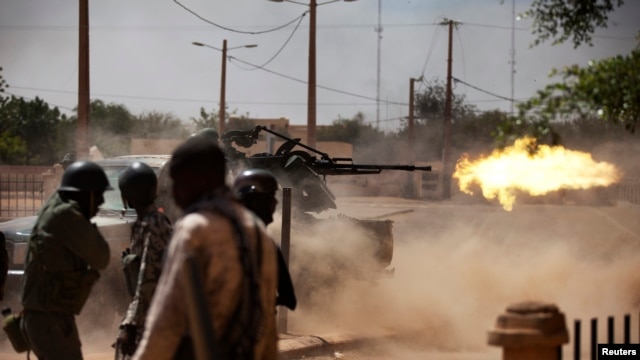
Malian soldiers fire a machine gun in Gao, February 21, 2013.
France's defense minister says that Malian and French troops have pushed out Islamist rebels who temporarily seized the town hall and mayor's residence in the city of Gao in northern Mali.

Jean-Yves Le Drian told reporters Thursday in Brussels that five Islamists were killed in the fighting and that the situation is back to normal.

New clashes between the militants and government troops supported by French forces erupted Wednesday in Gao, which was liberated last month after an occupation by Islamist insurgents.  Reports say that the Islamists had returned to Gao overnight and took control of some government buildings.

A correspondent told VOA that heavily armed Islamist militants took up positions in the mayor's office.  He said the office was set on fire during fighting that ensued, along with the courthouse and part of a nearby market.

Malian officials and militants say the militants are part of the Islamist group known as MUJAO, the Movement for Unity and Jihad in West Africa. 

A Malian Defense Ministry spokesman told VOA that while Gao was liberated last month, "pockets of insecurity" remained in the city.

In another incident, a car bomb exploded near a military base in the northern city of Kidal, killing the bomber and one civilian.  The base was being used by French and Chadian forces.

In January, French troops entered Mali, a former French colony, at the request of the Bamako government to help drive back Islamist militants who had seized northern cities and were moving toward the capital.

After a series of swift military advances in Mali, France said its forces were planning to hand over military operations to the Malian army and an African force.  French officials have also urged the United Nations to establish a peacekeeping mission in Mali.

from VOA News
February 21, 2013

Enhanced by Zemanta

Thursday, February 21, 2013

Fighting in Gao, Car Bomb in Kidal, Mali Conflict Continues

Heavy fighting has broken out in the centre of Gao, the largest town in northern Mali. A car bomb in the northern Mali town of Kidal has killed one person and injured another, according to a journalist at the scene.

Malian troops were fighting Islamists in Gao on Thursday.

The clashes left the main courthouse in flames.

Troops from Niger were the first to respond after heavy weapons fire was heard at at least two entries to the town overnight.

By midday Thursday the Malian army was battling what one military source said was a group of around 40 insurgents.

The source said at least three rebels had already been killed in the fighting.

Rebel fighters tried to carry out suicide attacks in the city, in one case successfully, on 8-10 February.

One person was killed and another injured by the Kidal bomb, according to a journalist in the town speaking to the Reuters news agency.

Other witnesses told the AFP agency that two civilians had been injured.

The blast was within a kilometre of the camp where French and Malian soldiers have been stationed since they arrived in the town on 29 January, following its takeover by dissident Islamists and Tuareg separatists from Al Qaida-linked armed groups.

A French soldier was killed on Tuesday in fighting in the Ifoghas mountains, north of Kidal, where the hardline Islamists have taken refuge. About 20 rebels were also killed, according to the French military.

from RFi
Article published the Thursday 21 February 2013
---
Fighting had first erupted overnight in Gao, where a military official and witnesses reported heavy gunfire around two main entrances to the main city in the north of the country.

"Our forces are currently confronting the jihadists near the Gao townhouse. They have infiltrated the city and we are currently retaliating," Amadou Diarra, a Malian army captain, told AFP in Bamako.

Troops from Niger were the first to respond to the Islamist presence in Gao overnight but by midday Thursday it was the Malian army battling what one military source said was a group of around 40 insurgents.

The source said at least three rebels had already been killed in the fighting, which involved heavy artillery fire and left the streets of Gao -- the most populous city in northern Mali -- largely deserted.

French forces wrested Gao back from the Al Qaeda-linked rebels who had controlled the city since April 2012 within two weeks of Paris' intervention in the former colony.

But Islamist rebels who redeployed on the outskirts of Gao have switched to guerrilla tactics and the city saw Mali's first ever suicide attacks two weeks ago, followed by street fighting. 

Enhanced by Zemanta

Tuesday, February 12, 2013

Malian, French Forces Repel Islamist Assault on Gao


French and Malian soldiers are on high alert in the northern town of Gao, a day after Islamist militants launched an assault to retake the city they were forced out of two weeks ago.

Residents who hid in their homes during the hours-long attack Sunday, cautiously entered the streets still littered with corpses.

Authorities report the crossfire killed three civilians and wounded at least 10 others, but it is still unclear how many soldiers or militants died.

Heavy gunfire and explosions resounded Sunday through the Saharan town, the largest in northern Mali, as the combined government force, complete with French helicopter gunships, fought the Movement for Oneness and Jihad in West Africa.

Clashes were ongoing for days in areas just outside the city.  Saturday and Friday suicide bombers attacked an army checkpoint near the entrance to Gao.  The two suicide blasts were the first in Mali.

The Malian military said the bomber in Saturday's attack was a young Arab man and the Movement for Oneness and Jihad in West Africa claimed responsibility.

The militant group seized control of Gao in April and had ruled the city until the arrival of French and Malian forces last month.  Military officials have said some elements of the group remain in the Gao area, and other fighters are hiding in the surrounding desert.

The group is a splinter faction of al-Qaida's North African wing which, in loose alliance with the home-grown Malian Islamist group Ansar Dine, held Mali's main northern towns of Timbuktu and Gao for 10 months until the French-led offensive drove them out.
from VOA News
Enhanced by Zemanta

Sunday, February 10, 2013

Malian military on high alert after suicide attack

map by Evan Centanni (www.polgeonow.com)
BAMAKO, Feb. 10 (Xinhua) -- Malian military were on high alert and reinforced security in the northern largest city of Gao on Saturday, a day after an Islamist suicide bomber targeted a checkpoint on the city's outskirts in the country's first suicide attack.

The Malian troops in Gao were fortifying checkpoints with sandbags and heavy machine guns and patrolling the city in heavy rotation, as the Friday suicide blast raised new concerns about the insurgence in the West African country.

On Friday, a young Tuareg man riding a motorcycle detonated an explosive belt at the checkpoint, killing only himself and wounding a soldier, according to reports.

The Movement for Oneness and Jihad in West Africa (MUJAO) claimed responsibility for the attack against the Malian soldiers "who chose the side of the miscreants, the enemies of Islam," the reports said.

The MUJAO as well as other rebel groups took advantage of a military coup in the distant capital Bamako on March 22, 2012 to sweep through northern Mali.

Fears of suicide bombing attacks have been high since the discovery of industrial-strength explosives in Gao earlier this week.

UN Secretary General Ban Ki-moon warned on Thursday that the armed groups and terrorist elements in Mali that fled amid French troops' offensive might come back and stage reprisal attacks, although the French operations there so far have been effective and successful.

France intervened in its former colony on Jan. 11, after the Islamic militants began pushing south, raising alarm that they were inching closer toward the capital.

Moreover, a gunfight in Bamako between rival factions of the Malian army on Friday exposed the weakness and division of Mali's military.

Government troops exchanged fire with paratroopers loyal to former President Amadou Toumani Toure, who was ousted in the March 2012 coup, as they fired into the air to protest an order deploying them elsewhere.

Two people were killed and 13 others injured in the confrontation at the 33rd camp of the Djicoroni paratroopers brigade, who are commonly known as the red berets, the government said in a statement.

The government "deplored the death of two adolescents and the injuring of 13 other people" during an attack against the paratroopers' camp by green berets and the police who wanted to push the red berets out of the camp, it said.

Interim President Dioncounda Traore condemned the clashes, calling for a "definitive end" to the internecine fighting.

"I am deeply saddened by the clashes within the Malian army," Traore said on state-run television.

The arrival of the first European Union (EU) contingent, comprising 70 military instructors, came as a boost to the Malian army.

Its head, Colonel Bruno Heluin, told the press in Bamako that the mission will assist in "reforming Mali's army so that it is able to safeguard the country's national territory and respond rapidly when called upon."

The EU decided to dispatch hundreds of trainers to reinforce the capacity of the Malian army, following a request for support by the country's senior military officials, who wanted their soldiers to be well trained and equipped to fight rebel groups in northern Mali.

Mali has been unstable since Toure was ousted on March 22, 2012.

In December 2012, then Prime Minister of the transitional government Cheick Modibo Diarra announced resignation and dissolved the cabinet after being arrested by troops supportive of ex-coup leader Amadou Sanogo.

Northern rebels continued its southward push in January 2013, briefly taking the key town of Konna in central Mali and threatening the Bamako-based government of transition, which is recognized by the international community.

The Malian army launched counter-offensives with the backing of other African countries and France, the former colonial ruler of Mali.

The rebels have retreated in disarray since the French military intervention, with the Malian government taking back the northern towns of Gao, Timbuktu and Kidal.

Although Mali's transitional President Dioncounda Traore has announced that elections are scheduled for July 31 to end the crisis, analysts see uphill challenges ahead to restore territorial integrity and constitutional rule in the aftermath of the coup and rebellions.

from XINHUA
by Editor: Bi Mingxin
2013-02-10 12:20:43

Enhanced by Zemanta

Men Wearing Explosives Arrested in Mali

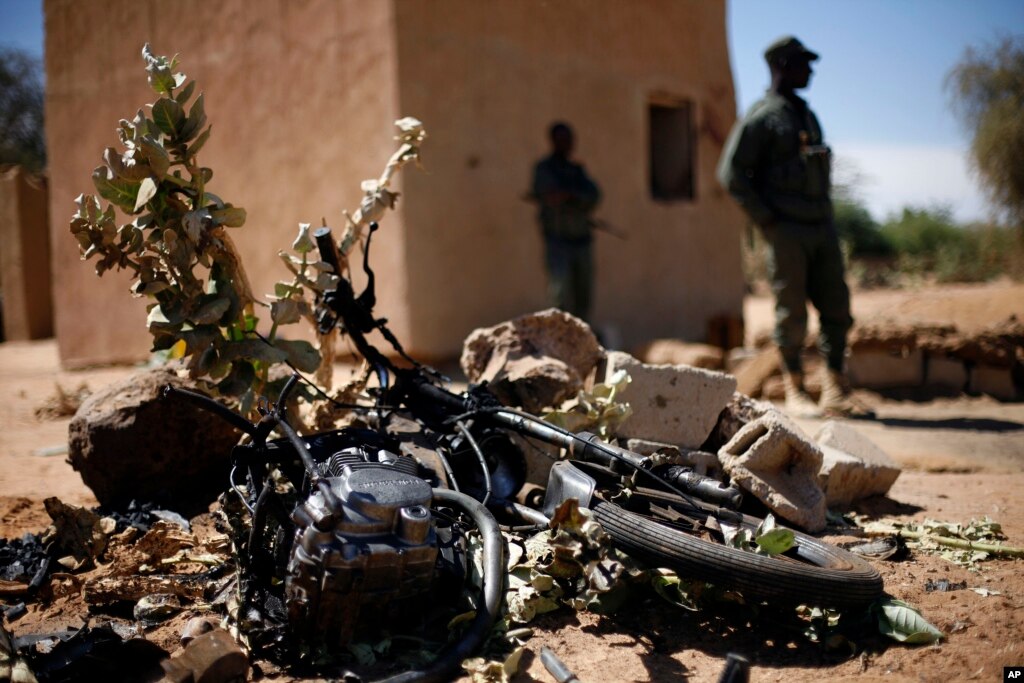
Malian soldiers stand by a motorcycle used by a suicide bomber at the entrance of Gao, northern Mali, Feb. 8, 2013.
Malian officials say two men who were allegedly wearing explosives were arrested near Gao on Saturday, a day after a suicide bomber attacked a military checkpoint near the northern city.

A Malian military spokesman and witnesses say the two men were detained on a road that leads into Gao.

Malian troops bolstered security after Friday's attack. A local journalist said the bombing occurred less than 10 meters from the military checkpoint.

The Movement for Oneness and Jihad in West Africa (MUJAO) claimed responsibility for the Friday blast and vowed to carry out more attacks against Malian soldiers who sided with what it called "enemies of Islam."

MUJAO is one of several military groups that had strongholds in northern Mali before French forces intervened in January.

Radio France Internationale said Saturday that Malian authorities had issued arrest warrants for the leaders of MUJAO as well as Ansar Dine and the Tuareg separatist group MNLA. All three militant groups have been linked to unrest in the country's north.

Friday's violence overshadowed the arrival of 70 European Union military trainers. They were the first of 500 military instructors who are being deployed to help strengthen the Malian army.

The Mali crisis began in early 2012 when the Tuareg separatist group MNLA launched a rebellion in the north. The MNLA and Islamist militants seized control of the north after the March coup in Bamako, but the MNLA was soon swept aside as the militants imposed harsh Islamic law on the region.

At the request of Mali's government, France entered its former colony last month to drive back the al-Qaida-linked militants who had begun moving in the direction of the capital, Bamako.

France wants to begin handing over its four-week-old military operation to the Malian army and African forces.  But officials say any transfer will have to wait until Mali's security situation stabilizes.

France has proposed the United Nations establish a peacekeeping mission in Mali.  Diplomats have said privately that a U.N. Security Council resolution authorizing the mission is not likely before the end of February.  It could take another two months after that to transition the African forces into U.N. peacekeepers.

Some information for this report was provided by AP and AFP.

from VOA News
February 09, 2013

Enhanced by Zemanta

Wednesday, February 6, 2013

French, Malian Troops Clash With Islamists Around Gao

map by Evan Centanni (www.polgeonow.com)
French and Malian troops suffered casualties in clashes with Islamist fighters near northern Mali's main town, Gao, Defence Minister Jean-Yves Le Drian said on Wednesday. He vowed to hunt down the combatants and claimed they had suffered "significant losses".

"Once our troops, supported by Malian forces, started patrols around the the towns that we have taken, they met residual jihadist groups who are still fighting," Le Drian told Europe 1 radio.

French troops will start to withdraw from Mali next month, "if all goes according to plan", Foreign Minister Laurent Fabius told the Metro freesheet published Wednesday.

He put the cost of the campaign to the French exchequer at "several tens of millions of euros".
"We will go after them. We are securing the towns we have been able to take along with the Malian forces. The jihadists around Gao were using rockets yesterday."

The Islamist group Mujao on Tuesday claimed that to have attacked French and Malian positions near Gao, although witnesses indicated that their had only been long-distance exchanges of fire.

"This is a real war," Le Drian said, when questioned about his statement Tuesday that French troops had killed hundreds of their opponents. But, he added, "I'm not going to get into an accounting exercise."

There are now 4,000 French troops in Mali, Le Drian said. The size of the force matches the French deployment in Afghanistan at its height in 2010.

Confirming the first French casualties since a helicopter pilot was killed at the start of the intervention, Le Drian said there had been several French troops injured but that their wounds had been relatively light.
Enhanced by Zemanta

Sunday, January 27, 2013

Mali deploys military police to protect civilians in Gao and Timbuktu

map by Evan Centanni (www.polgeonow.com)
BAMAKO, Jan. 27 (Xinhua) -- After the deployment by air of the military police to Gao on Sunday morning, two additional units comprised of 400 officers are expected to be deployed Sunday evening to protect people and their properties in Gao and Timbuktu in northern Mali, a security source has said.

The mission of the military police is to prevent any form of abuses and violence against the civilian population.

In this regard, a meeting between Mali's defense minister and his internal security counterpart, will be held on Monday in Bamako to define the rules of engagement of the national police on the ground.

On Sunday morning, a French fighter jet bombarded the mansion of the leader of Ansar Dine movement, Iyad Ag Agaly, and later it also bombarded the number 2 camp in Kidal which has been serving as the logistical base for the rebels.

It is reported that the French and Malian troops have reached Timbuktu Saturday evening without encountering any resistance from the rebels at the city, a desert trading center occupied by the rebels last year. The French and Malian forces have seized Gao, another strategic town, and several other smaller towns in northern Mali in their two-week or so battle against the rebel groups which were believed under the influence of al-Quaida.

from XINHUA
2013-01-27 21:37:06
Editor: Yang Lina

Enhanced by Zemanta

French-Backed Malian Forces Retake Gao, Advance on Timbuktu

Malian soldiers ride in a Malian army pickup truck in Diabaly January 26, 2013. (photo by Joe Penney)
French and Malian forces are advancing against Islamist militants in northern Mali heading toward Timbuktu after more than two weeks of fighting.  

Overnight, French air strikes destroyed the home of an al Qaida linked militant leader in the town of Kidal some 1,500 from the capital, Bamako.

The assault came  a day after French and Malian forces recaptured the strategic city of Gao.

The French Defense Ministry said Saturday that a contingent of troops from Nigeria and Chad was moving into the city to help maintain stability. The ministry also said the city's mayor, who had sought refuge in the capital, Bamako, was returning.

VOA correspondent Idrissa Fall in Mali says the military intervention in Gao is significant because the city had become a haven for rebel groups.

"Gao is the most important city in northern Mali. Gao was a kind of capital for the Movement for the Unity of God and Jihad in West Africa and also a capital for Ansar Dine. It was the former capital of the MNLA, those rebel Tuaregs who proclaimed independence."

Earlier Saturday, French and Malian forces regained control of Gao's airport and a nearby bridge. French Defense Minister Jean-Yves Le Drian said the forces used an air and ground operation to cut off the logistic and transportation capabilities of the militants.

map by Evan Centanni (www.polgeonow.com)
The U.S. Defense Department announced late Saturday it is expanding its aid to the French mission in Mali.  Defense Secretary Leon Panetta told Le Drian in a phone conversation that the Pentagon is prepared to conduct aerial refueling missions.  The two defense officials also discussed plans for the U.S. to transport troops from other African nations into Mali.  The U.S. has not planned to send its own troops to Mali.

The conflict in Mali and how to end it is the main topic of discussion at the African Union meeting in Addis Ababa, Ethiopia Sunday. The AU has asked leaders of the 54-member bloc of nations to consider committing troops to the mission in Mali.

France began a military offensive in Mali earlier this month, after rebels who seized control of much of the country's north last year began pushing toward the capital, Bamako. The rebels have been imposing a strict form of Islamic law on civilians.

As military operations continue in Mali, defense chiefs from the West African regional bloc known as ECOWAS were holding an emergency meeting in the Ivory Coast to discuss Mali's unrest. ECOWAS has been discussing plans to send roughly 3,000 troops to Mali as part of a U.N.-backed mission. 
from VOA News
Enhanced by Zemanta

Monday, January 14, 2013

Malian rebels flee after day-long air bombardments

photo from facebook/INFOSDEFENSE.COM - Opération Serval - Mali
BAMAKO, Jan. 14 (Xinhua) -- Sunday's aerial bombardments by the French army have forced rebels in Mali's northern town of Gao and its environs to flee, a well placed military source said.
The air raids were carried out by four French Rafale fighter jets. Well placed sources told Xinhua that the training grounds, the infrastructure and the logistical bases used by rebels were destroyed.

In the coming days, the Malian ground forces supported by troops from the Economic Community of West African States (ECOWAS) are expected to comb the area to eliminate the remaining pockets of resistance.

A number of eyewitnesses told Xinhua on phone that following bombardments by four fighter jets in Gao, the rebels fled from the region's small town of Askia. The youths in Gao were "celebrating" in town, promising to support the army to chase away the rebels from the area.

Other eyewitnesses told Xinhua that fear was spreading in Timbuktu and Kidal, the two other northern towns occupied by rebels, that the flare could expand further soon.

On Sunday, the rebels were seen surrounding the local airport in Timbuktu, while efforts to get information from Kidal bore no fruit as the region's communication channels were cut off from the rest of the world.

Fierce fighting erupted between rebels and the Malian army in the central town of Konna. On Friday, France confirmed the intervention of its troops to stop rebels from advancing towards the government-held South.

from XINHUA
2013-01-14 19:09:29
Editor: Lu Hui

Enhanced by Zemanta

Sunday, January 13, 2013

French Planes Bomb Rebel Positions in Mali

PARIS — France attacked Islamists targets in Mali for the third straight day on Sunday, bombing an key northern town held by the extremists.

French fighter jets bombed the northern Malian town of Gao, even as West African troops were due to arrive to help Bamako beat back an Islamist insurgency.

In a television interview, French Defense Minister Jean-Yves Le Drian said the air raids would continue Monday.

Le Drian said roughly 400 French soldiers have been deployed to Bamako, to ensure security and protect French and European nationals.  More French troops were dispatched to the town of Mopti, about 500 kilometers north of the capital.

Launched Friday, the attacks aim to eradicate an Islamist insurgency that was making inroads to the south last week, after capturing vast chunks of territory in northern Mali.  France says the Islamists not only threaten Mali and surrounding countries, but also Europe.

Paris has also notched up its terrorism alert, underscoring concerns extremists may launch retaliatory attacks in the city and against more than half a dozen French hostages held by Islamists in West Africa.

News reports describe Bamako as calm, with some cars sporting French flags.  The offensive has earned praise in Europe and West Africa.

Residents in Gao say the Islamists who occupied their town and imposed Islamic Sharia law have fled.  Interviewed on French radio, the town's mayor, Diallo Sadou, hailed the French attacks.

Sadou thanked France for its courage to have launched the offensive, and said he hoped God was protecting the French hostages.

One French soldier has died since the French airstrikes began Friday.  The Malian government says at least 11 of its soldiers have been killed and another 60 injured.   

from VOA News
by Lisa Bryant
January 13, 2013

Enhanced by Zemanta

Over 100 dead in French strikes and fighting in Mali


(Reuters) - More than 100 people including rebels and government soldiers were killed in Mali during French air strikes and fighting over the strategic town of Konna, Malian military sources and witnesses said on Saturday.

An army officer at the headquarters of Mali's former military junta in Bamako said nearly 30 vehicles carrying Islamist fighters had been bombed and "over 100" rebels had been killed in fighting.

"We have driven them out, we are effectively in Konna," Malian Defence Ministry spokesman Lt. Col. Diaran Kone told Reuters. "We don't know if they have planted mines or other traps, so we are moving with caution. There were many deaths on both sides."

A shopkeeper in Konna said he had counted 148 bodies in four different locations in the town. Among the dead were several dozen uniformed government soldiers. Others wore traditional robes and turbans.

Fighters from the Islamist coalition that currently controls northern Mali do not wear military clothing.

A resident in the town of Gao, the stronghold of the MUJWA Islamist group, said fighters had begun arriving with their dead on Friday.

"Electric power is available at the mortuary, which is not always the case. And the Islamists have bought plenty of burial mats," the man said.

from REUTERS
BAMAKO | Sat Jan 12, 2013 8:23pm GMT
(Reporting by Adama Diarra and Tiemoko Diallo; Writing by Joe Bavier; Editing by Kevin Liffey)

Enhanced by Zemanta

Saturday, January 5, 2013

Kidnapped Algerian diplomats in new terror tape

Three Algerian diplomats kidnapped by terrorists in Gao last April appeared in a new video posted online Tuesday (January 1st) by Mauritania's al-Akhbar.

The hostages are shown sitting on the ground surrounded by their armed captors from al-Qaeda splinter group Movement for Tawhid and Jihad in West Africa (MUJAO).

"We call on the President of the Republic, Mr Abdelaziz Bouteflika, to find a solution to our situation by accepting the terms of the group so that we can come back to our families," one captive said.
The hostage added: "We had the opportunity to leave the city of Gao before we were kidnapped, but on the orders of the Algerian Ministry of Foreign Affairs, we stayed to offer services to the diaspora."
Another of the Algerian diplomats pleaded, "Get us out of this crisis and enable us to come back to our families."

As far as the Algerian government is concerned, discretion remains the watchword. On Wednesday, it said that contact with the kidnappers was being maintained through various intermediaries.
Algerian foreign ministry spokesman Amar Belani refused to comment on the video of the hostages but said that authorities were "endeavouring to secure the release of the Algerian nationals".

Soon after the Algerians were abducted in Gao, they appeared in a video aired by Al Jazeera, in which the MUJAO claimed responsibility for the kidnapping. The video showed the Algerian diplomats in a vehicle with blank expressions, but apparently in good health.

One month later, the MUJAO issued a ransom demand. They wanted Algeria to release prisoners, as well as a 15m euro ransom.
Three of the hostages were freed in July.


On August 26th, another video released by MUJAO showed one of the remaining hostages asking the Algerian authorities to save his life. But the terror group later executed the diplomat, identified as Taher Touati.
The wife of hostage Mourad Guessas has appealed to the terrorists to free the diplomats. She said that they were merely "innocent, ordinary civil servants" and urged President Bouteflika to work to free them, adding they were kidnapped while in the "service of the Algerian state".

Algeria has staunchly opposed the terrorists' ransom demands, with Algerian Maghreb and African Affairs Minister Abdelkader Messahel saying last October that there would be "no negotiations with terrorists".

During a session with Parliament's foreign affairs committee last week, Foreign Minister Mourad Medecli revealed that both the National Movement for the Liberation of Azawad (MNLA) and Ansar al-Din were mediating the release of the Algerian diplomats kidnapped in Mali.
Last April, President Bouteflika reportedly approved a large military operation to free the hostages, according to a December article by El Khabar. The operation was to be conducted by a few hundred to 3,000 soldiers along with Special Forces, fighter jets and attack helicopters.
El Khabar said that the goal was to free the Algerian diplomats and strike a serious blow to the armed extremists who had taken over northern Mali.
The Algerian military operation was cancelled at the last minute.

from MAGHAREBIA
By Walid Ramzi in Algiers and Bakari Gueye in Nouakchott for Magharebia – 04/01/13

Enhanced by Zemanta

Monday, June 4, 2012

Malian rebels quit accord signed with al Qaeda affiliate

By


Less than a week after Tuareg rebels belonging to the National Movement for the Liberation of Azawad (MNLA) merged with the al Qaeda-supported Ansar Dine (Defenders of Faith) Islamist group and signed an accord to create the Islamic Republic of Azawad in northern Mali, leaders from the MNLA have publicly revoked their support for the accord.

Ansar Dine fighters fly al Qaeda's banner in Northern Mali in late April 2012. (Source: PanAfrican News Wire)
"The political wing, the executive wing of the MNLA, faced with the intransigence of Ansar Dine on applying sharia in Azawad and in line with its resolutely secular stance, denounce the accord with this organization and declare all its dispositions null and void," read a written message attributed to senior MNLA political leader Hama Ag Mahmoud on June 1. Other senior political MNLA officials, including Magdi Ag Bohada, have also disavowed the accord.

Discord between the MNLA and Ansar Dine occurred almost immediately after both parties signed the agreement on May 26 that established an independent Tuareg state in northern Mali reinforced by the imposition of sharia.

Senior MNLA members have long been uneasy with Ansar Dine's harsh interpretation of Islam and desire for a strict version of sharia law. "We want sharia similar to that in Mauritania or even Egypt. This point must be clarified," Ibrahim Ag Assaleh, an MNLA official in the northern city of Gao, told Reuters three days after the accord was signed. The MNLA has also strongly disagreed with Ansar Dine about what types of punishments should be implemented against those accused of committing a crime, specifically the amputation of hands.

Despite the public statements by MNLA leaders renouncing their support for the accord, armed Ansar Dine militiamen continue to patrol the streets of northern Mali's population centers, including Gao, Kial, and Timbuktu, enforcing sharia no matter how unpopular the new restrictions have become among residents who have long observed moderate Islamic values and customs.

Local Tuaregs have protested against Ansar Dine's attempt to enforce a strict dress code, the prohibition of alcohol and smoking of cigarettes in public, and the closure of cinemas. According to The New York Times, Ansar Dine militiamen have defaced the shrine of a 15th-century Sufi saint, music has been banned from the radio, and the black flags of Ansar Dine, which mirror those of al Qaeda, have been draped around the urban environs of northern Mali. These and other unpopular restrictions have forced many residents to flee northern Mail since the MNLA and Ansar Dine consolidated power in the region around a month ago.

The United Nations estimates that more than 160,000 Malians have fled to the neighboring countries of Mauritania, Burkina Faso, and Niger, and more than 140,000 residents have been displaced in Mali itself since the Malian government collapsed in late March.

The current political crisis between the MNLA and Ansar Dine has prompted senior members of Ansar Dine, including its leader and former MNLA spokesman Iyad Ag Ghali, to travel back to Gao from an undisclosed location in an attempt to salvage the May 26 accord. Some members of Ansar Dine believe the voice of dissent among the MNLA is restricted to the movement's political wing, and view the crisis as a minor, if not irrelevant, development.
Enhanced by Zemanta

Friday, June 1, 2012

Mali: Briefing - Tuareg Separatists, Salafists Forge Alliance

Dakar — Two months after taking the northern strongholds of Timbuktu, Gao and Kidal, Mali's rival rebel movements have supposedly put aside ideological, religious and cultural differences to agree on the creation of a joint Council of the Islamic State of Azawad, independent of the rest of Mali.

The agreement signed in the northeastern city of Gao on 26 May, came after three weeks of talks between the Tuareg-dominated National Movement for the Liberation of Azawad (MNLA), which launched its insurgency against the government of Mali in mid-January, and Ansar Dine, which has championed the promotion of Sharia Law in the north of Mali.

Breakaway rejected by Bamako

Reaction from Bamako to the "self-dissolution" of the two rebel entities was swift and hostile. Government spokesman Hamadoun Touré said the government "categorically rejects any idea of the creation of a state of Azawad, even more so the creation of an Islamic state".

Speaking to IRIN, the parliamentary representative for Timbuktu, El Hadji Baba Haidara, said the new protocol proved the MNLA had used a "double identity", concealing its real intentions and alliances. "The MNLA tried to woo Western governments by preaching moderation and distancing itself from radical Islam," Haidara argued. "The agreement shows that the MNLA and Ansar Dine are one and the same. For how many centuries has Mali been a Muslim country? People in the north have never asked to be 'liberated' in this way."

Different movements, different goals?

The rebels' string of easy victories in the north in late March and early April came against a background of political breakdown and confusion in the south. The coup staged in Bamako by mutinous soldiers on 22 March removed outgoing President Amadou Toumani Touré weeks before elections were to have been held. But the junta which replaced Touré, headed by Capt Amadou Sanogo, quickly faced regional islolation and international condemnation. With the Malian military distracted, the rebels moved quickly to occupy poorly-defended towns and their surroundings.

It was the MNLA which confidently declared a ceasefire on 5 April, confirming that its military objectives had been attained. The following day, the MNLA formally declared the founding of the Republic of Azawad. But Ansar Dine combatants were much in evidence, particularly in Timbuktu. The MNLA had dismissed the rival movements as an irritant more than an ally, entering the conflict weeks after the MNLA had initiated hostilities and espousing a Salafist version of Islam that had little popular support in Mali.

Senior MNLA figures, including senior commander Mohamed Ag Najim, were openly disparaging of Ansar Dine. There was concern that Ansar Dine's leader, Iyad Ag Ghali, while a prominent figure in past struggles, was now a distraction, more concerned with Sharia Law than forming a new state. Ghali also had reported links to Al Qaeda in the Maghreb (AQIM) and its long-established smuggling and kidnapping networks. The MNLA's platform included a commitment to purging the new Azawad of these elements, with senior figures accusing the government in Bamako of having actively connived with AQIM.

Islamists take the upper hand

But as the state crumbled in the north, Ansar Dine's profile increased. Its fighters rapdily outmanoeuvred their MNLA counterparts in Timbuktu, and their leaders took a stronger lead in imposing their authority while also carrying out recruitment drives targeting the youth. The allegations of strong ties between Ansar Dine and AQIM grew stronger with reports of meetings between senior figures from the two movements. Adding extra fuel were unconfirmed reports of Nigerian militants from Boko Haram in northern Mali and even fighters from Pakistan.

In a recent interview, AQIM's Emir, Abdelmalek Droukdel, looked to be addressing Ansar Dine directly when he talked of a gradual approach in the imposition of Sharia law, arguing that "it would be a mistake to impose all the rules of Islam in one fell swoop".

The desecration by Ansar Dine supporters of the tomb of one of Timbuktu's most revered spiritual leaders, Sidi Mahmoud Ben Amar, on 4 May generated fierce reaction both locally and internationally, with UNESCO warning of the need to protect Mali's cultural heritage. Ansar Dine's critics say the movement continues to disrespect local sensitivities. They say the Salafist agenda goes well beyond tackling crime and banning alcohol, arguing that Ansar Dine's supporters have also transformed schools into 'madrassas', devoted to Koranic study, compelled women to wear the veil, and tried to ban both playing football and listening to the radio. Demonstrations in Gao on 14 May are reported to have been triggered in part by hostility to such moves.

MNLA ready to unite?

An MNLA-organized meeting of tribal elders and community leaders in Gao in late April restated many of the movement's main objectives and included a strong defence of the role of women in the creation of a new Azawad, but made no reference to Ansar Dine or Sharia Law.

But speaking to IRIN from Paris after the signing of the entente in Gao, MNLA spokesman Moussa Ag Acharatomane said reported differences between the two movements had been exaggerated: "Ansar Dine is a Tuareg movement, from our own soil, not foreigners ... We have always shared the same objectives, even if our methods were different. We are a revolutionary movement, but we never said we were without religion."

Ag Acharatomane strongly denied any links between Ansar Dine and AQIM, saying the new authorities in Azawad would ensure the prompt expulsion of foreign elements engaged in violence. He also rejected reports of the rapid implementation of Sharia. "I have just returned from Gao and I can confirm these stories about radios and football being outlawed are without foundation. A moderate, tolerant form of Islam is being practiced."

Both Ansar Dine and the MNLA have faced strong criticism in reports by Amnesty International and Human Rights Watch (HRW). In its 30 April report entitled Mali: War Crimes by Northern Rebels, HRW noted persistent complaints from civilians of looting, rape, wrecking of medical facilities and even summary executions, with the MNLA implicated in many of the accusations.

The movement hit back strongly, arguing that MNLA combatants had been "confused with other groups", but promised its own investigations into human rights violations throughout Azawad.

Despite the show of unity between Ansar Dine and the MNLA, there are hints of fresh tensions ahead. In its 14 May edition, Algerian daily newspaper El Watan reported the existence of a newly formed Mouvement républicain pour la restauration de l'Azawad (MRRA) - Republican Movement for the Restoration of Azawad, intent on mobilizing Tuaregs to expel AQIM from the north and push for a reintegration of Azawad into Malian national territory. The MNLA has frequently accused El Watan of idle speculation and fabrication.

Whatever happens in the north, the authorities in the south look ill-equipped to resolve the crisis. The departure of Mali's interim President Dioncounda Traoré to Paris to receive medical treatment for injuries sustained in an assault by demonstrators in Bamako has left Sanogo and an uneasy coalition of soldiers and civilians steering national policy. Hopes that a Traoré-led interim administration could pacify the country and leave the way clear for elections in 2013 look increasingly fragile.

Meanwhile, the USA and France have signalled fresh concern about the direction Mali appears to be heading in; the Economic Community of West African States (ECOWAS) has confirmed its readiness to deploy troops; and President Blaise Compaoré of Burkina Faso remains the mediator-in-chief.

Sources: Radio France Internationale (RFI), El Watan, Jeune Afrique, Tamurt.info

[ This report does not necessarily reflect the views of the United Nations ]


from allAfrica

Enhanced by Zemanta

Thursday, April 5, 2012

Mali's rebels announce end to military operation: statement

BAMAKO, April 4 (Xinhua) -- The National Movement for the Liberation of Azawad (MNLA) decided on Wednesday to put an end to its military operations as of Thursday.

The Tuareg group "decides unilaterally to proclaim an end to military operations as of Thursday, April 5 at midnight GMT", "following the complete liberation of the territory of Azawad and given the strong demand from international community, especially the Security Council and UN Peace, United States of America, France and the States of the Sub-Region," according to a statement on the movement's website.

The groups "calls on States of the subregion and the international community to ensure the people of Azawad, against all assaults of Mali," the statement said.

The announcement came after the Tuareg rebels of the MNLA on Sunday captured Mali's heritage town of Timbuktu after taking two other important towns of Kidal and Gao. Timbuktu fell into the hands of Tuareg rebels, marking a milestone in their repeated uprisings since the 1960s for an independent Azawad land comprising Timbuktu, Gao and Kidal.

For the first time, the rebels have the three towns under control.

Tuareg rebels apparently took advantage of the coup on March 22, when the junta toppled President Amadou Toumani Toure, citing his failure to provide means for the military to curb the rebellion in the north.

With the fall of the northern towns, Mali's military junta is facing increasing pressure from two fronts: the military offensive by the rebels and the demand by the 15-member West African bloc ECOWAS to hand over power.

On Sunday, the junta reinstated the country's constitution of 1992 to pave the way for a transition leading to the presidential election, without clarifying who would head the transition and when to hold the polls.
Enhanced by Zemanta

Tuesday, April 3, 2012

Mali: Urgent Action Needed to Protect Civilians


The Tuareg and Islamist armed groups who have taken the northern cities of Kidal, Gao and Timbuktu must protect the civilian population in areas under their control, Amnesty International said today.

In Gao, the organisation received reports of armed men firing into the air and looting public and private buildings, including the hospital.

One witness living there told Amnesty International today: "Armed people are entering the houses and looting. They are firing in the air and we are all terrified. We are left with no defence."

A woman was forced to give birth in the street in Gao as the hospital was being looted by armed men. One patient died as medical care was withdrawn.

"The armed groups who seized these towns in the last three days must ensure human rights abuses do not occur and where they do, they must take action and remove anyone implicated from their ranks," said Gaëtan Mootoo, Amnesty International's researcher on West Africa.

"The looting must be halted to ensure that the civilian population can safely go about their lives."

"In Gao especially, there is an atmosphere of terror and confusion. People must be reassured that if they stay they will not be harmed."

In Timbuktu a young man was reportedly killed on Sunday by a stray bullet while walking in the street.

As chaos spirals more and more people are fleeing their homes.

A resident of Kidal told Amnesty International this morning: "I'm trying to leave the city with my family but there is a waiting list at the bus station. I hope I can have a ticket for Wednesday."

The Azawad National Liberation Movement (Mouvement national de liberation de l'Azawad, (MNLA), a Tuareg armed opposition group, launched a military uprising in the north of the country late January 2012.

Meanwhile Islamic group, Ansar Dine, which says it aims to implement the Sharia law in Mali, has also been fighting against the national army.

Since the beginning of the uprising, more than 200,000 people have fled the north of Mali with an estimated 100,000 crossing to the neighbouring countries of Mauritania, Niger, Algeria and Burkina Faso.

"There is a real risk of a humanitarian crisis as aid agencies are encountering many problems gaining access to those in need," said Gaëtan Mootoo. "This situation is aggravated by the fact that the whole Sahel region is facing a widespread food and nutrition crisis."

The situation in Bamako continues to be volatile ten days on from the military coup that toppled Mali's President Amadou Toumani Touré.

The leader of Mali's new ruling junta promised on Sunday to reinstate the constitution, hours ahead of a deadline set by the Economic Community Of West African States (ECOWAS) either to start handing back power or face sanctions.


an Amnesty International Press Release
from allAFRICA
Enhanced by Zemanta

Monday, April 2, 2012

Administrator in northern Mali killed by Tuareg rebels

BAMAKO, April 2 (Xinhua) -- The administrator of Bourem, a region in Gao in northern Mali, was killed by Tuareg rebels, local residents reported on Sunday.

The residents said the administrator, Mohamed Sidibe, attempted to flee with his family on Saturday, after learning that the rebels of the National Movement for the Liberation of Azawad (MNLA) were going to attack Gao.

A resident of Bourem said the MNLA fighters took away the vehicle of the administrator and his body was returned on Sunday. His wife was also reportedly killed.

Residents in another northern region of Sevare went on panic after learning that the Tuareg rebels were preparing to attack their town.

The Malian soldiers and civilians who fled from Gao, Niafunke and Timbuktu are taking refuge in Sevare.

Tuareg rebels seized Kidal, Gao and Timbuktu respectively on Friday, Saturday and Sunday.

For the first time since they took arms the 1960s, the rebels have taken the northern towns in pursuit of independence of an Azawad land comprising Timbuktu, Gao and Kidal.

The rebels apparently took advantage of the coup on March 22, when the junta declared takeover from President Amadou Toumani Toure, citing his failure to provide means for the military to curb Tuareg rebels in the north.

Enhanced by Zemanta

Search this blog