Monday, May 2, 2011

Gettin' Dirty with Company D Tankers

Gettin' Dirty with Company D Tankers

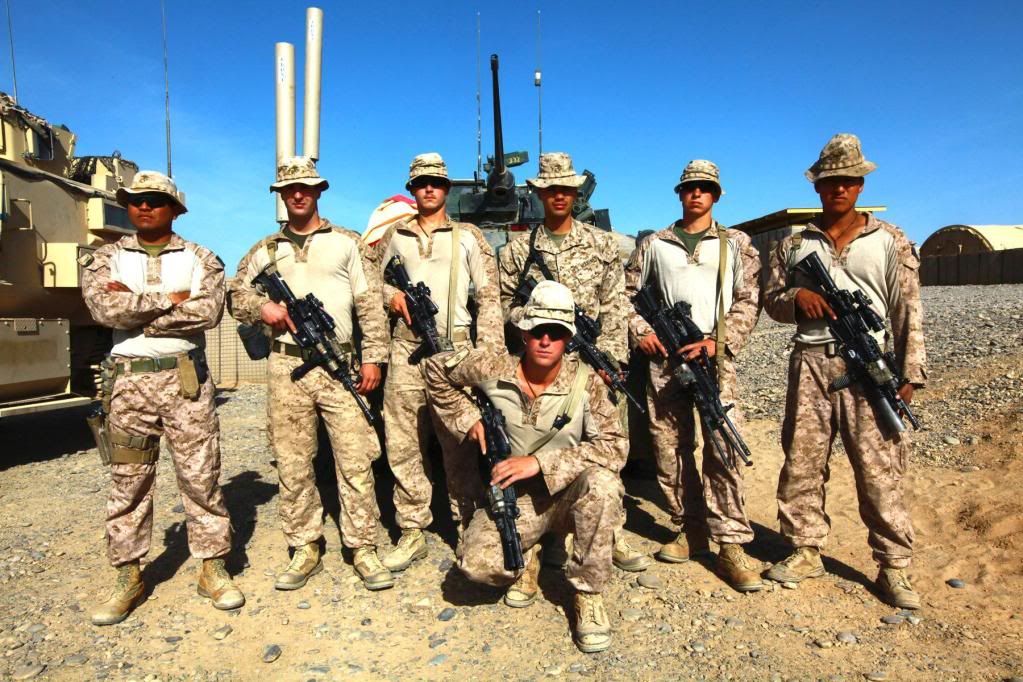
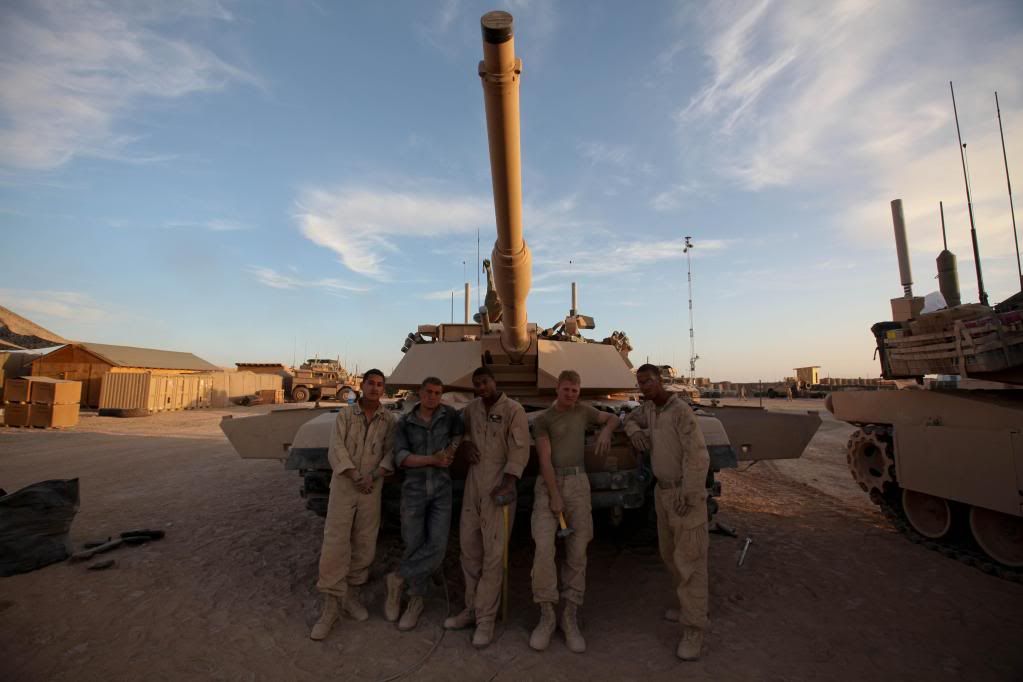
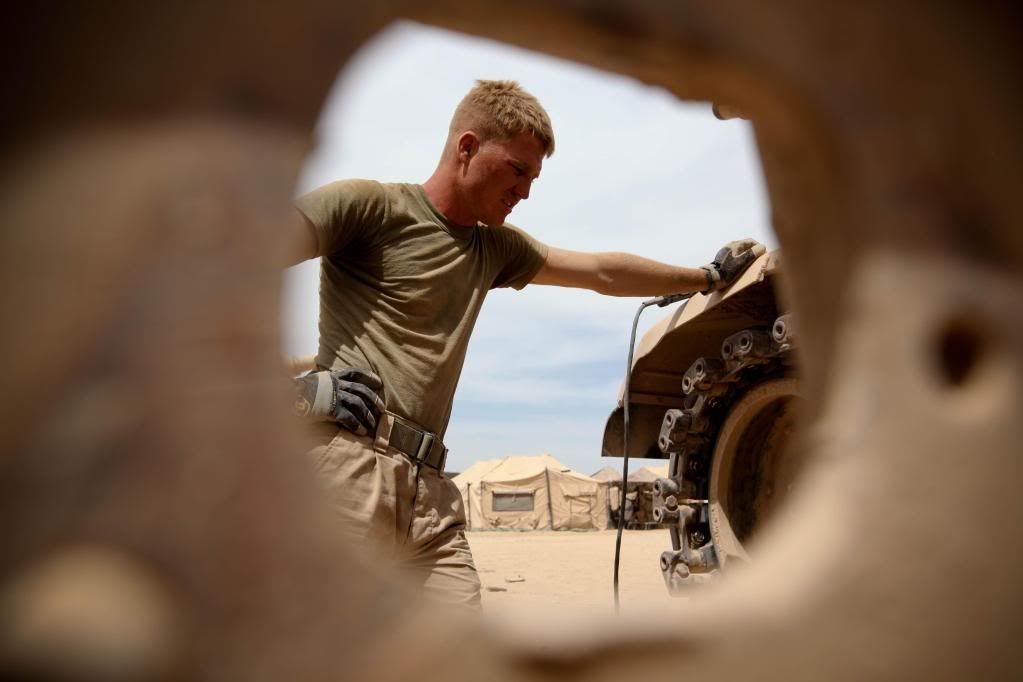
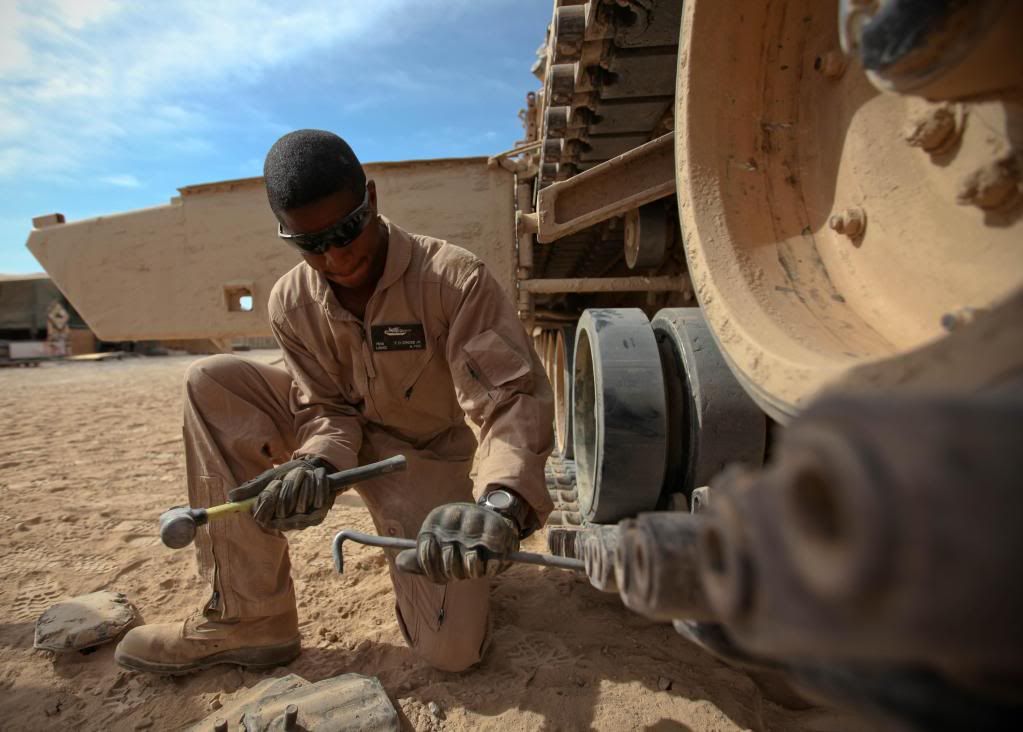
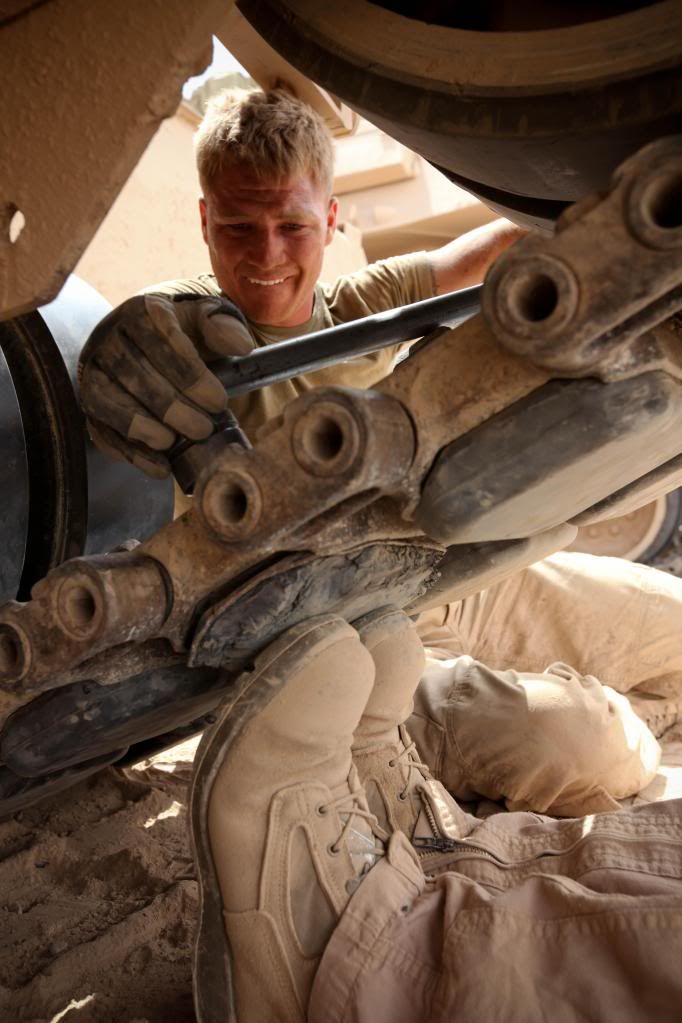
The brown beads of sweat stream down their faces as they work on the largest mobile ground weapon in the Marine Corps. These Marines have no problem living up to Company D’s alias: “Dirty Delta.”
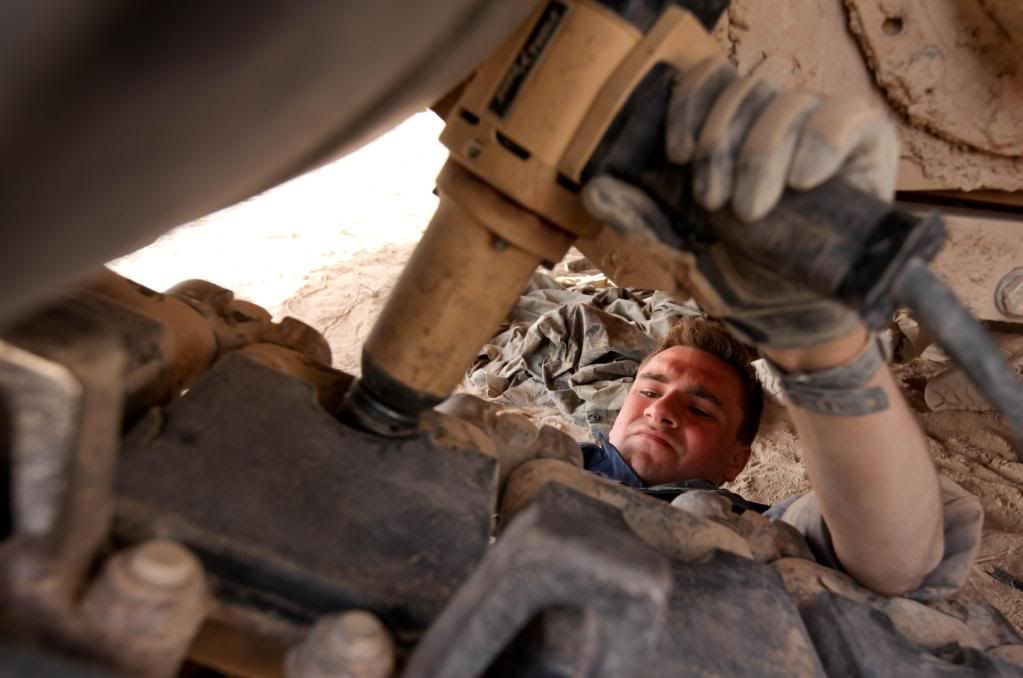
The tankers with 1st Tank Battalion, 1st Marine Regiment, 2nd Marine Division (Forward), crank wrenches and get dirty to maintain their M-1A1 “Abrams” Main Battle Tank.


Gettin' Dirty with Company D Tankers
2nd Marine Division
Combat Outpost OUELLETTE, Helmand province, Islamic Republic of Afghanistan
Story and photos by Cpl. Marco Mancha


COMBAT OUTPOST OUELLETTE, Helmand province, Islamic Republic of Afghanistan – The brown beads of sweat stream down their faces as they work on the largest mobile ground weapon in the Marine Corps. These Marines have no problem living up to Company D’s alias: “Dirty Delta.”

The tankers with 1st Tank Battalion, 1st Marine Regiment, 2nd Marine Division (Forward), crank wrenches and get dirty to maintain their M-1A1 “Abrams” Main Battle Tank.

The only other thing cranking besides the wrenches are the tunes playing on the MP3 while they work on the tanks. It is no easy task to maintain one of the most sophisticated weapons the military has to offer; just ask Elkridge, Md., native Sgt. Todd Cross.

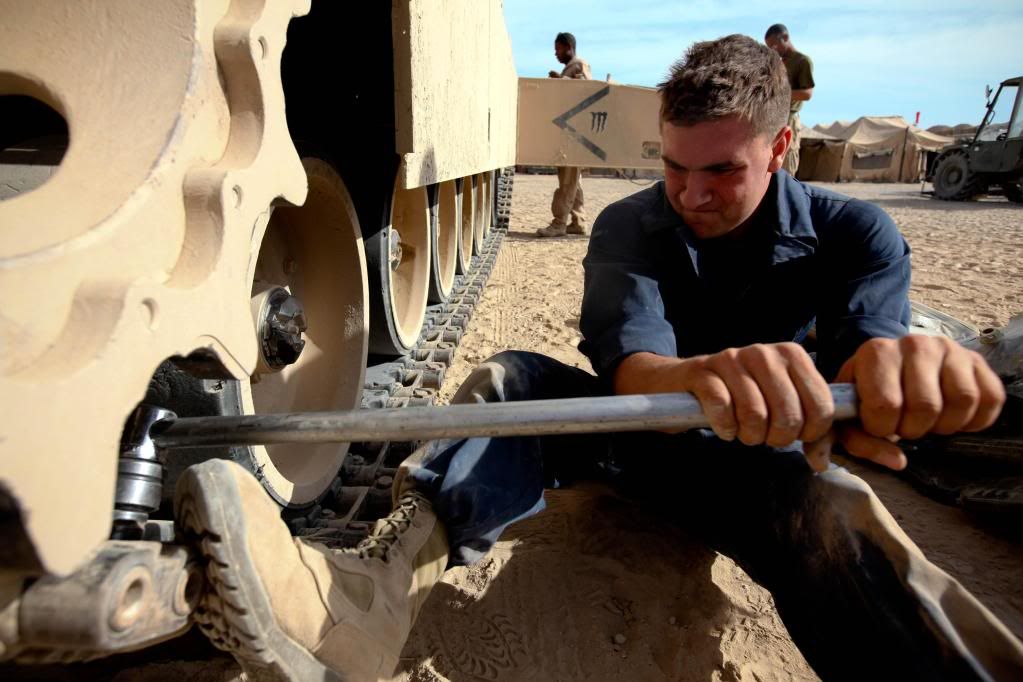
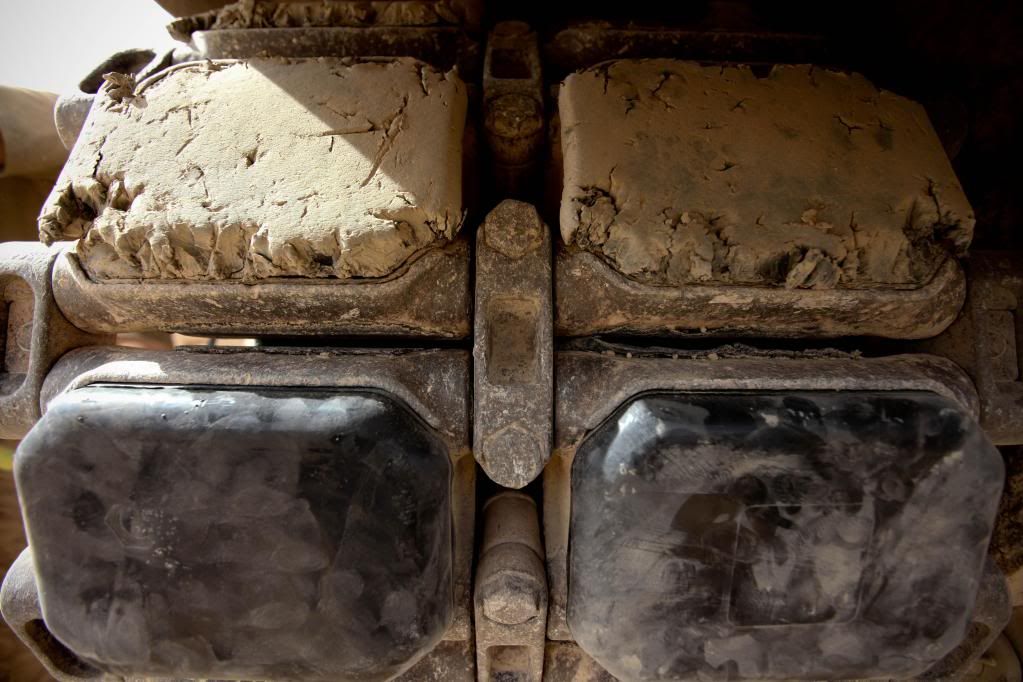
“We don’t stop working ‘til the job gets done,” said the section leader with the unit. “Changing the track pads, like we did today, is a really long process that may take more than just a day to finish. I don’t know if you know this, but there are 320 track pads on a single tank. That definitely means you’re getting dirty out here.”

Cross and his Marines must usually swap out worn pads on each tank about every three months due to wear and tear. The rough and cratered terrain of Afghanistan takes a toll on the tanks’ pads and can cause damage to the tank if they are not replaced regularly.

“The tank can definitely take a beating,” explained Lance Cpl. Kevin Kuntschik, a tank gunner with the unit and a Gonzales, Texas, native. “But if (the tank is) not moving, we’re useless.”


Maintenance is a top priority because the tanks have become a large asset to the platoons providing overwatch in the area. The M-1A1 tanks bring a whole new element to the area and pack quite a punch with their 120 mm, smooth bore cannon, two M-240B Medium Machine Guns, and an M-2 .50-Caliber Machine Gun.

“My favorite part about being a tanker is that I’m in control of the biggest and baddest machine on the block,” said Kuntschik, who is responsible for manning the main gun on the tank. “So I don’t mind getting some dirt between the fingernails to keep her running.”

The team of tankers was covered in Afghan dirt as they only took a few short breaks to grab a sip of water and a bite of chow. They wrenched the pads off one by one and replaced them with new pads just as if the Marines were changing the tires on a car.

The day’s light began to dim and the sun had reached its setting point as the Marines reached a small obstacle. The power tool they were using to remove the tracks overheated and stopped working. The dusty, hot environment finally took its toll on the electric powered impact wrench which normally saves the tankers hours of work.

“We weren’t going to let that stop us,” explained Cross. “If the job’s not done, we just have to keep on trucking. My guys know that. So, they just wipe the sweat off their foreheads and keep on working.”

When every single pad was replaced on the 72-ton tank, the night breeze gave them a breath of cool air. They picked up all their tools and headed back to their 12-man tent.

As the tank sat under the moonlit sky awaiting the next day’s mission, the Marines of the first company to roll American tanks into Afghanistan reflected on the final scene of another day in the life of “Dirty Delta.”

“Being a tanker is hard work and demands a lot of dedication,” said Cross. “My Marines and I love it, and that is what makes us a really good team. Getting dirty is just a small bonus we really don’t mind.”

Saturday, April 30, 2011

Portland Marine engages enemy, leads team to safety

FORWARD OPERATING BASE PAYNE, Afghanistan – For much of their deployment, Marines of 3rd Light Armored Reconnaissance Battalion have found an insurgent force which was reluctant to fight them toe to toe. Rather, the enemy has relied more on improvised explosive devices and indirect fire.


Regional Command Southwest
Story and photos by Cpl. Adam Leyendecker

However, on April 20, Lance Cpl. Jesse K. Knerr, section leader for 3rd Platoon, E Company, 3rd LAR, and native of Portland, Ore., found that when insurgents have their backs against the wall they are left with no choice but to fight.

The mission of the day was to conduct a search of an area that hadn’t been explored by coalition forces, but was suspected of being a site for possible insurgent fighting positions.

When Knerr and his fire team patrolled the area, they found structures made of rock, which blended into the ridge of the mountain. This was different than the buildings they were accustomed to seeing, which were mainly mud huts.

Knerr signaled for his team to search the structures, where they found battery packs, rocket-propelled grenades, enemy propaganda and half-eaten meals that were still warm.

After radioing in the intelligence, Knerr and his fire team followed a trail outside the buildings, which led up the ridge of the mountain to a small cave with an even bigger cave about 100 meters above it.

As they walked up the ridge, the fire team found fighting positions all along the ridge. Suddenly, they began taking small-arms fire from insurgents in the bigger cave, only about a football length away from their positions.

The fire team immediately found cover. It was around 4:30 p.m. when Staff Sgt. Yobani Tejada, platoon sergeant for 3rd Platoon, received a radio call from Knerr stating that his team was engaged by enemy fire on the mountain ridge.

Tejada, who was in a Light Armored Vehicle 25 at the bottom of the mountain, told the Marines to find cover so they could provide fire from their turret and call in air support.

Knerr realized he had to come up with a plan which would get his Marines out of there safely.

Spotting an area which supplied sufficient cover, Knerr directed the Marines to suppress the enemy’s fire while each of them advanced toward the area.

After the Marines were clear, Knerr radioed back to Tejada, who had two vehicles simultaneously suppressing the enemy’s fire. The insurgents returned fire with rocket-propelled grenades, but came no closer than 100 meters of the vehicles. Air support arrived in the form of F-18s, which destroyed the enemy positions.

Afterward, Knerr was thankful that he and his fire team made it out safely.

“I knew that we all had to come together at that very moment when we were under fire and execute my plan perfectly or lives could be lost,” said Knerr. “In a situation like that, there is no room for error.”

Petty Officer 1st Class Joshua I. White, a corpsman who was with the fire team, said he and the other fire team members give credit to Tejada for preparing them for the situation.

“He’s always told us to strengthen our mind, or we’ll lose it,” said White.

In this particular battle, the strong mental awareness of Knerr and his fire team made all the difference in successfully getting the team out of a dangerous situation.

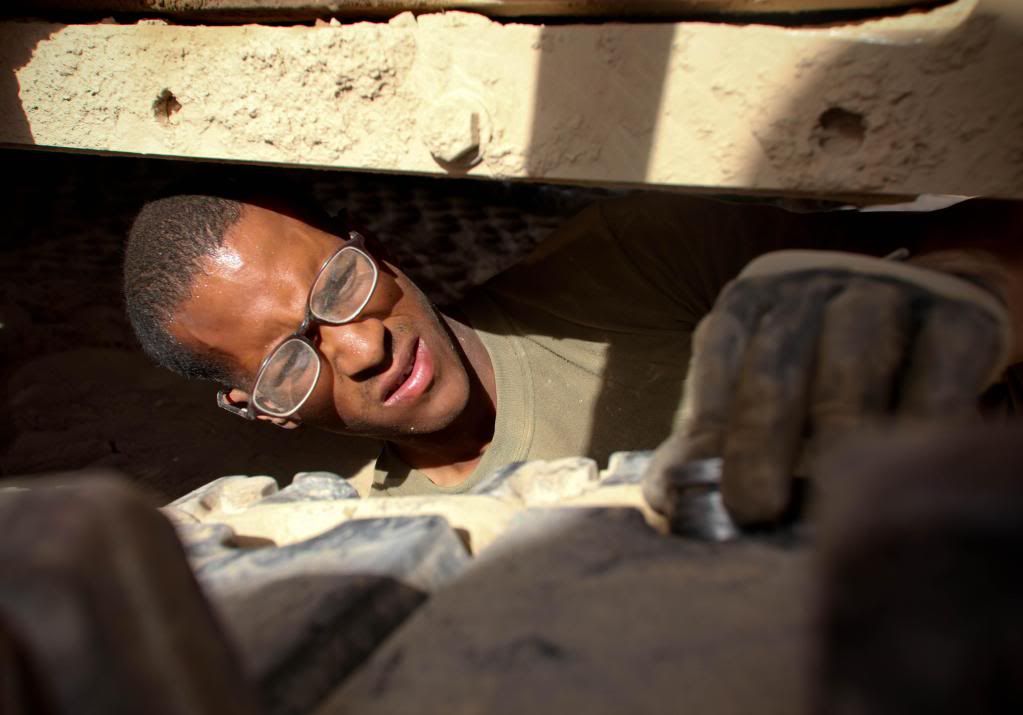
Members of 3rd Platoon, E Company, 3rd Light Armored Reconnaissance Battalion, stand in front of their Light Armored Vehicle 25 at Forward Operating Base Payne in Helmand province, Afghanistan, April 26. From left to right: Staff Sgt. Yobani Tejada, 3rd platoon sergeant; Cpl. Samuel E. Sirman, combat engineer; Petty Officer 1st Class Joshua I. White, corpsman; Lance Cpl. Luis Maldonado-Santiago, LAV 25 gunner; Pfc. Tyler A. Nikkel, LAV 25 driver; Lance Cpl. Levi R. Hale, rifleman; and Lance Cpl. Jesse K. Knerr (center), section leader.

Friday, April 29, 2011

Video: USS Florida Homecoming, April 29., 2011. (HD)

Video: USS Florida Homecoming, April 29., 2011. (HD)

The Ohio class guided missile submarine USS Florida arrives at Naval Submarine Base Kings Bay, April 29., 2011. Florida returned after a 15 month deployment. Florida participated in Operation Odyssey Dawn, becoming the first guided missile submarine to launch Tomahawk land attack missiles.
Produced by Petty Officer 2nd Class Jacob Sippel


Search this blog