Tuesday, March 26, 2013

French forces kill two Indians in Bangui airport

In these photos taken on Friday March 22, 2013 and provided on Monday March 25, 2013 by the French Army Communications Audio visual office, French soldiers arrive at Bangui airport, Central Africa Republic. Rebels overthrew Central African Republic's president of a decade on Sunday, seizing the presidential palace and declaring that the desperately poor country has "opened a new page in its history." The country's president fled the capital, while extra French troops moved to secure the airport, officials said. (AP Photo/Elise Foucaud, ECPAD)
PARIS, March 25 (Xinhua) -- French defence ministry confirmed that French forces fired on vehicles trying to enter the Bangui airport in Central African Republic, killing two Indian nationals.

The accident occurred "in a particularly confusing situation", as French troops based in the Bangui airport had been fired upon "from an unknown source," the ministry said in a statement.

"These vehicles were transporting Chadian and Indian nationals. Despite warning shots fired by troops guarding the site, the vehicles kept going at high speed," the ministry said in a statement.

"Two Indian nationals died. French forces immediately took charge of the injured Indian and the Chadian, who were driven to an aid facility," the ministry said.

It is reported that five other Indians and four Chadians got wounded in this accident.

Expressing deeply regret for the accident, the French defence ministry has decided to conduct an investigation to determine the exact circumstances.

France has sent 350 soldiers to the Central African Republic over the weekend to reinforce its protection of French citizens in the conflict-ridden country where the capital Bangui was seized by rebels who ousted the president on Sunday.

from XINHUA
2013-03-26 07:43:43

Enhanced by Zemanta

Syrian Jihadist Fighters Getting Western Weapons

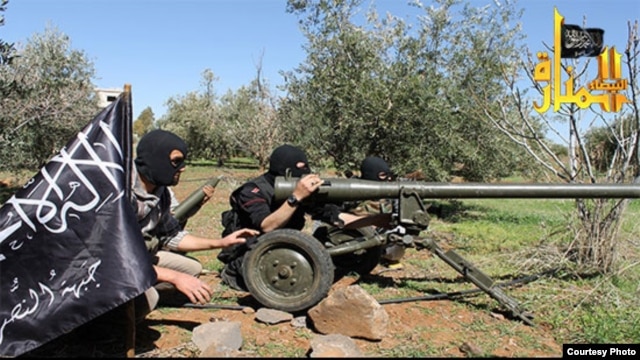
Syria's al-Nusra rebels posted this photo of its fighters using an M-60 anti-tank weapons March 24.

A Syrian rebel group the Obama administration considers a terrorist organization is managing to obtain modern anti-tank weapons meant for other groups fighting to oust President Bashar al-Assad, according to regional experts.

The Jihadist Jabhat al-Nusra militia is managing to secure weapons being supplied by Saudi Arabia and Qatar to rebel brigades affiliated to the Free Syrian Army, the experts say. The Obama administration considers al-Nusra a terrorist organization because of suspected links with al-Qaida.

The weapons include the Croatian-made M79 portable 90 mm anti-tank gun and M60 recoilless anti-tank weapons. Regional experts say Saudi Arabia and Qatar had been supplying such weapons to rebel units more acceptable to the West, mainly secular or nationalist-focused groups such as the Free Syrian Army (FSA) brigades fighting to oust the Assad government.

Croatian-made weapons

According to the experts, the weapons are now appearing in the hands of al-Nusra fighters in videos posted by group on Jihadist websites.

In February, the New York Times first reported that the Saudis were supplying Syrian rebels with arms bought from Croatia. The supply operation was prompted by the fear in the West, and among Gulf allies, that Jihadist groups were better equipped than other rebel units and were increasingly able to dominate the anti-Assad movement.

The newspaper reported Monday that U.S. Central Intelligence Agency consultants were helping Arab nations and Turkey in getting heavy weapons to the Syrian rebels despite Washington’s public stance against supplying such weapons itself.

Citing air traffic data and interviews with unnamed officials and rebel commanders, the Times said the weapons airlift to the rebels had grown to include more than 160 military flights by Jordanian, Saudi and Qatari cargo planes landing at Esenboga Airport near Ankara, and at other Turkish and Jordanian airports.

Reports of CIA assistance

Croatian weaponry believed to be part of those airlifts had been seen being used earlier this year by other Jihadist groups fighting in Syria, but al-Nusra videos posted on the internet this weekend showed for the first time their fighters using the M79 and M60 antitank weapons.

“Neither of these weapons are locally available, either from the black market or looted from the Syrian army because they don't have them,” said British-based weapons researcher, Eliot Higgins, who first spotted the videos. “That's what made them so easy to track; they stand out like sore thumbs in Syria.”

Since announcing its formation in Syria in early 2012, Jabhat al-Nusra has grown rapidly and is considered one of the most effective forces opposing the Assad government.

The rise of al-Nusra, which has homegrown fighters in its ranks as well foreign jihadists drawn from elsewhere in the Middle East, North Africa, and Central Asia, has complicated Western considerations about whether and how to supply arms to the Syrian rebels.

British and French want stepped-up shipments

The British and French governments have been pushing to increase the flow of weapons to the Syrian rebels, but other European nations have resisted, arguing that the equipment could fall into the hands of jihadist groups such as al-Nusra. Critics of the Anglo-French position said the intended recipients of the weapons, the FSA rebel units, worked too closely with al-Nusra to keep the weapons to themselves.

“We were concerned that the FSA is not really a cohesive force with a single command-and-control structure, but is far more a loose alliance of rebel brigades,” says a German diplomat based in Brussels. “We didn’t believe the FSA could or would even bother to police who received any European-supplied weaponry. FSA units fight alongside al-Nusra and other Jihadists.”

Al-Nusra, like other rebel units, also uses weapons it seizes from captured Syrian army facilities.

This past Saturday, al-Nusra fighters joined other rebel units in overrunning an air defense base in southern Syria’s Daraa Province near the border with Jordan. Videos posted by al-Nusra appeared to show rebel fighters carting off portable surface-to-air missiles, often called SAMS or MANPADS, for “Man-Portable-Air-Defense-System.”

Syrian rebels have been urging the West and Gulf countries for months to supply the rebellion with such anti-aircraft missiles, but the Obama administration has said “no.” It also has urged allied not to supply such missiles, fearing they would fall into the wrong hands.

But with each capture of Syrian army bases, though, there are opportunities for rebels, Jihadists included, to seize anti-aircraft missiles, Western security officials say.

from VOA News
by Jamie Dettmer, March 25, 2013

Enhanced by Zemanta

Monday, March 25, 2013

26 inmates freed during first day of Bagram prison transfer

The full responsibility of Bagram prison was handed over to the Afghan government on Monday after US troops handed over around 4,000 prisoners to Afghan security forces during the Afghan year 1391.

According to reports around 100 prisoners are currently kept by US troops and are due to be handed over to Afghan security forces by next week.

Around 26 prisoners were freed from the Bagram prison during the first day of prison transition to Afghan governmnet.

Afghan officials said around 949 prisoners were in the custody of US troops despite an agreement on the transfer of prisoners was signed by the two nations.

The transition of Baram prison to Afghan government was completed during a ceremony held in Bagram on Monday which was attended by Afghan defense minister Bismillah Mohammadi, Gen. Joseph Dunford NATO commander and a number of other high level Afghan and American officials.

Chief of the security transition committee Ashraf Ghani Ahmadzai said, “One of the national ambitions of the Afghan people was completed by the transition of Bagram prison today.”

Mr. Ahmadzai further added that the transfer of Bagram prison to Afghan government reflects the respect of United States towards the Afghan constitution and law and this will to further improve bilateral ties between the two nations.

In the meantime NATO commander Gen. Joseph Dunford said United States remains committed to assist Afghanistan.

Afghan defense minister Bismillah Mohammadi said Afghan defense ministry is prepared to take security of the prison and assured that the ministry had taken necessary steps for the security of Bagram prison.

from KHAAMA
By Ghanizada - 25 Mar 2013, 8:49 pm

Enhanced by Zemanta

12 militants killed in Laghman airstrike

JALALABAD (PAN): A dozen militants, including three of their commanders, were killed in an International Security Assistance Force (ISAF) airstrike in Mehtarlam, the capital of eastern Laghman province, an official said on Monday.               

The incident took place on Sunday night in the Abuzai area on the outskirt of the city, a spokesman for the 201st Selab Military Corps, Col. Mohammad Noman Hatifi, told Pajhwok Afghan News.  

He said the rebels came under attack when they were meeting. Their bodies, still lying at the scene, would be handed over to locals, the spokesman added.

from Pajhwok
By Mahbob Shah Mahbob Mar 25, 2013 - 19:41   

Enhanced by Zemanta

South Africa: 13 South African Soldiers Dead in CAR

map by Evan Centanni (www.polgeonow.com)
Johannesburg — Thirteen South African soldiers were killed and 27 wounded in clashes with rebels in Central African Republic, President Jacob Zuma announced on Monday.
"We are deeply saddened by the events and developments in that country over the past 72 hours, which saw violence escalating and many innocent lives lost. We have confirmed that 13 of our brave soldiers who were committed to fighting for peace and stability in Africa fell in Bangui," Zuma said at a briefing in Pretoria.

"One soldiers is still not accounted for and they are still looking for him.

"Twenty seven were wounded. We wish them a speedy recovery. The chief of the SANDF will provide further details later today on operational matters," Zuma said.

In December, Zuma sent Defence Minister Nosiviwe Mapisa-Nqakula to the Central African Republic to assess the security environment and general situation which was tense after the Seleka rebel coalition launched an armed campaign.

The report from that mission recommended an intervention, he said.

On January 2 2013, Zuma as the commander-in-chief authorised the deployment of up to 400 South African soldiers to CAR.

Only 200 of the soldiers had been sent at the time of the attack.

Zuma said South Africa and CAR had signed a military co-operation agreement in 2007. This was renewed for a further five years in December 2012.

That agreement entailed provision of military training to the CAR army and refurbishment of military infrastructure.

The deployment of SANDF troops in CAR was part of the country's effort to contribute towards peace and stability in the region, Zuma said.

SANDF was tasked with building the capacity of the CAR defence force and help the CAR with the planning and implementation of the disarmament, demobilisation and reintegration process.

"On behalf of the government and the people of South Africa we would like to convey our sincere condolences to the bereaved families," he said.

The just over 200 soldiers fought armed forces numbering over 1000 in a high tempo battle which lasted nine hours until the rebels raised a white flag and asked for a cease fire.

"South African soldiers inflicted heavy casualties among the attacking bandits," he said.

Zuma said the South African government had not taken any decision to withdraw the army from CAR.

"We have not taken a decision to withdraw. You would in a sense appreciate that there existed an agreement between two countries…And our being there was related to the task that we were given. We defended our base successfully…There has been no reason for us to leave. What we've been looking at is how do we enforce our forces, how do we ensure that there are no further casualties," said Zuma.

"There is no reason for us to issue a command for withdrawal."

from allAfrica/SAPA
By Penwell Dlamini, 25 March 2013

Enhanced by Zemanta

Kidnapped German aid worker freed in northern Afghanistan

Location map for Badakhshan Province in Afghan...
Location map for Badakhshan Province in Afghanistan.  (Photo credit: Wikipedia)
According to local authorities in north-eastern Badakhshan province of Afghanistan, Afghan security forces freed a German citizen from the unknown hostage takers in this province.
Provincial security chief Gen. Imamuddin Mutmaein confirming the report said the German citizen used to work in a non-governmental organization in the central city of Faizabad.

Gen. Mutmaein further added that the unknown gunmen had kidnapped the German citizen from Batash village on Sunday.

He said Afghan security forces managed to free the kidnapped German citizen following a military operation conducted in Argo district at Danishmandan village on Sunday night.

At least three suspected individuals were also arrested in connection to the incident.

This comes as unknown gunmen kidnapped at least five foreigners including 2 female doctors in remote mountains of Faizabad district earlier last year.

The aid workers employed by Swiss-based aid group Medair were making their way from Faizabad city in rugged northeast Badakhshan province to visit flood-stricken areas when they were abducted about half-way to their destination.

The kidnapping of foreigners has become relatively common in parts of Afghanistan since U.S-backed Afghan forces toppled the Taliban government in 2001, heralding a 10-year anti-insurgent war.

In 2010, 10 foreign medical workers, including six Americans, were killed in Badakhshan in an attack blamed on insurgents.

from KHAAMA
By Meena Haseeb - 25 Mar 2013, 10:58 am

Enhanced by Zemanta

In Several Joint Clearance Operations, 12 Armed Taliban Killed (Mar.25.2013.)


Publish Date: Mar 25, 2013

In Several Joint Clearance Operations, 12 Armed Taliban Killed

Counterterrorism:
In past 24 hours, Afghan National Police conducted several joint clearance operations with the cooperation of Afghan National Army, NDS and Coalition Forces to clean some of the areas from terrorists and enemies of peace and stability of Afghanistan.

The operations were conducted in Kunduz, Kandahar, Zabul, Uruzgan, Khost and Paktika provinces, as a result 12 armed Taliban were killed, three wounded and two other armed Taliban were arrested by Afghan National Security Forces.                                                                                       

 Also, during these operations, Afghan National Police discovered and confiscated some amount of light and heavy round ammunitions and IEDs.

During the same 24 hour period, Afghan National Police discovered and defused 15 different types of mines placed by enemies of Afghanistan for destructive activities in Helmand, Nimroz and Maidan Wardak provinces.

Counter Crimes:
The 101 Kabul Zone National Police detained two suspects accused of drug trafficking and theft in the Bagrami and 13th Districts of Kabul-City.
Enhanced by Zemanta

Taliban abduct 10 Afghan soldiers, 1 doctor in Badakhshan

According to local authorities in north-eastern Badakhshan province of Afghanistan, Taliban militants abducted at least 10 Afghan national army soldiers along with a doctor in this province.

Provincial governor spokesman Abdul Maroof Rasukh confirming the report said the individuals were abducted by Taliban militants during a military operation in Wardoj district around 3 days back.

Mr. Rasukh furhter added that negotiations have been started to free the army service members along with the doctor from the Taliban hostage.

This comes as Taliban militants abducted at least 20 Afghan national army soldiers a few weeks back and murdered 16 army personnel in Wardoj district. The remaining army soldiers were released by Taliban militants following negotiations by tribal elders.

from KHAAMA
By Ghanizada - 25 Mar 2013, 11:13 am

Enhanced by Zemanta

Mar. 25., 2013. - ISAF Joint Command Operational Update

KABUL, Afghanistan – Afghan and coalition security forces confirmed today the death of Taliban leader, Tamim, during an operation in Nahr-e Saraj district, Helmand province, March 18.

Tamim was responsible for planning and directing attacks against Afghan and coalition forces, facilitating weapons to fighters throughout Helmand province, and serving as a vital link in the local Taliban’s intelligence apparatus. He also served as a member in illegitimate Taliban judicial proceedings and actively recruited civilians to join a number of insurgent cells.

In other International Security Assistance Force news throughout Afghanistan:

South

Afghan and coalition security forces confirmed today the death of Taliban leader, Gul Ahmad Akhund, during an operation in Nad ‘Ali district, Helmand province, March 17. Akhund had operational control over a cell of insurgent fighters directly responsible for multiple attacks targeting Afghan and coalition forces throughout Helmand province. He was instrumental in acquiring and distributing weapons and ammunition to his fighters.

Enhanced by Zemanta

Mar. 25., 2013. - RC-East operational update

BAGRAM, Afghanistan - Afghan and coalition forces found and safely cleared 13 improvised explosive devices, killed three insurgents and detained one suspected insurgent during operations in eastern Afghanistan throughout the past 24 hours, March 24.

Ghazni province
Afghan National Security Forces detained one suspected insurgent during operations in the Dehyak district. The suspected insurgent was taken to a base for questioning.

Afghan National Security Forces found and safely cleared 11 IEDs during operations in the Gelan district.

Laghman province
Coalition forces killed three insurgents during operations in the Mehtar Lam district.

Nangarhar province
Afghan National Security Forces found and safely cleared an IED during operations in the Surkh Rod district.

Wardak province
Afghan National Security Forces found and safely cleared an IED during operations in the Sayyidabad district.

Enhanced by Zemanta

Search this blog